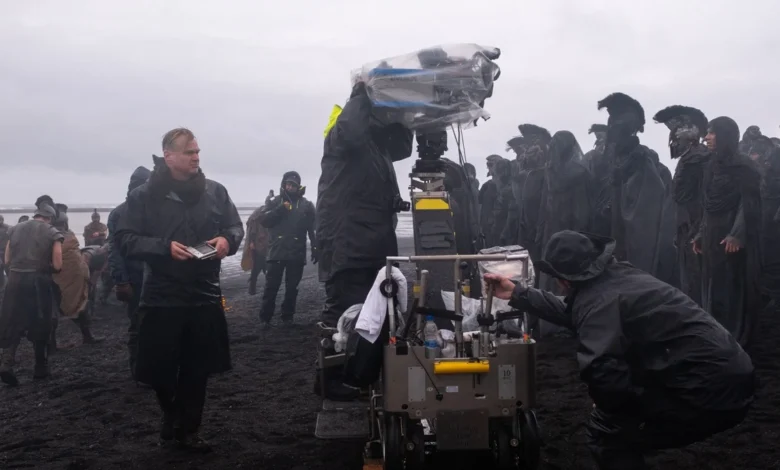
In a recent pronouncement that has ignited debate across literary and technological circles, Elon Musk, the prominent tech mogul, declared his intention to produce a full-length film adaptation of Homer’s Odyssey using his AI platform, Grok Imagine. Musk’s stated goal is to deliver a rendition that is "historically accurate and true to the art of Homer." This ambitious undertaking, however, has drawn criticism from various quarters, with many questioning the very premise of an AI-generated, "historically accurate" epic and contrasting it with the enduring power of human artistic interpretation.
The initial spark for this discussion originated from a social media post by Musk, who shared an AI-generated visualization of a scene from The Odyssey. This visual, created by Grok Imagine, appears to be the precursor to the full-length film he envisions. Musk’s accompanying statement, "Before this year ends, Grok Imagine will make a full-length movie of The Odyssey that is historically accurate and true to the art of Homer," has become the focal point of the controversy. Critics argue that Musk’s emphasis on historical accuracy, coupled with his reliance on artificial intelligence, fundamentally misunderstands the nature of classical literature and the essence of artistic creation.
Homer’s Odyssey, a cornerstone of Western literature, has been a subject of translation, interpretation, and adaptation for millennia. The epic poem, believed to have been composed between the 8th and 7th centuries BCE, chronicles the arduous ten-year journey of the Greek hero Odysseus as he strives to return home to Ithaca following the Trojan War. The poem’s origins are steeped in oral tradition, and its exact authorship remains a subject of scholarly debate. The events of the Trojan War, the narrative’s inciting incident, are estimated to have occurred in the 13th or 12th centuries BCE, creating a temporal chasm of several hundred years between the historical events and their poetic recounting. This inherent blend of myth, history, and oral storytelling challenges any notion of a singular, definitive "historical accuracy."
The Elusive Nature of Historical Accuracy in Ancient Epics
The very concept of "historical accuracy" when applied to The Odyssey is, according to many scholars and critics, a misnomer. Ancient cultures did not possess the same empirical standards of truth and documentation that define modern historical inquiry. For these societies, the lines between myth, legend, and verifiable fact were far more fluid. The Odyssey likely served multiple functions: it was a form of communal storytelling, a means of reinforcing cultural identity, and a vehicle for moral and philosophical instruction. It was not intended as a documentary account of events, but rather as a narrative that explored universal themes of heroism, loyalty, loss, and the human condition.
Furthermore, the history of The Odyssey‘s reception demonstrates a long tradition of human interpretation. From ancient Greek rhapsodes to modern translators and filmmakers, each iteration has filtered the epic through the lens of its own time and cultural context. Emily Wilson’s acclaimed modern translation, for instance, boldly reinterprets the poem, offering a nuanced perspective that deviates from more traditional readings. Similarly, filmmakers like Christopher Nolan, while not directly adapting The Odyssey in the current context, are known for their idiosyncratic and often historically revisionist approaches to complex narratives. Nolan’s directorial style, characterized by intricate plotting, psychological depth, and thematic exploration, prioritizes emotional resonance and artistic vision over strict historical fidelity. His adaptations, though not always factually precise, often achieve profound cultural impact by tapping into deeper human truths.
Musk’s pronouncement, in this context, has been interpreted by some as a continuation of his public persona, which often emphasizes technological prowess and a self-styled image of genius and innovation. Critics suggest that his focus on AI and historical accuracy for The Odyssey may be a misinformed or even disingenuous response to ongoing cultural debates, potentially including discussions around casting and representation in artistic adaptations.

The Role of Interpretation and Human Artistry
The essence of art, many argue, lies in interpretation and the unique perspective of the creator. The journey of Odysseus is not merely a sequence of events but a profound exploration of human experience. The emotions, struggles, and triumphs resonate because they are filtered through the consciousness of human storytellers and artists. Harold Bloom, the late literary critic, emphasized the concept of "anxiety of influence," suggesting that great artists distinguish themselves by forging their own path, often through "misreadings" of their predecessors. This process of creative deviation and personal interpretation is what imbues art with its vitality and enduring power.
AI, by its nature, operates on existing data. Large language models like Grok are trained on vast datasets of text and images, enabling them to generate content that mimics patterns and styles found in their training material. While this can produce impressive results in certain domains, critics contend that it lacks the essential human elements of lived experience, emotional depth, and genuine originality. An AI, they posit, can only regurgitate and recombine existing artistic tropes, leading to derivative and ultimately hollow creations.
The initial output from Grok Imagine, as previewed in the @heavypulp thread that Musk reposted, has been met with lukewarm reception. Descriptions of the AI-generated clip highlight a lack of emotional conviction in the performances, flat visual landscapes, and uninspired musical scores. The inaccuracies in visual elements, such as Roman-style armor and brush-top helmets, further underscore the potential limitations of an AI striving for "historical accuracy" without a nuanced understanding of the source material and its historical context. The AI’s attempt to replicate cinematic styles, such as a faux-Laurence Olivier accent for Odysseus and a generic 1950s Hollywood aesthetic for Calypso, points to a reliance on established cinematic archetypes rather than a fresh artistic vision.
The Implications for Art and Technology
Musk’s venture into AI-driven filmmaking raises broader questions about the future of artistic creation and the role of technology. While AI tools can undoubtedly assist in certain aspects of production, such as generating visual assets or drafting scripts, the fear is that an overreliance on these technologies could lead to a homogenization of art. The unique human capacity for empathy, subjective experience, and the expression of complex emotions is what makes art meaningful. An AI, however advanced, cannot replicate the vulnerability, the struggle, and the deeply personal vision that characterize truly groundbreaking artistic endeavors.
The implication of Musk’s project is that art can be reduced to a set of algorithms and data points, stripped of its human core. This perspective stands in stark contrast to the enduring legacy of works like The Odyssey, which continue to captivate audiences because they speak to fundamental aspects of the human condition. Christopher Nolan’s approach, for example, while not a direct adaptation of The Odyssey, exemplifies how a human artist can draw inspiration from classical narratives and infuse them with contemporary relevance and emotional depth, thereby creating a work that resonates profoundly with audiences.
The debate surrounding Elon Musk’s AI-generated Odyssey serves as a timely reminder that while technological innovation continues to accelerate, the fundamental elements of human creativity—interpretation, vulnerability, and the pursuit of emotional truth—remain irreplaceable. The true epic lies not in the flawless replication of historical data by a machine, but in the messy, complicated, and deeply human journey of artistic expression. As The Odyssey continues to inspire and challenge, its enduring power lies in its ability to evoke emotion and foster connection, a testament to the unique and invaluable contribution of human artistry.
Related posts: