Marvel Age of Comics: Paul Levitz on the growth of Marvel Comics Examining the explosion of Marvel success from 1968-1972

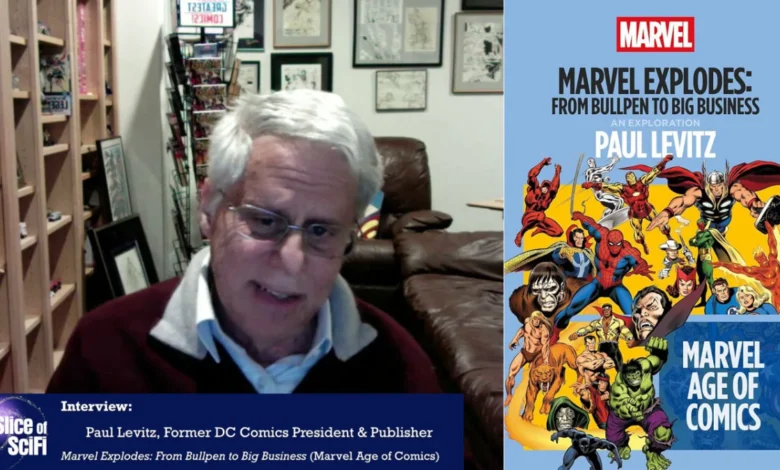
The transformation of the American comic book industry during the late 1960s and early 1970s remains one of the most fascinating corporate and creative evolutions in pop culture history. At the center of this seismic shift was Marvel Comics, a publisher that evolved from a scrappy, fast-paced "bullpen" into an indomitable pop-culture enterprise. Paul Levitz, former President and Publisher of DC Comics—Marvel’s greatest historic rival—dives deep into this pivotal era in his new volume, Marvel Explodes: From Bullpen to Big Business, published as part of Bloomsbury Academic’s prestigious Marvel Age of Comics series.
In a comprehensive interview on the Slice of SciFi podcast, Levitz unpacks the mechanics behind Marvel’s explosive rise between 1968 and 1972. Beyond analyzing the historical data of a bygone era, Levitz also offers rare industry insight into DC Comics’ tactical responses at the time, alongside modern reflections on the current corporate and creative challenges facing DC and its parent company, Warner Bros.
The Crucible Years: Why 1968–1972 Defined Modern Marvel
To understand how Marvel conquered the comic book landscape, one must look at the specific conditions of the late 1960s. For decades, National Periodical Publications (later known as DC Comics) had dominated the superhero medium, maintaining a comfortable stronghold on newsstands across North America. However, the "Marvel Age of Comics," which unofficially began with the debut of The Fantastic Four #1 in 1961, slowly eroded DC’s monopoly through dynamic storytelling, relatable teenage and flawed adult heroes, and a revolutionary direct-to-reader marketing voice pioneered by Stan Lee, Jack Kirby, Steve Ditko, and others.
Yet, as Levitz explores in Marvel Explodes, the period between 1968 and 1972 marks a distinct, crucial inflection point where Marvel transitioned from an upstart challenger into a fully realized corporate entity. This four-year window was characterized by massive corporate restructuring, distribution shifts, an explosive increase in the volume of published titles, and a dramatic expansion of the company’s intellectual property footprint.
During these years, Marvel was no longer merely surviving against industry titans; it was setting the standard for how serialized pop culture would be consumed. The influx of new creative talent, shifting ownership structures—including Marvel’s acquisition by Martin Goodman’s corporate masters at Perfect Film & Chemical Corporation—and a rapidly aging readership demanded a new business approach. Levitz’s academic and historical lens sheds light on how these operational changes allowed the publisher to scale its output dramatically while capturing a larger share of the entertainment market.
Chronology of an Expansion: Key Milestones in the Marvel Boom
The trajectory of Marvel Comics from 1968 to 1972 was marked by several critical milestones that cemented its place at the top of the comic book hierarchy:
- 1968 (The Corporate Shift): Perfect Film & Chemical Corporation (later known as Cadence Industries) purchased Martin Goodman’s Magazine Management, which included Marvel Comics. This acquisition provided Marvel with the financial backing and corporate infrastructure necessary to expand its line well beyond its historical publishing limits.
- 1969–1970 (Title Explosion and Talent Evolution): Freed from restrictive legacy distribution caps that had historically favored DC through independent monopolistic delivery systems, Marvel flooded the market with fresh genres. While continuing to anchor its success on flagship heroes like Spider-Man, the Avengers, and the X-Men, Marvel successfully diversified into horror (The Tomb of Dracula), martial arts (Master of Kung Fu), and sword-and-sorcery (Conan the Barbarian).
- 1971 (The CCA Crisis and the Birth of Mature Storytelling): When the Department of Health, Education, and Welfare approached Stan Lee to write an anti-drug storyline, the Comics Code Authority (CCA) famously refused to approve The Amazing Spider-Man #96-98 because it depicted narcotics use—even though the message was explicitly cautionary. Marvel published the issues anyway without the Code stamp, forcing a watershed moment that ultimately led the CCA to relax its rigid guidelines, opening the door for more nuanced, socially relevant storytelling.
- 1972 (Stan Lee’s Promotion and Generational Handover): Stan Lee stepped back from his day-to-day writing duties to assume the role of publisher, paving the way for a new generation of creators—including Roy Thomas, Gerry Conway, and Len Wein—to take the narrative reins. This leadership transition proved that Marvel’s universe was sturdy enough to survive beyond the original creative architects.
Industry Reactions and DC’s Defensive Maneuvers
As Marvel’s market share climbed exponentially, DC Comics was forced to recalibrate its strategy to avoid being entirely eclipsed. As a premier historian of the medium and a former executive who spent decades at the helm of DC, Paul Levitz offers an insider’s perspective on how the "Distinguished Competition" reacted to the pressure.
During the late 1960s and early 1970s, DC attempted to modernize its stable by introducing relevant social themes—epitomized by the legendary "Hard-Traveling Heroes" run on Green Lantern/Green Arrow by Denny O’Neil and Neal Adams. Furthermore, DC aggressively recruited top-tier talent away from Marvel, most notably orchestrating the high-profile defection of legendary co-creator Jack Kirby in 1970.
Levitz analyzes these maneuvers with a balanced, academic eye, noting that while DC’s efforts yielded critically acclaimed masterworks, they often struggled to match the organic, cohesive momentum that Marvel had cultivated with its loyal readership base. DC’s institutional legacy proved to be both a shield and an anchor, slowing its ability to pivot as rapidly as the nimble, newly corporate-backed Marvel.
Modern Parallels: Corporate Crossroads at Warner Bros. and DC
Levitz’s expertise extends far beyond historical retrospectives. Having navigated the upper echelons of comic book publishing corporate structures for decades, his analysis naturally bridges the gap between historical corporate shifts and the contemporary challenges facing modern entertainment giants.
In discussing the current state of affairs at DC Comics and its parent entity, Warner Bros. Discovery, Levitz draws upon his deep institutional knowledge to evaluate today’s shifting media landscape. The transition of comic book publishers from traditional print-first entities into multi-billion-dollar intellectual property incubators for cinematic universes mirrors the corporate growing pains Marvel experienced in the late 1960s.
Industry analysts frequently point out that the modern era of comic book publishing operates less on newsstand sales and more on long-term franchise viability. Levitz’s historical framework provides a valuable reminder that current corporate restructuring efforts at Warner Bros.—ranging from shifting film studio leadership to recalibrating the DC Universe under James Gunn and Peter Safran—are simply the latest chapters in a century-long struggle to adapt sequential art to changing economic realities.
Broader Impact and Implications for Comic Scholarship
The publication of Marvel Explodes: From Bullpen to Big Business marks a significant milestone in the academic study of comic books. For decades, the history of the medium was largely relegated to fan magazines, anecdotal memoirs, and nostalgic retrospectives. Bloomsbury Academic’s Marvel Age of Comics series represents a growing shift toward rigorous, institutional-grade historiography.
By treating the business operations, distribution models, and corporate acquisitions of comic book publishers with the same academic rigor applied to traditional literature and film history, works like Levitz’s elevate the discourse surrounding the medium. Understanding the financial mechanics of 1968–1972 demystifies the mythos of the "creative bullpen," revealing that Marvel’s ultimate triumph was as much a triumph of strategic corporate positioning and logistical adaptation as it was a stroke of artistic genius.
As comic book history continues to inform multi-billion-dollar cinematic landscapes, insights from industry veterans like Paul Levitz ensure that the foundational roots of the medium are accurately documented, analyzed, and preserved for future generations of creators, scholars, and fans alike.