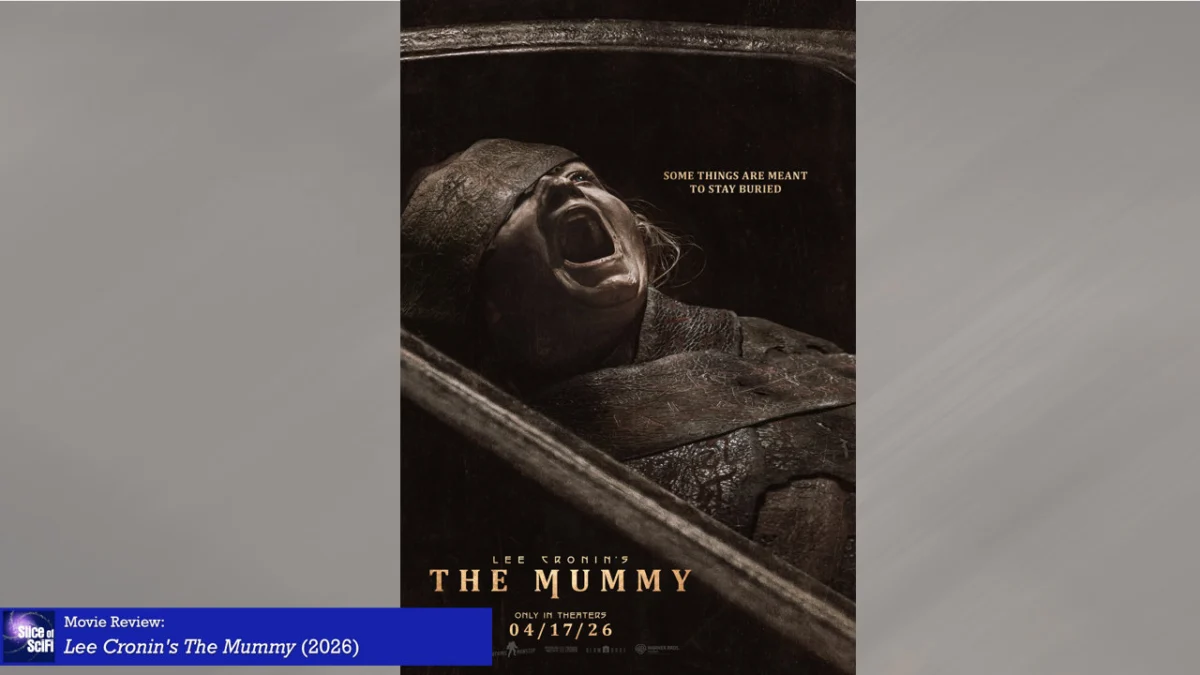
Lee Cronin’s latest directorial effort, "The Mummy," presents a visually arresting and sonically potent horror experience, boasting impressive production values that are a hallmark of contemporary genre filmmaking. The film delivers on visceral scares through striking visual effects, unsettlingly graphic body horror, and a compelling musical score amplified by meticulously crafted foley work. However, these technical achievements are ultimately undermined by a narrative that struggles with coherence and a screenplay that falters in its character development and plot construction.
A Descent into Darkness: The Unfolding Narrative
The film’s initial act sets a disconcerting tone, opening with a family embarking on a road trip through Egypt. The mundane attempt at familial bonding, with a father encouraging his children to sing along to the radio, is abruptly shattered by the mother’s abrupt cessation of the music, citing a headache. This subtle discord foreshadows the deeper disturbances that will soon engulf them.
Upon their return home, a chilling discovery awaits: one of their pet birds lies lifeless in a pool of viscous, dark fluid. This unsettling omen prompts the parents to descend into a subterranean crypt, where they encounter an obelisk-like sarcophagus. The mother, identified in the credits as "the Magician" (Hayat Kamille), attempts to unveil its contents using sophisticated machinery. In a moment of disorienting terror, her light source fails, and when it is restored, a fleeting, macabre image is glimpsed. Tragically, her husband becomes ensnared in the very mechanisms he helped operate, meeting a gruesome end.
The narrative then shifts to Cairo, introducing Charlie (Jack Reynor) and his pregnant wife, Larissa (Laia Costa) Cannon. The scene depicts Charlie attempting to teach his daughter, Katie (Emily Mitchell), the intricacies of International Morse Code. A televised segment featuring Charlie discussing Egyptian water issues becomes a point of ridicule for his children, particularly his son Sebastian (Dean Allen Williams), who mocks his father’s gesticulations.
Later, as Larissa prepares to depart, Charlie receives a call confirming a lucrative television job in New York City, injecting a brief moment of optimism. However, this is quickly overshadowed by a sibling dispute, culminating in Sebastian impulsively paragliding one of Katie’s dolls from a balcony, causing irreparable damage. Charlie intervenes to repair the toy, and Katie, still harboring resentment, ventures outside.
In a lush, garden-like setting, Katie delves into a box of her belongings. A disembodied voice emanates from beyond a fence, drawing her attention. The film reveals that Katie had a childhood friend named Layla, the daughter of the Magician. Layla reappears, engaging Katie with magic tricks and offering her a nectarine, cryptically apologizing for what is about to transpire. Upon biting into the fruit, a horrifying incident unfolds as a bug enters Katie’s mouth, leading to her immediate collapse.
Charlie, discovering candy wrappers left by Layla, investigates the yard and witnesses a robed figure abducting Katie. He pursues them relentlessly, but a sudden, violent dust storm forces him to abandon the chase. The ensuing investigation at a police station leads to the parents becoming suspects in their daughter’s disappearance, with Detective Dalia Zaki (May Calamawy) diligently translating Arabic testimonies.
An Eight-Year Void and a Harrowing Return
The film then leaps forward eight years. A plane crash in rural Egypt reveals the same distinctive obelisk-like casket from the Magician’s crypt amidst the wreckage. The casket is transported to a laboratory, where, upon opening, investigators discover long strips inscribed with letters. In a sudden, terrifying turn of events, the figure entombed within the sarcophagus reanimates.
Simultaneously, back in the United States, in the remote outskirts of Albuquerque, New Mexico, Charlie is employed at a local television station, while Larissa works in the medical field. Their lives, now seemingly settled in a sprawling, isolated residence, are upended by a phone call: Katie (Natalie Grace) is alive and has been found in Egypt. The news is met with a mixture of shock and profound apprehension, as the implication of her return is overshadowed by the chilling question of her condition.
Technical Prowess Amidst Narrative Weaknesses
The film undeniably excels in its technical execution. The portrayal of body horror is rendered with a disturbing vividness that effectively elicits revulsion, a common and often effective tool in the horror genre. Several sequences achieve genuine terror, punctuated by well-timed jump scares. The reviewer highlights an "ingested scorpion giving Zaki an involuntary tracheotomy" as a particularly inventive and gruesome moment.
The setting of the Cannon home in New Mexico is also lauded for its production design, featuring well-appointed interiors and strategically placed hidden corridors that enhance the film’s spatial dynamics and facilitate the unfolding action. The inclusion of what appear to be wolves at the gate, though noted as coyotes, adds to the film’s atmospheric unease.
The Egyptian ritual depicted on a VHS tape is described as suitably creepy and frightening, with the lettered wrappings of the sarcophagus contributing to the unsettling imagery. The musical score is consistently praised as superb, evoking a spooky and eerie atmosphere, while the foley effects, particularly the thunderous thumping sounds, are noted for their frightening intensity.
Narrative Stumbles and Questionable Character Choices
Despite these considerable strengths, "The Mummy" falters significantly in its storytelling. The reviewer expresses strong disapproval of the characters’ perceived lack of intelligence and their baffling decisions. The return of Katie, described as bearing a resemblance to unsettling cinematic figures like Chucky and Linda Blair’s Regan MacNeil at her worst, presents a stark picture: she is mute, communicating only in guttural outbursts, has self-inflicted wounds, and exhibits uncontrollable spasms.
The decision by Charlie and Larissa to bring their visibly traumatized and physically afflicted daughter to their remote home, rather than seeking immediate professional medical and psychological intervention, is presented as a critical narrative flaw. The film depicts Katie exhibiting violent tendencies, such as attacking her grandmother, necessitating sedation. Yet, the parents continue to care for her themselves, an approach deemed illogical given the severity of her condition.
Charlie’s attempts to decipher Katie’s actions through Morse Code, and his subsequent consultation with an Egyptology professor, are framed as desperate measures in a narrative that increasingly strains credulity. Larissa’s distressing act of cutting Katie’s toenails to the point of skinning her leg, presented as a routine occurrence, further underscores the reviewer’s criticism of the family’s actions and the film’s portrayal of their caregiving.
The film’s narrative structure, centered on the "terror in one house over time," is compared unfavorably to films like "Abigail," which, despite also being confined to a single location, featured characters who demonstrated more agency and awareness of their perilous situation, alongside a more compelling plot.
Egyptology and Exploitation: A Confused Focus
The Egyptology aspect of the film is criticized for being poorly defined. The reviewer questions why a supposedly world-threatening demon would remain confined to a single household. The film’s excessive runtime of two hours and fifteen minutes is noted, with a significant portion dedicated to revealing Katie’s origins, a reveal that, by its conclusion, fails to elicit sufficient audience investment due to the preceding narrative shortcomings. The imbalance of settings, with too little action occurring in Egypt and too much in New Mexico, further detracts from the film’s potential to explore its supernatural elements more effectively.
A particularly disturbing element for the reviewer is the depiction of an eight-year-old child being subjected to peril within an Egyptian ritual. The film is accused of blurring the line between legitimate storytelling and exploitation, ultimately leaning towards the latter.
Furthermore, the film’s disregard for the laws of physics, physiology, and anatomy is a recurring grievance. The reviewer points out the implausibility of human characters surviving the extensive damage inflicted by a demonic entity.
A Dichotomy of Quality
The creation of a compelling horror film is acknowledged as a challenging endeavor. However, the experience of watching "The Mummy" is described as profoundly conflicted, presenting a stark contrast between admiration for its production values and detestation for its narrative. The film’s technical prowess serves as a testament to modern filmmaking capabilities, yet its fundamental story issues leave a significant void, preventing it from achieving its full potential.
Official Statements and Broader Context
While specific official statements from the filmmakers or studio regarding the narrative critiques are not publicly available in the provided text, the director Lee Cronin, known for his work on "The Hole in the Ground," has previously expressed interest in exploring themes of motherhood and primal fears within horror narratives. This context suggests a deliberate artistic intent, even if the execution in "The Mummy" has proven divisive. The film’s premise, centered on a child’s disappearance and supernatural return, taps into deep-seated anxieties surrounding loss, the unknown, and the corruption of innocence. The use of Egyptian mythology, while criticized for its execution, adds a layer of ancient mystique and terror, a trope that has a long and varied history in horror cinema, from classic Universal monster films to more modern interpretations.
Implications and Audience Reception
The critical reception of "The Mummy" suggests a significant disconnect between its technical ambition and its narrative execution. For audiences seeking a purely visceral and visually spectacular horror experience, the film may offer moments of genuine fright and unsettling imagery. However, those who prioritize a coherent plot, well-developed characters, and logical narrative progression are likely to find themselves frustrated by its shortcomings. The film’s commercial performance and subsequent audience reviews will ultimately determine its lasting impact and place within the genre. The current assessment indicates a film that, while aesthetically impressive, struggles to translate its technical strengths into a truly satisfying or resonant horror story, ultimately leaving viewers with a sense of missed opportunity.
Rating: Two and a half out of five stars.