The penultimate episode of Star Trek: Strange New Worlds’ fourth season, titled Once La’An A Time, debuted on September 17, 2026, marking a significant narrative pivot for the series. Directed by Sydney Freeland and written by Onitra Johnson, the episode serves as a character-centric exploration of La’An Noonien-Singh, utilizing a high-concept fantasy setting to externalize the internal psychological conflict of a central crew member. As the series approaches its conclusion, the episode functions as a thematic bridge, reconciling the past traumas of its characters with their future trajectories within the Starfleet hierarchy.
The Narrative Premise and Chronological Context
The episode begins with the bridge crew of the USS Enterprise expressing concern regarding the behavior of security chief La’An Noonien-Singh, whose recent conduct during a diplomatic wedding—involving an aggressive confrontation with an Orion spy—raised questions about her emotional stability. Before the command staff can address these concerns, the Enterprise encounters an anomalous, “unknown flat planet” that defies standard scientific classification.

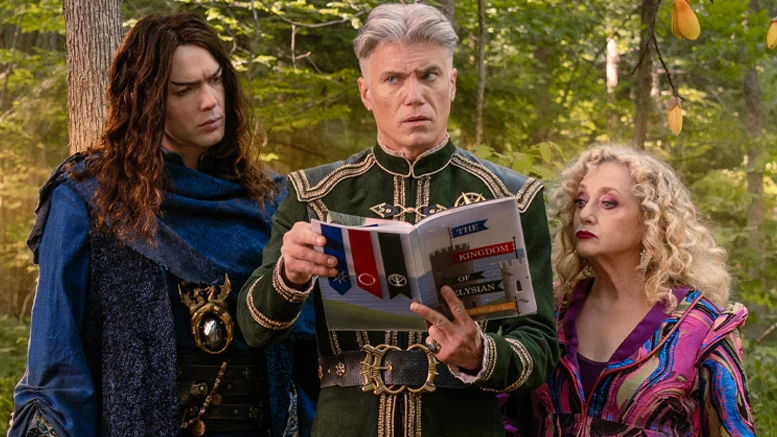
Upon investigation by a landing party led by Captain Christopher Pike, the crew discovers an environment that mirrors the events of the season one episode The Elysian Kingdom, in which the crew was previously transformed into fairy tale archetypes by a sentient nebula entity known as Debra. In this new iteration, the environment appears specifically tailored to La’An, who is cast in the role of “Princess Thalia.” The narrative quickly reveals that the planet is not merely a geographic location but a vessel, acting as a sentient construct that archives and projects the emotional experiences of those it encounters.
Thematic Exploration: The Shadow Self and Jungian Psychology
The core of the episode relies heavily on the psychological concept of the “shadow self,” a term frequently attributed to Carl Jung. By forcing La’An to confront a literal manifestation of her dual nature—represented by the contrast between her duty-bound, stoic security persona and her suppressed vulnerabilities—the narrative mirrors classic Star Trek tropes, such as the original series episode The Enemy Within.
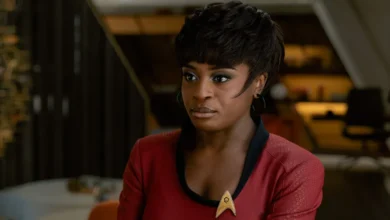
The appearance of “Prince Dashing,” a character who bears a striking resemblance to James T. Kirk, acts as an avatar for La’An’s suppressed desires and her struggle to accept her identity as a descendant of Khan Noonien-Singh. Through a series of quests—including a retrieval mission in a swamp and a masquerade ball—the episode deconstructs the barriers La’An has placed around her own history. The resolution, which involves La’An working in tandem with her own double to defeat the antagonist Queen Neve (portrayed by Uhura), symbolizes the integration of her disparate emotional states.

Production and Technical Execution
Production-wise, the episode leverages the show’s established high-quality visual effects and costume design. The decision to reuse and repurpose costumes from the first season serves a dual purpose: it provides a meta-textual nod to the show’s history while maintaining budgetary efficiency. The inclusion of a dragon—a visual spectacle that forced the Enterprise to engage in "erratic evasive maneuvers"—demonstrates the series’ commitment to high-concept genre blending.
The performance of Christina Chong, who portrays both the princess and the standard iteration of La’An, provides the dramatic anchor for the episode. Her ability to navigate the tonal shifts between the fantastical setting and the grounded psychological drama is pivotal to the episode’s success. Similarly, Anson Mount (Pike) and Ethan Peck (Spock) display a marked enthusiasm for their roles as Sir Rauth and the wizard Pollux, respectively, providing much of the episode’s levity through their attempts to reconcile their scientific training with the illogical constraints of the fantasy environment.
Comparison to Previous Genre Diversions
Critics have noted that while Strange New Worlds has gained acclaim for its "genre-swinging" episodes—which have included musical, comedic, and horror-inspired installments—this specific episode arrives at a time when the show’s limited episode count makes every narrative detour a subject of intense scrutiny. Compared to The Elysian Kingdom, this outing demonstrates a higher degree of character continuity; the protagonists retain the memory of their experience, indicating a shift toward long-term character development rather than purely episodic resets.

However, the lack of an explicit scientific explanation regarding the planet’s origin remains a point of contention for some viewers. While Pelia, the ship’s engineer, provides a tenuous explanation linked to her past, the narrative ultimately prioritizes emotional catharsis over hard science fiction rigor. This approach is consistent with the show’s focus on the human—and Vulcan—condition, though it highlights the ongoing tension between the series’ traditional roots and its current, more experimental storytelling philosophy.
Broader Impact and Implications for the Series
As the series heads into its final episodes, the resolution of La’An’s personal arc is significant. The episode concludes with the security officer retrieving a piece of her history—a necklace belonging to her father—and finally engaging in a candid conversation with James T. Kirk. This interaction is designed to close the loop on her previous, partially classified romantic and professional entanglement with the future captain, allowing her to "start over" with a sense of equilibrium.
The episode also highlights the role of Pelia, whose backstory continues to be a highlight of the fourth season. Her interaction with the ship’s chef, Max, and her role in piloting the sentient planet home, reinforces her status as a character with deep historical roots within the Star Trek timeline. By the time the Enterprise resumes its standard mission parameters, the crew is depicted as having reached a state of relative emotional stability, setting the stage for the final series arc.

Analysis of Narrative Pacing and Story Structure
The structure of Once La’An A Time is intentionally recursive. By incorporating elements of the "fetch quest" and the "masquerade ball," the writers evoke the sensibilities of classic fantasy cinema, specifically citing influences such as The Princess Bride. This stylistic choice is used to lower the barrier for the audience to accept the episode’s more bizarre elements.
Despite the effectiveness of these moments, the pacing of the episode suggests an attempt to compress complex character development into a single hour. The transition from the bridge to the fantasy world and back again happens with a speed that occasionally leaves little room for the scientific mystery to breathe. The episode functions best as a character study rather than a technical exploration of the anomaly, which may alienate viewers seeking more traditional space exploration narratives.
Conclusion and Future Outlook
The ninth episode of season four serves as a definitive statement on the identity of Strange New Worlds. It is a show that values the emotional growth of its crew above the strict adherence to scientific logic, utilizing the expansive nature of the Star Trek universe to provide safe environments for psychological experimentation.

With only one episode remaining in the fourth season and a limited number of total episodes left in the series, the focus on wrapping up character arcs is evident. The successful integration of La’An’s "shadow" provides a satisfying conclusion to one of the show’s longest-running character threads. Whether the series will return to more traditional science fiction storytelling for its final hour remains to be seen, but for now, the creative team has prioritized the internal lives of the Enterprise crew, ensuring that their personal journeys are resolved with the same care as their interstellar adventures.
As the production moves toward its final bow, the legacy of these genre-bending episodes will likely be debated. While some may argue that the series could have benefited from more traditional plots, the consensus among observers remains that the commitment to character-focused, high-concept storytelling has been the defining feature of the Strange New Worlds era. The episode ends on a note of cautious optimism, with the crew having survived yet another encounter with the impossible, better prepared for whatever challenges await them in the final mission.