Simon and Kirby Airborne Battle in Blue Bolt 7 Hits Auction Block Featuring World War II Real World Parallels

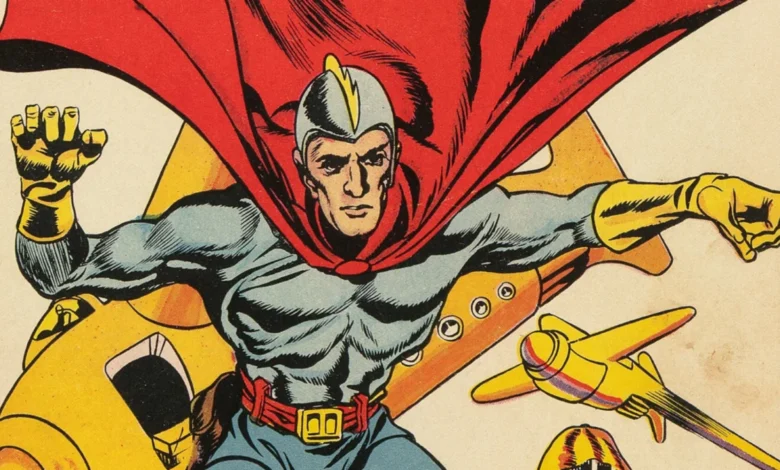
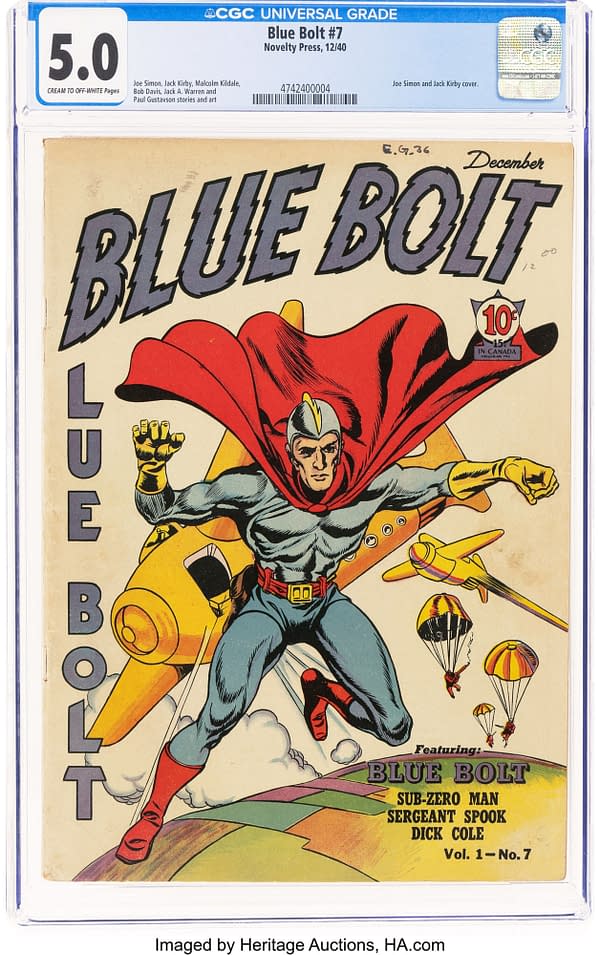
The intersection of real-world geopolitics and early Golden Age comic book storytelling represents a fascinating era of American pop culture history. A prime example of this phenomenon is currently drawing significant attention from vintage comic book collectors and historians alike. A certified copy of Blue Bolt #7, published by Novelty Press in December 1940 and featuring the legendary creative partnership of Joe Simon and Jack Kirby, is scheduled to go under the hammer at the upcoming Golden Age Century Comics Showcase Auction #40378, presented by Heritage Auctions on November 5, 2026. This specific issue captures the legendary creative duo operating at the absolute height of their early storytelling prowess, utilizing unfolding international conflicts of the Second World War as a direct blueprint for fantastical comic book narratives.
Background Context of the Golden Age and the Simon-Kirby Partnership
To fully understand the historical weight of Blue Bolt #7, one must examine the state of the American comic book industry in late 1940. The United States had not yet officially entered World War II, but the shadow of escalating global conflict hung heavily over the nation. Months before Joe Simon and Jack Kirby famously punched Adolf Hitler on the cover of Captain America Comics #1—published by Timely Comics in March 1941—they were already weaving the horrifying realities of European warfare into the speculative fiction pages of Novelty Press’s Blue Bolt.

Joe Simon and Jack Kirby formed one of the most consequential creative teams in the history of the medium. Their collaboration pioneered dynamic panel layouts, aggressive and kinetic action sequences, and narrative stakes that felt far more urgent than many of their contemporaries’ wholesome adventures. Blue Bolt, featuring a protagonist endowed with electrical powers operating behind a mysterious radioactive barrier on Earth, allowed Simon and Kirby to experiment with genre-bending storytelling that blurred the lines between high fantasy, early science fiction, and ripped-from-the-headlines war drama.
The Green Sorceress Learns Blitzkrieg: A Narrative Breakdown
In the primary feature of Blue Bolt #7, the narrative takes a dark and startlingly topical turn. The story centers on the Green Sorceress, an adversary who appears to be definitively defeated after Blue Bolt demobilizes his forces. However, the conflict is abruptly reignited through technology supplied by Blue Bolt’s resident scientist colleague, Bertoff. Utilizing a specialized telescreen that breaches the radioactive barrier separating their world from the outer Earth, the characters witness the devastating mechanics of the ongoing war in Europe.
Through the flickering screen, the characters observe the terrifying efficiency of modern military doctrine: refugees being targeted by machine-gun fire, paratroopers descending from the skies in coordinated drops, and mechanized tank columns working in terrifying tandem with dive bombers to overwhelm traditional defense lines. Rather than viewing these atrocities with horror, the captive Green Sorceress studies the aggressors’ tactics—specifically the speed and ruthlessness of the Blitzkrieg, combined with systematic airborne deployment and psychological propaganda.
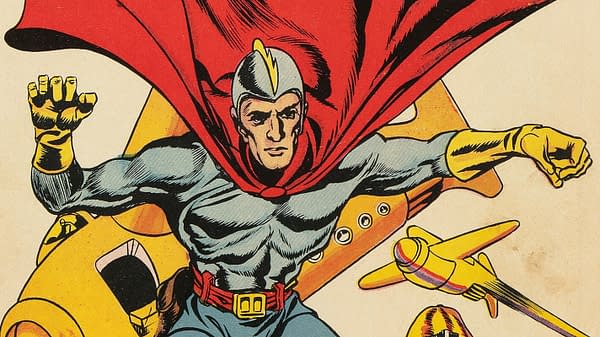
Recognizing the effectiveness of these real-world military strategies, the Sorceress manages to escape. She immediately reorganizes her Green Army, implementing modern mechanized warfare and tactical maneuvers learned directly from the newsreels of European dictators. She launches a surprise counter-offensive against Blue Bolt and his allies precisely when they have lowered their guard, believing the war to be won. Simon and Kirby render this airborne battle and technological integration with spectacular science-fiction visuals, establishing a template where fantastic elements are driven by contemporary geopolitical anxieties.
Broader Content of Blue Bolt #7
Beyond the headline Simon and Kirby feature, Blue Bolt #7 offers a comprehensive snapshot of how the entire comic book industry was pivoting toward national defense and military themes as the probability of American involvement in World War II increased.
The issue includes auxiliary stories that abandon pure fantasy in favor of industrial espionage and domestic defense concerns. In Runaway Ronson, an adventure attributed to artist Paul Gustavson, criminal elements actively sabotage the American war mobilization effort. Thieves successfully divert heavy railroad artillery guns that were being shipped from a crucial Midwestern manufacturing plant to an Atlantic coastal-defense fortification, plotting to sell the armaments abroad for illicit profit. This narrative directly reflected contemporary American anxieties regarding domestic security, fifth-column infiltration, and the vital importance of the nation’s burgeoning industrial manufacturing base.
Additionally, the issue features Andrew McWhiney’s prose serial, The Ray Master. This text-based adventure expands the magazine’s scope by incorporating real-world military aviation, placing United States Army Air Corps B-18 Bolo bombers into a high-stakes confrontation involving a remote mesa stronghold and a devastating experimental paralysis ray. By blending prose with sequential art, Novelty Press ensured that readers received a diverse package of patriotic and defense-oriented thrills.
Market Data, CGC Census, and Auction Details
For modern collectors, the physical condition and historical scarcity of Blue Bolt #7 place it in high demand. According to the Certified Guaranty Company (CGC) census data, the book is exceptionally rare in high grades. The census lists a total of 15 Universal (unrestored) entries for the issue. Among these, two copies sit at a 5.0 grade, with only four copies graded higher. Additionally, the census notes five Restored entries, underscoring how heavily handled these early comic books were by their original young readers.
The copy headed to the auction block is a CGC VG/FN 5.0 specimen featuring cream to off-white pages. It is slated to be sold during the Golden Age Century Comics Showcase Auction #40378 on November 5, 2026. Given the extraordinary historical significance of early Simon and Kirby collaborations, alongside the striking cover art—widely considered by vintage enthusiasts to be the finest cover of the entire Novelty-published Blue Bolt series—pre-sale market interest remains exceptionally strong.
Implications and Historical Legacy
The appearance of Blue Bolt #7 at auction offers more than just an opportunity for high-end investors to acquire a scarce piece of Golden Age paper; it serves as a tangible artifact of a medium finding its cultural voice. In late 1940, comic books were rapidly transforming from lightweight juvenile diversion vehicles into influential cultural mirrors.
By taking the harrowing innovations of mechanized warfare from the European theater and translating them into the sci-fi conflicts of the Green Sorceress and Blue Bolt, Simon and Kirby demonstrated an uncanny ability to connect with their readership’s subconscious fears. The creators took current events and refracted them through an imaginative lens, preparing young American readers for the realities of a changing world long before the nation officially entered the global conflict. The enduring legacy of Blue Bolt #7 lies precisely in this historical synthesis—a milestone work where the foundational architects of modern comic book storytelling first mastered the art of merging real-world history with pure, unadulterated pulp adventure.