The cultural legacy of science fiction television and cinema is often measured by its adherence to realism, understated performances, and grounded emotional beats. Yet, within the sprawling mythos of the Star Trek franchise, one actor carved out a distinct artistic territory through unapologetic theatricality, deliberate cadence, and magnetic intensity. Decades after first stepping onto the bridge of the USS Enterprise, William Shatner’s portrayal of Admiral James T. Kirk continues to be reevaluated by critics, scholars, and fans alike. Long dismissed by pop culture as an object of parody, Shatner’s unique performance style—characterized by pregnant pauses, operatic delivery, and unbridled emotional commitment—is increasingly recognized as a masterclass in high-melodramatic acting that perfectly suited the grand scale of space opera.
The Evolution of a Cultural Archetype
To understand the modern appreciation of Shatner’s work, one must examine how his reputation shifted from a revered leading man to a frequent target of satire. When Star Trek premiered in September 1966 under the creation of Gene Roddenberry, television was undergoing a transition toward sophisticated storytelling infused with moral and philosophical dilemmas. Shatner’s Captain Kirk was the nexus of this endeavor—a swaggering, intellectual, and deeply passionate commander who balanced the cold logic of first officer Spock with the folksy intuition of Chief Medical Officer Leonard McCoy.
During the original series’ three-season run, Shatner established a rhythm that relied heavily on theatricality. Whether reciting Shakespearean-inspired dialogue, confronting god-like alien entities, or engaging in hand-to-hand combat on cardboard sets, Shatner anchored the proceedings with absolute conviction. However, as the franchise transitioned into syndication during the 1970s and 1980s, these idiosyncratic vocal patterns became prime material for impressionists and comedians. Satirical sketches, most notably by John Belushi on Saturday Night Live in 1976, magnified Shatner’s distinctive pauses and emotional swells.
Over time, this affectionate mockery fused with a broader cultural reassessment of the actor’s post-Star Trek career. Projects such as the 1980s police procedural T.J. Hooker cast Shatner in a different light, moving from the utopian idealism of Star Federation diplomacy to the earthbound, hard-nosed vigilantism of an urban street cop. While Star Trek allowed Shatner to muse on the boundless potential of humanity, T.J. Hooker featured him delivering heavy-handed monologues on societal decay. By the time The Next Generation debuted in 1987, led by the classically trained Royal Shakespeare Company actor Patrick Stewart as Captain Jean-Luc Picard, cultural standards for science fiction acting had shifted. Stewart’s refined, understated gravitas made Shatner’s older, more visceral style look antiquated to a new generation of viewers.
Chronology of a Legacy: From Television Icon to Cinematic Legend
The timeline of William Shatner’s involvement with the Star Trek franchise spans active leadership, cultural incubation, cinematic redemption, and enduring icon status.
1966: Star Trek premieres on NBC, establishing James T. Kirk as the definitive space-faring captain.
1979: Star Trek: The Motion Picture brings the franchise to the big screen, proving the enduring commercial viability of the original cast.
1982: Star Trek II: The Wrath of Khan cements the dramatic legacy of the film series, featuring iconic emotional beats such as Spock’s death and Kirk’s eulogy.
1994: Star Trek: Generations bridges the gap between generations, pairing Shatner with Patrick Stewart in a thematic passing of the torch.
2000s–Present: Shatner embraces his pop-culture persona through commercials, mockumentaries, books, and public appearances, culminating in a critical reappraisal of his acting methodology.
The Critical Re-Examination of Star Trek II: The Wrath of Khan
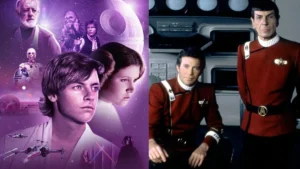
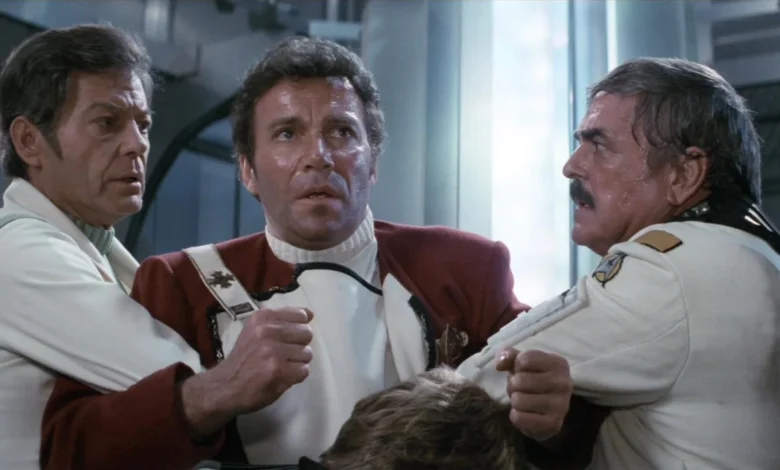
The definitive turning point in appreciating Shatner’s dramatic efficacy is frequently traced back to the climax of 1982’s Star Trek II: The Wrath of Khan, directed by Nicholas Meyer. Following the self-sacrificing death of Leonard Nimoy’s Spock within the warp core chamber, Kirk is tasked with delivering a eulogy to the assembled crew.
Standing before his grieving subordinates, Kirk utters the famous line: "Of all the souls I have encountered in my travels… his was the most… human."
The genius of the delivery lies not in the script alone, but in Shatner’s physical and vocal manipulation of the moment. By inserting a deliberate, elongated pause before the word "human"—a designation that a living Spock would have outwardly rejected—Shatner forces the audience to feel the profound weight of grief and the agonizing realization of mortality. His facial expressions register a visceral shock and a deep, aching vulnerability. For years, critics focused on the theatricality of the pause, missing the emotional architecture underpinning it. In the context of a cinematic universe dealing with cosmic phenomena, interstellar warfare, and existential philosophy, understated realism would have fallen flat. Shatner matched the operatic scale of the narrative with an equally operatic performance.
Generational Contrast: Kirk Versus Picard in Star Trek: Generations

The release of 1994’s Star Trek: Generations offered a direct cinematic juxtaposition between William Shatner’s James T. Kirk and Patrick Stewart’s Jean-Luc Picard. While the film received mixed reviews for its meandering plot and the underwhelming handling of its villain, played by Malcolm McDowell, it succeeded profoundly in showcasing the contrasting acting philosophies of its two lead captains.
The narrative mechanics of Generations bring Picard into the Nexus—an extra-dimensional realm of absolute, timeless bliss—where he encounters a retired Kirk living an idealized pastoral life. Picard’s mission is to convince Kirk to leave the illusion behind and return to reality to stop a catastrophic threat.
In this sequence, Stewart’s Picard approaches the encounter with characteristic caution, speaking in measured, careful tones so as not to startle his predecessor. By contrast, Shatner infuses Kirk with a kinetic, restless energy. When Kirk stumbles upon an artifact from his past—a clock that once belonged to Dr. McCoy—Shatner freezes, his face going completely still to absorb the shock of memory before launching into a rapid-fire delivery of his next lines.
While a comedic imitation would reduce these shifts to parody, within the film they create a dynamic sense of spontaneity. Picard’s measured stoicism clashes against Kirk’s vibrant impulsivity. Shatner understood that a meeting between two foundational figures of science fiction television required theatricality, emotional excess, and a sense of legendary weight. He refused to let the moment pass quietly, ensuring that the transition of leadership was marked by undeniable dramatic presence.
Broader Impact and Analysis of Melodramatic Acting
The reassessment of William Shatner’s career points to a broader shift in how media scholarship evaluates melodramatic performance. In the mid-to-late 20th century, critical consensus heavily favored naturalism, minimalism, and psychological interiority derived from method acting traditions. Performers who exhibited heightened emotions, stylized speech patterns, or larger-than-life physical expressions were often categorized as campy or lacking in technical control.
However, genre fiction—particularly space opera, fantasy, and superhero cinema—operates under different structural requirements. When characters grapple with the destruction of planets, time travel anomalies, and abstract philosophical questions about the nature of existence, minimalist acting can register as insufficient or emotionally detached. Shatner’s genius lay in his willingness to lean entirely into the absurdity and grandeur of the material without a trace of irony. He treated the fantastic as if it were absolute reality, committing heart and soul to every shouted command, whispered secret, and tearful farewell.
Industry Reactions and Cultural Permanence
Over the decades, fellow actors and filmmakers have increasingly spoken out in defense of Shatner’s unique methodology. Directors who worked within the franchise have noted that Shatner possessed an innate camera awareness and a rhythmic understanding of dialogue that elevated routine expositional scripts into memorable cinematic moments. Even Patrick Stewart, whose style represents the antithesis of Shatner’s, has acknowledged the singular magnetism required to carry a television franchise through its formative years and establish an archetype that endures more than half a century later.
Furthermore, Shatner’s ability to embrace the humor of his own public persona—participating in self-deprecating comedy roasts, commercial campaigns, and internet memes—demonstrated a cultural self-awareness that solidified his status as a living legend rather than a relic of television history.
Conclusion
As the Star Trek franchise continues to expand through numerous streaming series, cinematic reboots, and animated spin-offs, the shadow of James T. Kirk looms larger than ever. Modern captains draw upon the blueprints established by Shatner in the late 1960s, balancing authority with empathy, and intellect with action.
William Shatner’s legacy is not merely that of a television pioneer, but of an actor who understood the precise currency of science fiction: the willingness to feel deeply, loudly, and without reservation. Whether viewed through the lens of nostalgia, dramatic theory, or pop-culture iconography, Shatner’s dynamic performances remind audiences that within the infinite diversity of the cosmos, the most compelling element remains the unashamedly human capacity for emotional expression.