The longevity of cinematic horror franchises is a rare phenomenon, particularly when born from independent, low-budget beginnings. Nearly four and a half decades after director Sam Raimi first unleashed a relentless wave of Kandarian demons upon unsuspecting audiences in a remote Tennessee cabin, the Evil Dead universe continues to expand. Spanning six feature films, a critically acclaimed television series, and a loyal global fanbase, the property has evolved from a gritty 1981 midnight movie into a cornerstone of modern horror culture. As the franchise prepares for future installments, film critics and enthusiasts frequently reexamine the lineage of the Deadites, assessing how each chapter contributes to a legacy defined by practical effects, escalating gore, and the enduring icon status of Bruce Campbell’s Ash Williams.
Establishing a definitive hierarchy for a series as stylistically diverse as Evil Dead presents a unique challenge. The franchise has famously shifted tones across its decades-long lifespan, moving from unyielding, low-budget terror to slapstick horror-comedy, and later returning to bleak, psychologically punishing modern survival horror. Evaluating these six films requires a balance between technical innovation, narrative impact, and cultural resonance.
The Chronological Evolution of the Franchise
The genesis of the series occurred in 1981 with the release of The Evil Dead, a micro-budget feature directed by Sam Raimi and produced with bootstrap financing. Shot over several grueling months in rural Tennessee, the film struggled initially to find domestic distribution before becoming a massive sleeper hit internationally, driven largely by word-of-mouth and its reputation for transgressive violence.
Recognizing an opportunity to expand the mythology while correcting the budgetary limitations of the original, Raimi returned in 1987 with Evil Dead II: Dead by Dawn. Operating as both a sequel and a loose remake, the second installment doubled down on the chaotic energy of its predecessor while introducing a heavy dose of slapstick physical comedy. This tonal pivot permanently altered the trajectory of the franchise, cementing Bruce Campbell as a comedic physical actor of rare caliber and establishing the definitive formula for subsequent entries.
The trilogy concluded in 1993 with Army of Darkness, which abandoned the claustrophobic cabin setting entirely. Moving the narrative to a medieval fantasy landscape, Raimi leaned fully into broad comedy and high-adventure action, positioning Ash Williams as an arrogant, wisecracking hero battling hordes of skeletal warriors. For twenty years, the cinematic franchise remained dormant, though the character of Ash lived on through comic books, video games, and eventually the Starz television series Ash vs Evil Dead, which aired from 2015 to 2018.
A new era for the intellectual property began in 2013 with a soft reboot directed by Fede Álvarez. Stripping away the comedic elements entirely, the production prioritized grim realism, visceral practical gore, and relentless tension. This modern template was further refined a decade later in 2023 with Evil Dead Rise, directed by Lee Cronin, which relocated the demonic terror from the traditional wilderness to a decaying Los Angeles high-rise apartment building. The franchise continued its aggressive expansion into the mid-2020s, culminating in 2026 with Evil Dead Burn, a French-produced installment that pushed the series into the territory of New French Extremity.
Comprehensive Critical Breakdown and Ranking
-
Army of Darkness (1993)
While universally praised for its boundless creativity and Campbell’s magnetic, charismatic lead performance, Army of Darkness sits at the bottom of many purist rankings due to its radical departure from traditional horror. Tripling the budget of its predecessor, Sam Raimi’s medieval fantasy caper trades psychological dread and graphic terror for broad slapstick and swashbuckling adventure. Ash Williams is at his most cartoonish, delivering non-stop one-liners amidst elaborate stop-motion skeleton battles. While the film remains a beloved cult classic among fantasy-comedy fans, its conscious pivot away from genuine scares leaves it fundamentally detached from the core identity that defined the franchise’s origins. -
Evil Dead Burn (2026)
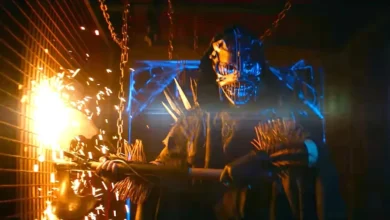
Representing the most polarizing entry in the modern era, 2026’s Evil Dead Burn brought a distinct European sensibility to the franchise under the direction of Sébastien Vaniček and Florent Bernard. Infused with the bleak, uncompromising aesthetics of New French Extremity, Burn earned an immediate reputation as the nastiest and most brutal installment in the series’ history. Chronicling a messy divorce complicated by a husband’s demonic possession and a series of harrowing household atrocities—including an infamous dinner table sequence involving a family pet—the film alienated segments of the fanbase accustomed to Hollywood polish and classic monster-movie pacing. Despite utilizing impressive practical effects mixed with controversial CGI, its cold, relentlessly grim atmosphere ensures its place as an acquired taste within the broader cinematic lineage. -
The Evil Dead (1981)
The foundational milestone that launched a multi-media empire, Sam Raimi’s original feature remains a masterclass in independent filmmaking ingenuity. Operating under extreme financial constraints, Raimi utilized inventive camera angles, frantic tracking shots, and relentless pacing to create an atmosphere of inescapable dread. However, retrospective analysis often highlights the film’s rough edges, dated special effects, and certain controversial narrative choices, such as the infamous tree assault scene. While it successfully established the Kandarian demon mythology and served as an essential proof-of-concept for its director’s technical prowess, subsequent sequels refined the formula to achieve greater artistic and entertainment heights. -
Evil Dead (2013)
Directed by Fede Álvarez, the 2013 franchise reboot successfully proved that the intellectual property could thrive independently of Sam Raimi and Bruce Campbell. Abandoning the comedic undertones of the later trilogy entries, Álvarez delivered a pitch-black, suffocatingly intense survival horror experience anchored by Jane Levy’s powerhouse performance as Mia. Boasting some of the most meticulously crafted and wince-inducing practical gore effects in modern horror history, the film successfully updated the classic cabin-in-the-woods scenario. Despite its technical excellence and box-office success, critics note that its strict adherence to familiar genre beats kept it from forging an entirely unique identity, ultimately prompting subsequent filmmakers to seek out entirely new settings. -
Evil Dead Rise (2023)
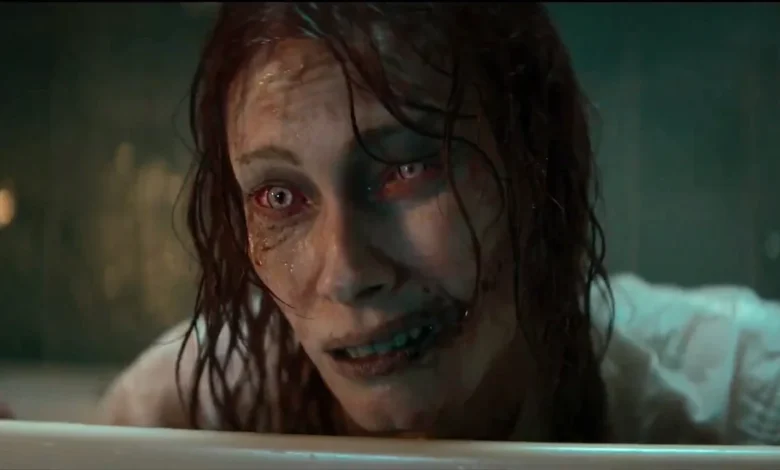
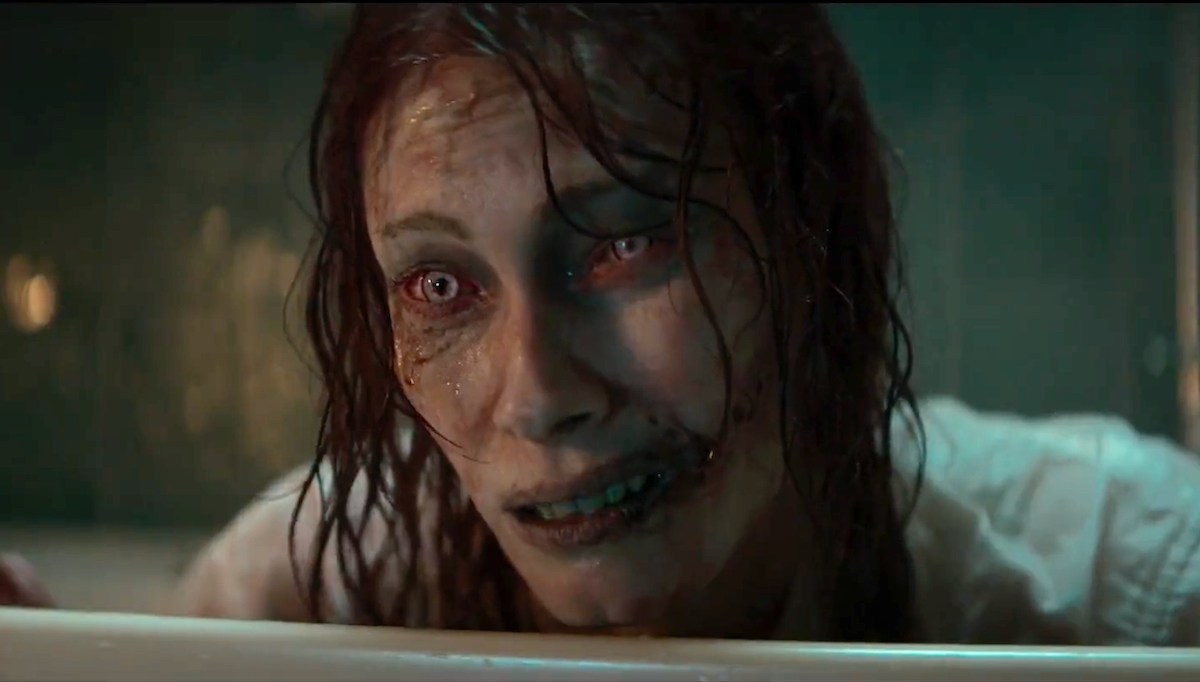
Shifting the demonic plague from isolated woodland retreats to a claustrophobic, crumbling Los Angeles apartment complex, Lee Cronin’s Evil Dead Rise revitalized the franchise by weaponizing domestic space. Alyssa Sutherland delivers a terrifying, physical performance as Ellie, a struggling mother whose sudden possession turns her against her own children and estranged sister. The film excels through its relentless pacing, inventive use of household objects as instruments of horror, and a sharp modernization of ancient mythology. By maintaining a balance between high-concept terror and deep-seated familial dread, Rise stands as a high-water mark for contemporary studio horror. -
Evil Dead II: Dead by Dawn (1987)
Undisputedly holding the top position across nearly all critical evaluations, Evil Dead II is widely regarded as one of the greatest horror-comedy achievements in cinematic history. Taking the basic premise of the original film and amplifying every element exponentially, Raimi transformed a simple cabin into a playground of surreal, grotesque invention. The sequence featuring Ash’s possessed, rebellious hand—culminating in the iconic chainsaw amputation—masterfully bridges physical comedy with body horror. Driven by Bruce Campbell’s career-defining, uninhibited performance, the film achieves a rare, sublime equilibrium between terror and hilarity, setting a gold standard that no subsequent installment has managed to surpass.
Implications and the Future of the Franchise
The enduring vitality of the Evil Dead series offers significant insight into the economics and artistic sustainability of modern horror intellectual properties. Unlike cinematic universes tethered to strict continuity or sprawling superhero mythologies, the Evil Dead franchise thrives on stylistic reinvention. Each filmmaker is permitted to impose a distinct aesthetic signature—ranging from Raimi’s anarchic cartoonishness to Álvarez’s grim realism and Vaniček’s transgressive extremity.
Industry analysts note that this anthology-like flexibility protects the brand from audience fatigue, allowing it to adapt to shifting cultural appetites over four decades. As new directors continue to experiment with the core elements of the Necronomicon and the relentless deadite hordes, the franchise proves that genuine horror, when paired with technical audacity, possesses an indefinite shelf life.