As Saturday Night Live enters its 52nd season, its monumental imprint on American culture and its status as a foundational incubator for generations of comedy stars remain undisputed. Yet, a deeper examination of television history reveals that the legendary NBC sketch comedy franchise’s most enduring contribution to the entertainment industry may not be its own weekly broadcasts, but rather the vibrant, fiercely competitive ecosystem of alternative programs it inadvertently spawned. The release of the Netflix documentary SCTV: The Greatest Show You’ve Never Heard Of brings this dynamic back into sharp focus, offering a timely reminder that much of the boundary-pushing comedy of the late 20th and early 21st centuries exists precisely as a direct reaction to, or rebellion against, the institutional norms of Lorne Michaels’ flagship creation.
The genesis of this competitive landscape dates back to the mid-1970s. When Saturday Night Live launched in 1975 under the stewardship of creator Lorne Michaels, it revolutionized late-night television. Capitalizing on the countercultural energies of the era and featuring prominent Second City Toronto alumni such as Dan Aykroyd and Gilda Radner, the show established a high-wire, live-event spectacle complete with celebrity guest hosts and musical acts. However, the show’s sudden dominance created an immediate artistic pressure cooker, particularly north of the border, where Canadian comedy creators felt an urgent need to carve out their own distinct identities without losing their homegrown talent to the lucrative migration pipeline heading south to New York City.
Chronology of a Creative Schism: The Rise of Alternative Sketch
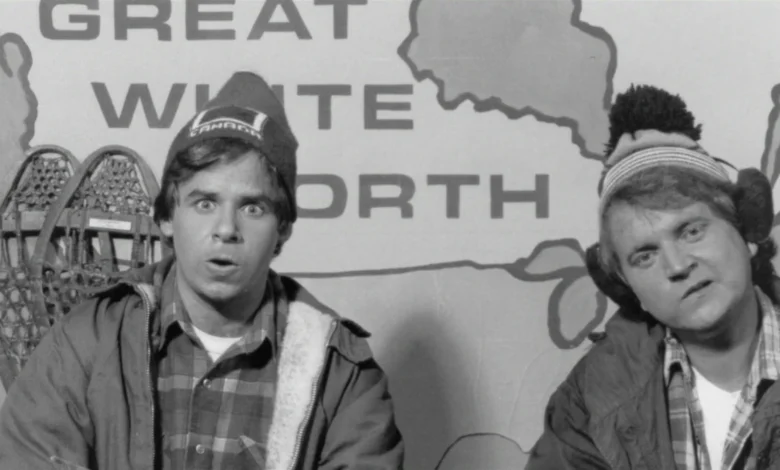
The immediate response to SNL emerged in 1976 with the debut of Second City Television, later known simply as SCTV. While SNL relied heavily on topical New York immediacy, star power, and weekly gimmickry, SCTV operated on an entirely different production and creative wavelength. Taped in Toronto on a smaller scale and entirely devoid of mainstream crossover star hooks, SCTV functioned as an interconnected, deeply satirical deconstruction of cheesy pop culture conventions and media tropes.
Despite operating as a fierce alternative, the talent pipelines between the two shows occasionally collided with awkward results. Archive footage and retrospective interviews highlighted in the Netflix documentary shed light on a notoriously disastrous audition in which Michaels brought in SCTV mainstays John Candy, Joe Flaherty, and Dave Thomas. According to Thomas, the group performed a set for Michaels that was met with stone-faced silence. Candy later recounted the bewildering experience with characteristic humor, suggesting there must have been something physically wrong with Michaels’ throat or that the producer was simply being rude. SCTV co-creator and producer Andrew Alexander noted in the documentary that Candy was deeply stung by the rejection.
Yet, Michaels would forge much more successful collaborations with subsequent generations of Canadian alternative comedy troupes. When Michaels returned to helm SNL during its tumultuous 11th season, he brought Kids in the Hall members Bruce McCulloch and Mark McKinney aboard as staff writers. Although that specific transition proved creatively misaligned, Michaels subsequently produced the troupe’s landmark eponymous sketch series. The Kids in the Hall offered a sensibility that diverged sharply from SNL—daring, structurally dark, and heavily influenced by cinematic aesthetics. Much like SCTV before it, the series failed to secure mainstream ratings dominance, instead cultivating a passionate, almost religious devotion among its audience throughout the early 1990s.
The 1990s: An Era of Internal Turmoil and External Rivals
The 1990s proved to be one of the most perilous decades in SNL’s history. Plagued by high-profile controversies—ranging from the Andrew Dice Clay hosting boycotts and Sinéad O’Connor’s infamous papal photograph tearing incident to a blistering investigative takedown by New York Magazine—the show faced intense internal pressure. Network executives frequently demanded the dismissal of breakout cast members such as Adam Sandler, Chris Farley, and Norm Macdonald, while simultaneously struggling to integrate heavily anticipated alternative talents like Janeane Garofalo, Sarah Silverman, and Chris Rock, many of whom found themselves underutilized or creatively constrained.
This vulnerability opened the floodgates for a wave of external competitors eager to capture the demographic segments alienated by SNL’s shifting institutional priorities.
The Ben Stiller Show, which premiered on Fox in 1992, shared stylistic DNA closer to SCTV than SNL, driven by meticulously directed short-film sketches rather than live studio segments. Stiller had departed the NBC mothership after just four episodes to pursue his cinematic vision. His fellow cast member and writer, Bob Odenkirk, maintained a famously tumultuous tenure as an SNL writer before co-creating the critically acclaimed Mr. Show with David Cross. Featuring an ensemble that included future alternative comedy luminaries such as Scott Aukerman, Brian Posehn, Paul F. Tompkins, Jack Black, and Sarah Silverman, Mr. Show became widely regarded by critics as one of the finest sketch comedy programs in television history.
Concurrently, The State emerged as a subversive, highly influential gem of 1990s cable and network experimentation. Led by creators David Wain and Michael Showalter, The State targeted the exact same young demographic as SNL but injected its sketches with significantly more conceptual bite and absurdist theatricality, laying the groundwork for decades of independent comedy filmmaking.
Challenging the Monopolies: Network and Cable Disruption
While basic cable networks demonstrated an aggressive appetite for boundary-pushing comedy, broadcast networks also mounted direct assaults on NBC’s late-night dominance. In 1990, creator Keenen Ivory Wayans launched In Living Color on Fox. The series deliberately broadened the scope of a genre that had historically marginalized non-white performers and writers. Starring members of the Wayans family—including Damon Wayans, who had previously been dismissed from SNL—alongside David Alan Grier and Jim Carrey, In Living Color captured the cultural zeitgeist for audiences under the age of thirty.
The commercial implications of these rivalries became starkly evident in talent retention. Jim Carrey, who had failed to secure a cast position at SNL despite multiple auditions, leveraged In Living Color into a trajectory that made him one of the highest-paid box-office stars globally. Simultaneously, Adam Sandler and Chris Rock transitioned from their abrupt SNL exits into cinematic superstardom and industry-defining stand-up careers, proving that the established pipeline was no longer the sole arbiter of comedy success.
Seeking to replicate Fox’s counter-programming strategy, MADtv debuted in the mid-1990s as a direct Saturday-night competitor to SNL at 11:00 p.m. Although the series ran for an impressive 14 seasons and successfully launched the careers of Keegan-Michael Key and Jordan Peele—who would later redefine the sketch genre with Key & Peele—it rarely achieved the critical prestige of its peers. Nonetheless, its prolonged presence served as an ongoing operational pressure point for Michaels’ production team.
The Virality Era: Chappelle, Robinson, and the Modern Landscape
As the television landscape transitioned into the 21st century, the definition of sketch comedy shifted dramatically away from the weekly studio-audience format. Chappelle’s Show arrived on Comedy Central in 2003, echoing the provocative, culturally fearless comedy of SNL’s earliest years while generating unprecedented word-of-mouth momentum via pre-digital viral sketches such as Clayton Bigsby, The Player Haters’ Ball, and Charlie Murphy’s True Hollywood Stories. The show achieved cultural permeation through material that conservative broadcast standards departments would likely have rejected.
A similar dynamic defines contemporary alternative success stories, such as former SNL cast member Tim Robinson’s I Think You Should Leave on Netflix. Leaning heavily into acute social awkwardness, rapid-fire absurdity, and hyper-specific meme culture, Robinson’s series occupies a cultural space that mainstream broadcast institutions struggle to replicate. In an era where media consumption is increasingly atomized, niche appeal often confers a level of artistic cachet that broad-audience variety shows find difficult to attain.
Implications for the Future of Broadcast Comedy
Critics and industry analysts note that SNL currently finds itself in a transitional phase. As traditional broadcast television contends with streaming flexibility, digital-first content creators, and the challenges of satirizing a political climate that frequently defies parody, the show has occasionally relied on stunt casting, commercial tie-ins, and formulaic structural tropes. By contrast, its international counterparts, such as the UK spinoff formats, frequently demonstrate a nimbler comedic voice.
Yet, cultural historians argue that viewing SNL solely through the lens of its current output or its internal missteps misses its most vital structural contribution. Just as David Letterman’s Late Night served as a chaotic, rule-breaking reaction to Johnny Carson’s Tonight Show—ultimately transforming the entire talk show genre—the broader ecosystem of 20th and 20th-century sketch comedy might never have flourished without an established, dominant institution to rebel against.
The legacy of Saturday Night Live is thus inextricably bound to the counter-narratives it unintentionally provoked. By serving as both a gold standard and a creative foil, SNL catalyzed a half-century of comedy evolution, ensuring its impact extends far beyond the confines of Studio 8H.