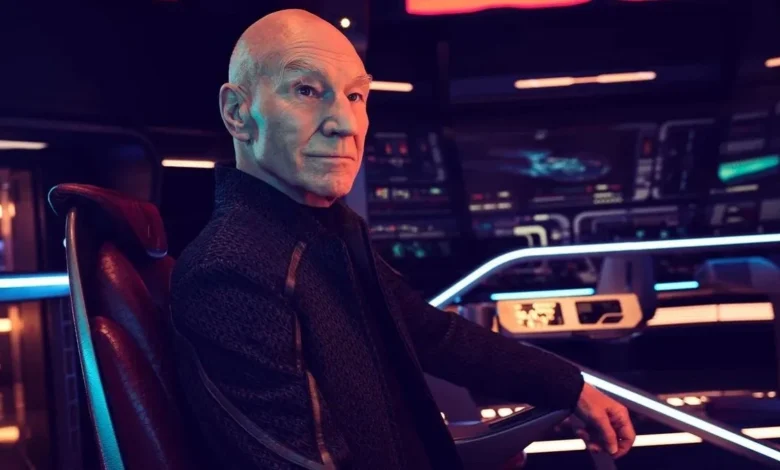
The loss of Sir Patrick marks the end of a transformative era in both classical theater and modern science fiction. His family released a poignant statement regarding his final hours, noting that he was surrounded by the warmth of loved ones, accompanied by live music, and held in the comfort of those who admired his profound contributions to the arts.
A Legacy Forged in Resilience
Born on July 13, 1940, in Mirfield, Yorkshire, England, Stewart’s early life was marked by the shadows of domestic instability. Growing up as the youngest of three children in a home marred by his father’s violence, Stewart frequently cited acting as an essential outlet for his childhood trauma. This early exposure to the necessity of performance would eventually evolve into a professional dedication to the craft, starting with his training at the Bristol Old Vic Theatre School.
By the age of 26, Stewart had secured a place with the Royal Shakespeare Company (RSC). It was here that he cultivated the commanding stage presence and precise elocution that would become his trademark. During the 1960s and 1970s, he became a pillar of British theater, earning acclaim for his roles in plays such as Antony and Cleopatra, The Tempest, and Hamlet. His transition to international recognition began in earnest with his performance as Sejanus in the 1976 BBC production of I, Claudius, which introduced his unique gravitas to American television audiences.
Chronology of an Iconic Career
Stewart’s filmography reflects a rare versatility, moving seamlessly between high-concept science fiction and the works of William Shakespeare.

- 1966: Joins the Royal Shakespeare Company, beginning a lifelong association with the Bard.
- 1976: Gains international attention for I, Claudius.
- 1981-1984: Appears in cinematic cult classics including Excalibur and David Lynch’s Dune.
- 1987: Debuts as Captain Jean-Luc Picard in Star Trek: The Next Generation. Despite initial resistance from studio executives who questioned the casting of a bald, classically trained British actor, the series becomes a cultural phenomenon.
- 2000: Debuts as Professor Charles Xavier in Bryan Singer’s X-Men, cementing his status as a titan of the burgeoning superhero genre.
- 2013: Marries Sunny Ozell, with long-time friend and collaborator Sir Ian McKellen officiating the ceremony.
- 2020-2023: Returns to the role of Jean-Luc Picard in the acclaimed series Star Trek: Picard.
- 2025: Completes filming for Avengers: Doomsday, marking his final cinematic appearance as Charles Xavier.
The Star Trek Phenomenon
Perhaps no role defined Stewart’s career as significantly as Captain Jean-Luc Picard. When the actor was first considered for The Next Generation, series creator Gene Roddenberry was famously hesitant, preferring a more traditional leading man. Bob Justman, a producer who had seen Stewart perform Shakespeare at UCLA, insisted that Stewart’s intellectual depth was exactly what the franchise required.
The resulting character became an archetype for the modern hero—thoughtful, diplomatic, and deeply moral. Stewart portrayed Picard for seven seasons and 178 episodes, followed by four feature films that culminated in 2002’s Star Trek: Nemesis. His return to the character in the Picard series allowed him to explore the twilight years of the legendary Starfleet officer, providing a thematic bookend to a role that defined television science fiction for a generation.
Marvel and the Professor Xavier Era
If Star Trek made him a household name, the X-Men franchise made him a cinematic icon for the 21st century. As Professor Charles Xavier, Stewart brought a sense of pathos and authority to the superhero genre that was largely absent at the time. His portrayal was widely praised for grounding the fantastical elements of the X-Men universe in the human experience.
His partnership with Sir Ian McKellen, who played the antagonist Magneto, became one of the most celebrated professional pairings in modern Hollywood. Their friendship transcended the screen, becoming a symbol of enduring camaraderie in the industry. The upcoming release of Avengers: Doomsday will serve as a final, bittersweet opportunity for audiences to witness the two legends sharing the screen one last time.
Clinical Context: Alzheimer’s and Lewy Body Dementia
The disclosure of Stewart’s diagnosis—Alzheimer’s disease coupled with Lewy Body Dementia—sheds light on the rapid, aggressive nature of these neurodegenerative conditions. Lewy Body Dementia, in particular, is often characterized by fluctuations in cognition, visual hallucinations, and motor impairments, which can make the demands of professional acting—such as memorization and complex blocking—extraordinarily difficult.

Medical experts note that the progression of these diseases is often unpredictable. The fact that Stewart was able to complete his work on Avengers: Doomsday while contending with these symptoms is a testament to his professional rigor and, perhaps, the therapeutic role that his work continued to play in his life. The acting community has responded with an outpouring of tributes, with many colleagues highlighting his work ethic, his kindness toward younger actors, and his unyielding commitment to the theater.
Broader Impact and Implications
Sir Patrick Stewart’s influence extends far beyond the scripts he read. As a knighted actor, he was a vocal advocate for arts education and a champion of various social causes, including his work with Amnesty International and his advocacy for domestic violence survivors, a cause rooted in his own traumatic upbringing.
His passing leaves a significant void in the industry. As the entertainment landscape shifts toward digital performances and heavy reliance on visual effects, Stewart remained an anchor for traditional, character-driven acting. He proved that an actor could transition from the intimate boards of the RSC to the massive soundstages of Marvel without sacrificing the integrity of his craft.
Industry analysts suggest that Stewart’s death will likely trigger a retrospective analysis of his career, with streaming platforms and theaters expected to host tributes honoring his Shakespearean roots and his sci-fi contributions. For the fans who grew up watching him on the bridge of the Enterprise or in the halls of Xavier’s School for Gifted Youngsters, his departure represents the loss of a mentor figure, both on and off the screen.
Final Reflections
In his memoirs and interviews, Stewart frequently discussed his fear of retirement, noting that he could never imagine a life without the challenge of a new role. His decision to continue working, even as his health began to decline, was not merely a career choice but a lifestyle. He remained a man of the theater until the very end, viewing every performance as an opportunity to connect with an audience.

As the industry mourns, the focus remains on the immense body of work he leaves behind. From his early, searing portrayals of Shakespearean villains to his final, authoritative performances as a telepathic mutant leader, Sir Patrick Stewart’s legacy is defined by an unwavering dedication to the truth of human emotion. He elevated the science fiction genre, brought prestige to comic book adaptations, and remained a formidable force in the arts for nearly 60 years.
While the world of entertainment is undeniably diminished by his absence, the characters he brought to life—Picard, Xavier, and so many others—remain, ensuring that his voice, his posture, and his distinct, commanding presence will continue to resonate with audiences for decades to come. The family has requested privacy as they navigate this transition, though they have expressed gratitude for the "outpouring of love" from the global community that admired the man who, in his own words, viewed every day as an opportunity to be "a little better than the day before."