The landscape of holiday-themed horror cinema has long relied on a predictable set of tropes: homicidal interpretations of Saint Nicholas, weaponized candy canes, and vengeful elves laying waste to unsuspecting suburbia. However, the international horror canon continues to expand through unconventional regional entries that subvert established expectations. Ilja Rautsi’s Finnish feature Red Snow (Punaista lunta) introduces a distinctively dark, blood-soaked variation to the seasonal slaughter subgenre by blending domestic dysfunction, pitch-black Nordic comedy, and a decidedly unglamorous vampiric threat.
Rather than adhering to the traditional slasher blueprint or the sparkling romanticism popularized by modern fantasy franchises, Rautsi’s film delivers a cynical, surreal examination of familial friction set against a backdrop of winter isolation. With a narrative that balances character-driven psychological tension with grotesque practical and digital creature effects, Red Snow positions itself as a notable entry in contemporary international genre filmmaking, offering a biting critique of holiday societal pressures.
Main Facts and Narrative Premise
At the core of Red Snow is Johanna, portrayed by Anni Iikkanen, an emotionally detached teenager thoroughly immersed in the glittering fantasy worlds of vampire literature as a coping mechanism for her bleak domestic reality. Her father, Jukka—played by Kari Hietalahti—is a self-important corporate consultant who insists on pushing forward with a holiday gathering and plans to remarry, ignoring his daughter’s vocal protests. With Johanna’s mother entirely out of the picture and offering minimal maternal support, the family travels to a remote grandmother’s house where Jukka has organized a holiday surprise.
Complications arise when a contracted holiday entertainer, summoned via a mobile application to brighten the festive mood, is intercepted and replaced by Martti, a middle-aged, out-of-shape vampire masquerading in a Santa suit. Played by Hannu-Pekka Björkman, Martti defies conventional vampire archetypes. Instead of the suave, aristocratic predators popularized in classic cinema or the brooding heartthrobs of contemporary teen fiction, Martti bears the physical reality of a post-middle-aged tradesman, complete with a prominent beer belly, receding hairline, and grotesque physiological mutations.
The narrative deepens when Martti is tracked to the household by Kaarlo, a suicidal, Van Helsing-esque hunter portrayed by Tommi Korpela, alongside his nihilistic home-nurse accomplice, Hoitsu, played by Krista Kosonen. Armed with a skull-decorated stake cannon, Kaarlo brings absolute chaos to the domestic retreat, inadvertently arming Johanna’s young brother, Joni, with a firearm while Martti systematically isolates the family members as prey.
Chronology and Escalation of Events
The progression of events in Red Snow moves from an uneasy family gathering to surreal, unmitigated violence. The timeline of the film’s central conflict unfolds through escalating layers of intrusion and psychological deterioration:
- The Domestic Departure: Jukka forces his estranged children into a holiday trip to his mother’s remote estate, ignoring Johanna’s alienation and his own structural failure as a single parent.
- The Interception: The digital-age Santa Claus service worker is ambushed on route by Martti, who assumes the disguise to infiltrate the family gathering under the guise of festive cheer.
- The Intrusion and Subversion: Martti enters the household, instantly dismantling Johanna’s romanticized notions of immortality and vampirism through his abject physical reality and predatory demeanor.
- The Hunter’s Arrival: Kaarlo and Hoitsu breach the premises with heavy weaponry and a relentless mission, shifting the dynamic from a quiet psychological infiltration into a multi-sided siege.
- The Climax of Carnage: The narrative culminates in widespread devastation, juxtaposing horrific violence against innocent bystanders with the banal commercialism of children opening presents, ultimately ending in a violent confrontation between the vampire and his pursuers.
Character Dynamics and Subversive Themes
Rautsi’s screenplay uses the vampire metaphor not merely as a vehicle for jump scares, but as a lens to examine domestic decay and generational friction. Johanna’s initial attraction to Martti stems from her disillusionment with her father, Jukka, whose behavior throughout the film exposes deep-seated misogyny, cowardice, and self-absorption. When Martti offers an alternative to her mundane existence, the film explores complex themes of agency, isolation, and the morbid curiosity of youth.
Conversely, Kaarlo represents the burnout and single-minded obsession of the traditional monster hunter, indifferent to collateral damage as long as his target is eliminated. Characters like Jukka’s new partner, Nhung (Marja-Liisa Nguyen), find themselves caught in a web of psychological manipulation and sudden violence, demonstrating that the human characters are often just as monstrous as the supernatural entity preying upon them.
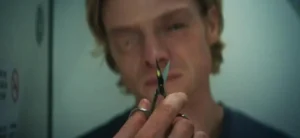
The creature design further emphasizes this subversion. Rejecting standard aesthetic conventions of cinematic vampires, Martti’s feeding mechanism involves a surreal, phallic, tentacled spike that erupts from his face. This visceral, slimy imagery bridges body horror with dark psychological satire, inviting comparisons to contemporary grotesque creature features while maintaining a distinctly Finnish brand of gallows humor.
Production Background and Genre Context
The emergence of Red Snow follows a growing tradition of Nordic horror films that successfully merge regional folklore and bleak existential comedy with high-production-value genre tropes, following in the footsteps of features like Rare Exports. Finnish cinema has increasingly found international audiences by subverting familiar global mythologies through a lens of deadpan realism and unflinching bleakness.
Director Ilja Rautsi, known for his work within the dark comedy and horror spaces, constructs a deliberately abrasive tone. The film does not shy away from intense gore, limb-ripping aggression, and cynical social commentary. This unapologetic harshness is balanced by moments of black comedy, though the tonal friction between broad satire and graphic violence requires a specific audience appreciation for extreme cinema.
Critical Analysis and Industry Implications
From an analytical standpoint, Red Snow contributes significantly to the evolution of the Christmas horror subgenre. By moving away from the conventional slasher template, the film demonstrates how classic monster tropes can be modernized to reflect contemporary anxieties regarding family structures, digital isolation, and the commercialization of tradition.
However, the film’s sharp tonal shifts may polarize viewers. The bleakness of the humor and the absurdity of the sensationalist plot points demand a tolerance for narrative dissonance. Despite these potential hurdles, Rautsi’s willingness to swing for ambitious thematic and visual goals establishes the project as a notable achievement in modern independent horror.
As distribution strategies continue to shift toward specialty streaming platforms—with Red Snow slated for release via genre-focused services such as Shudder—international horror titles of this caliber continue to secure dedicated global audiences. By prioritizing uncompromising creature design, psychological depth, and pitch-black satire over safe, commercial formulas, Red Snow offers a refreshing, if punishing, addition to the holiday horror canon.