The Golden Age of comic books continues to serve as an extraordinary historical lens reflecting the anxieties, politics, and psychological mobilization of the American public during the Second World War. A prime example of this medium mirroring geopolitical reality is now making waves in the vintage collecting market. A high-grade, CGC-certified copy of Daredevil Comics #8, published by Lev Gleason in March 1942, is currently heading to auction. Featuring exceptional creative contributions from industry heavyweights Charles Biro and Jerry Robinson, this historic issue tackles the complex, insidious threats of wartime domestic propaganda, fifth-column subversion, and government censorship. As collectors and historians examine the piece ahead of its appearance in Heritage Auctions’ upcoming Golden Age Century Comics Showcase Auction, the issue stands out not merely as a rare collectible, but as a fascinating cultural artifact of a nation confronting psychological warfare on its own soil.

The Historical Context: The Home Front and the German-American Bund
To fully appreciate the significance of Charles Biro’s lead story in Daredevil Comics #8, one must understand the domestic climate of the United States in the early months of 1942. Following the Japanese attack on Pearl Harbor on December 7, 1941, and the subsequent declarations of war, the United States was in a state of high alert. However, the threat of foreign aggression was not limited to overseas battlefields; federal authorities and the American public were acutely aware of domestic subversion, particularly from fascist-leaning organizations operating openly within U.S. borders.
Chief among these organizations was the German-American Bund, an pro-Nazi group that promoted anti-Semitic ideology, staged rallies, and operated youth indoctrination camps across the United States. According to historical documentation from the United States Holocaust Memorial Museum, the Bund actively worked to keep the United States out of the European conflict while fostering Nazi sympathies domestically. By early 1942, the federal government was actively cracking down on these elements, prosecuting its leaders for failing to register as foreign agents and clamping down on subversive activities.

It is against this tense backdrop that Charles Biro—writing and illustrating the lead feature for Daredevil Comics #8—crafted a narrative directly ripped from contemporary headlines. In the story, Daredevil is tasked with combating a sophisticated campaign of deceptive media designed to ignite a violent domestic insurrection. The antagonists utilize printing presses to churn out seditious literature, deploy clandestine radio broadcasts, sever crucial telephone and telegraph lines, and disrupt police communications to manufacture widespread panic and social fracture.
Biro’s narrative does not shy away from the darker realities of the Bund’s ideology. In a particularly striking sequence within a fictionalized Bund camp, a newly recruited member is subjected to harsh disciplinary punishment due to his ancestry, with camp leaders explicitly threatening him with deportation to Germany. The villainous leader, a thinly veiled caricature named Herr Herring, proudly keeps a copy of Adolf Hitler’s Mein Kampf prominently displayed on his desk. The psychological reach of the villains’ propaganda even extends to military installations, with subversive leaflets distributed at Camp Dix in a direct attempt to incite insubordination among American servicemen.

The plot thickens when a courageous teenager working alongside Daredevil to infiltrate the camp is captured. However, the youth’s refusal to comply with fatal orders ultimately causes the villains’ scheme to unravel from within. Teaming up with the young operative, Daredevil confronts Herr Herring directly, dismantling the operation and neutralizing the domestic terror cell. Through this action-packed framework, Biro successfully translated the very real, terrifying prospect of fifth-column infiltration into an accessible narrative for young readers, effectively aligning comic book heroism with national security awareness.
Jerry Robinson, the BBC, and the Battle Over Information Control
While Charles Biro focused his lens on domestic subversion and physical sabotage disguised as free speech, legendary artist Jerry Robinson explored a vastly different facet of wartime information control: state censorship and the power of broadcasting. In Robinson’s backup feature, the costumed hero London operates under the civilian identity of Marc Holmes, a prominent commentator for the British Broadcasting Corporation (BBC).

Holmes uses his formidable platform to take a courageous public stand against high-ranking political figures who favor appeasement—individuals he believes are actively impeding Britain’s war effort from within. This journalistic defiance immediately puts him at odds with the British Ministry of Information, which threatens to prohibit his broadcasts entirely. Undeterred by government edict, Holmes defies the censors and takes to the airwaves regardless.
This narrative thread draws clear inspiration from the real-world implementation of the censorship protocols established under Britain’s 1939 Emergency Powers Act. The Act gave the government sweeping authority to control the flow of information, regulate the press, and suppress commentary deemed harmful to national morale or military objectives. A particularly direct historical parallel can be found in the career of J.B. Priestley, a celebrated novelist, screenwriter, and wartime BBC commentator. Priestley’s immensely popular Postscripts radio broadcasts captivated millions of listeners across the United Kingdom, offering comforting yet socially progressive commentary. However, creative friction with government officials and the Ministry of Information ultimately led to Priestley voluntarily ending his first series in 1940, while heavy-handed intervention brought his subsequent broadcasting efforts to a halt in 1941.

In Robinson’s comic, the friction between free expression and wartime censorship has immediate, dangerous consequences. A nefarious saboteur dispatched by Adolf Hitler, a villain known as "The Boar," seizes upon the public controversy surrounding Holmes’s silenced broadcast. The Boar exploits the tension by generating a forged Ministry of Information summons, using bureaucratic authority as bait to draw Holmes into a perilous trap. The story brilliantly illustrates the dual-edged sword of information in wartime: while truthful broadcasting is essential to democratic resilience, the rigid machinery of censorship can inadvertently create vulnerabilities that malicious actors are eager to exploit.
CGC Census Data, Market Valuation, and Rarity
The convergence of masterwork storytelling, significant historical themes, and top-tier Golden Age creators makes Daredevil Comics #8 a prized target for serious vintage paper collectors. Gracing the market at a time when historical comic books documenting World War II home-front narratives are experiencing heightened appreciation, this specific issue holds a secure place in comic book history.

According to the Certified Guaranty Company (CGC) census, Daredevil Comics #8 is an exceptionally scarce commodity. There are only 16 Universal-grade copies recorded in the CGC census database. Of those rare surviving copies, just three are graded at a very fine 6.5, with only two known examples holding a higher numerical grade. This level of scarcity guarantees intense competition whenever a well-preserved copy changes hands.
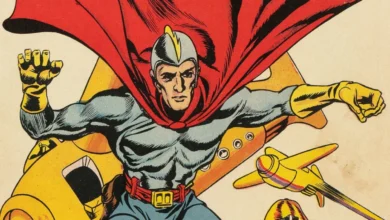
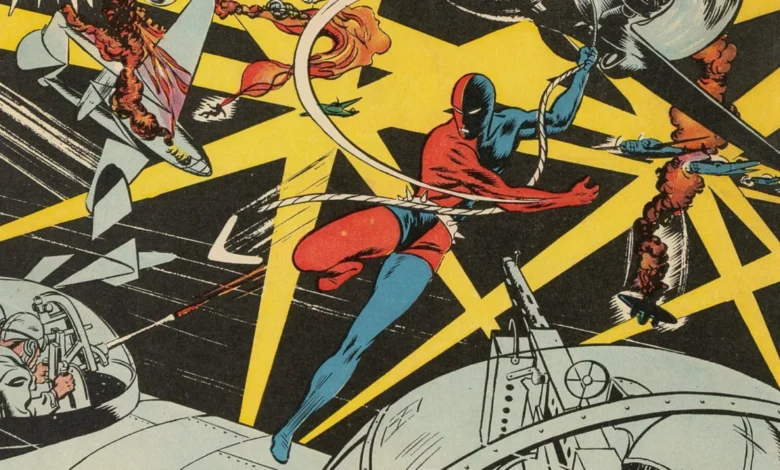
The copy heading to auction via Heritage Auctions is a CGC FN+ 6.5, featuring desirable off-white to white pages. Encapsulated and preserved in solid condition, the book presents vivid colors on Charles Biro’s iconic cover, which depicts Daredevil balancing precariously on the fuselage of an aircraft amid fiery aerial combat, complete with the visual iconography of the era. The issue is scheduled to cross the auction block on November 5, 2026, as part of the Golden Age Century Comics Showcase Auction #40378.

Broader Implications and Legacy
The pairing of Charles Biro and Jerry Robinson within the pages of a single comic book offers modern analysts and cultural historians a unique window into how the creative community processed the monumental shifts of the Second World War. Rather than merely offering mindless escapism, books like Daredevil Comics #8 engaged directly with the ideological battles defining the global conflict.
Biro’s exploration of the German-American Bund’s propaganda machine warned readers that the battle lines were not confined to the beaches of Normandy or the skies over Europe, but existed locally through pamphlets, radio waves, and the deliberate manufacturing of social division. Conversely, Robinson’s exploration of Marc Holmes and the Ministry of Information introduced nuance regarding the fragile balance between national security and the preservation of free speech—a debate that remains vital in times of national crisis.

As vintage paper collecting continues to evolve into a recognized discipline of cultural preservation, issues like Daredevil Comics #8 transcend financial valuations. They serve as tangible reminders of an era when ink and paper were deployed on the ideological front lines, and when comic book creators used their storytelling platforms to educate, mobilize, and steady a nation facing its darkest and most defining hour.