The landscape of American comic books underwent a profound transformation during the Second World War, as publishers, editors, and creators grappled with a shifting national psyche, wartime paper shortages, and the pressing demand for patriotic morale-boosting content. Nowhere was this philosophical shift more transparently articulated than in the pages of Holyoke Publishing’s popular Golden Age title, Cat-Man Comics. In the July 1942 issue, Cat-Man Comics #12, artist and editor Charles M. Quinlan used his editorial platform to lay down a definitive manifesto regarding the future of the series. Eschewing the growing trend of god-like, interplanetary, and magical caped crusaders, Quinlan officially drew a line in the sand: when it came to costumed adventurers, he favored the grounded, gritty realism of characters styled after Batman over the supreme omnipotence of figures like Superman.

Today, this pivotal issue stands as a remarkable artifact of Golden Age publishing history, capturing a precise moment when the comic book industry pivoted away from pure escapist fantasy to address the sobering realities of global conflict. For vintage paper collectors and historians alike, Cat-Man Comics #12 represents a crucial turning point. A high-grade CGC FN- 5.5 copy of the Continental 1942 edition, featuring cream to off-white pages and showcasing a classic Quinlan cover, has headed to auction as part of the November 5, 2026, Golden Age Century Comics Showcase Auction #40378 hosted by Heritage Auctions.
Charles M. Quinlan and the Wartime Mandate for Realism
To understand the weight of Quinlan’s editorial decision in Cat-Man Comics #12, one must examine the broader cultural and industrial landscape of the United States in mid-1942. Just months after the December 7, 1941, attack on Pearl Harbor plunged the nation into World War II, nearly every facet of American industry was forced to re-evaluate its output. The publishing sector was no exception, facing strict rationing of paper, ink, and metal printing plates, alongside an increasing societal expectation that mass media should contribute positively to civilian morale and national defense.

In his signed editorial titled Says, the Editor!, Quinlan addressed these sweeping industrial adjustments directly, transitioning smoothly from macroeconomic wartime shifts to the editorial direction of his own publications, which included Cat-Man Comics and its companion title, Captain Aero. With unflinching candor, Quinlan declared that the era of the unfettered, ultra-powerful protagonist was drawing to a close under his watch.
"Heroes of a too fantastic nature and super human qualities are out; only those characteristics which are within the realm of possibility can be considered satisfactory material for this unusual publication," Quinlan wrote. He further distanced his creative vision from competitors who relied on sensationalism, maintaining that intelligent, grounded reading material would ultimately prevail in the long run.

While Quinlan acknowledged that the competition’s high-octane sensationalism might yield short-term success, he doubled down on his commitment to "real human characters," lifelike artwork, and stories designed to steel the nerves of a nation at war. This editorial stance was not entirely abrupt; Quinlan had been deeply involved with the Cat-Man series from its inception as an artist and early editor. However, issue #12 codified a creative philosophy that reshaped the title’s roster and narrative trajectory moving forward.
The Batman Versus Superman Dichotomy in Golden Age Publishing
Quinlan’s preference for grounded vigilantism over cosmic super-powered beings mirrors a broader creative dichotomy that defined the earliest days of the comic book medium. Following the explosive debut of Superman in Action Comics #1’s 1938 debut, comic publishers scrambled to introduce their own iterations of powerful champions. However, the subsequent introduction of Batman in Detective Comics #27 (1939) and his further fleshing out in 1940 established a viable alternative template: the mortal hero who relied on physical conditioning, detective skills, tactical ingenuity, and specialized equipment rather than invulnerability or extraterrestrial origin.

In the context of World War II, this distinction carried heavy thematic weight. Readers living under the constant threat of global warfare, air-raid drills, and the loss of loved ones overseas often found greater emotional resonance in mortal heroes who struggled, bled, and triumphed through human grit.
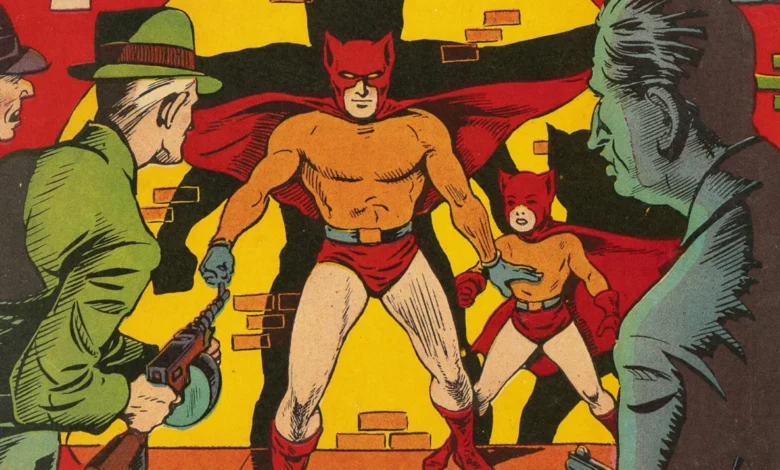
The visual presentation of Cat-Man Comics #12 reinforces Quinlan’s ideological preference. The issue’s striking spotlight cover, illustrated by Quinlan himself, depicts the titular heroes Cat-Man and Kitten cornered by a cadre of armed men. The composition bears a distinct thematic kinship to iconic covers of the era, such as Bob Kane and Jerry Robinson’s work on Batman #9. The emphasis is on tangible, terrestrial danger—gangsters, spies, and saboteurs—rather than abstract, mystical threats. By championing characters whose capabilities remained within the "realm of possibility," Quinlan successfully aligned his flagship title with the psychological needs of a wartime readership looking for relatable champions of justice.

Casualties of the New Policy: The Phase-Out of Superpowered Characters
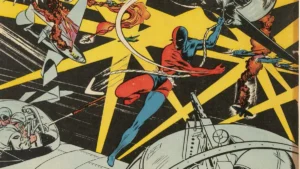
Quinlan’s strict adherence to plausibility had immediate, tangible consequences for the internal roster of Cat-Man Comics. The most notable casualty of this editorial pivot was Volton, an electrically-powered superhero who had been introduced just four issues prior in Cat-Man Comics #8. Created by the legendary Joe Kubert, Volton possessed abilities that placed him squarely in the camp of the "too fantastic" beings Quinlan sought to purge. The character’s installment in issue #12, illustrated by Sol Brodsky, marked his final appearance in the series.
Similarly, other mystical or high-concept features were quietly phased out. The magic-based Pied Piper feature, for instance, had already been wound down by issue #9. To fill the narrative void left by these departing superhumans, Holyoke Publishing began pivoting toward stories rooted in tangible reality. Beginning with issue #13, the publication introduced a dedicated section titled "Personal Adventure," which focused heavily on "true life" narratives and grounded human drama.

Infusing Reality: True-Life Wartime Heroism in Issue #12
Even within the pages of Cat-Man Comics #12, this transition toward realism was already well underway. A prime example is the one-page true-life feature titled One Man Navy, masterfully illustrated by Eddie Murphy. The feature celebrated the incredible real-world heroism of Lieutenant John D. Bulkeley and his pivotal role in executing General Douglas MacArthur’s daring evacuation from the Philippines, which had commenced on March 11, 1942.
Bulkeley’s exploits commanding Motor Torpedo Boat Squadron 3 had dominated front-page newspaper headlines across the United States throughout March 1942, capturing the public imagination during a dark period of early Pacific theater setbacks. By incorporating these ripped-from-the-headlines military triumphs into a comic book format, Quinlan and his creative team bridged the gap between escapist entertainment and vital wartime journalism. While the comic version presented Bulkeley’s exploits in a condensed, dynamic visual format, historical archives—such as those maintained by the Naval History and Heritage Command—document the full, extraordinary scope of Bulkeley’s Medal of Honor-worthy service.

Rarity, CGC Census Data, and Collector Appeal
From a modern numismatic and comic-collecting perspective, Cat-Man Comics #12 holds a coveted position of esteem. Golden Age superhero books published by minor houses like Holyoke Publishing often suffered from abysmal survival rates, as millions of copies were either recycled during wartime paper drives or simply read to pieces by enthusiastic children.
Data from the Certified Guaranty Company (CGC) census illustrates the extreme scarcity of this particular issue. Currently, there are only 22 Universal copies of Cat-Man Comics #12 recorded on the CGC census across all grades. This low population reflects the inherent difficulty in locating surviving vintage copies in respectable condition.

The copy slated for the November 5, 2026, Heritage Auctions event—graded CGC FN- 5.5 with cream to off-white pages—sits near the very top of the book’s known census distribution. With only three copies graded at a 5.5 and a mere two copies holding higher technical grades, the offering represents an extraordinary acquisition opportunity for serious collectors of Golden Age keys and wartime propaganda-adjacent paper.
Historical Implications and Legacy
The editorial realignment instituted by Charles M. Quinlan in Cat-Man Comics #12 offers modern researchers a fascinating window into the micro-decisions that shaped the Golden Age of comic books. At a time when publishers could easily have retreated entirely into mindless escapism or succumbed to the pressure of imitating industry titans like Superman, Quinlan chose a middle path. He doubled down on human agency, moral fortitude, and narrative plausibility.

By easing out superpowered anomalies like Volton in favor of grounded vigilantism and real-world military heroism, Cat-Man Comics successfully navigated the turbulent waters of World War II publishing. The legacy of issue #12 endures not only as a high-water mark for Quinlan’s artistic and editorial career but also as a testament to the medium’s capacity to reflect, engage, and strengthen a nation facing its greatest historical trial. As this premier CGC 5.5 copy heads to the auction block, it serves as a physical reminder of an era when comic book editors viewed their ink and paper not merely as commodities for entertainment, but as vital instruments of national morale.