Epic Games CEO Tim Sweeney accuses Steam of holding back the gaming industry through its restrictive Steamworks ecosystem

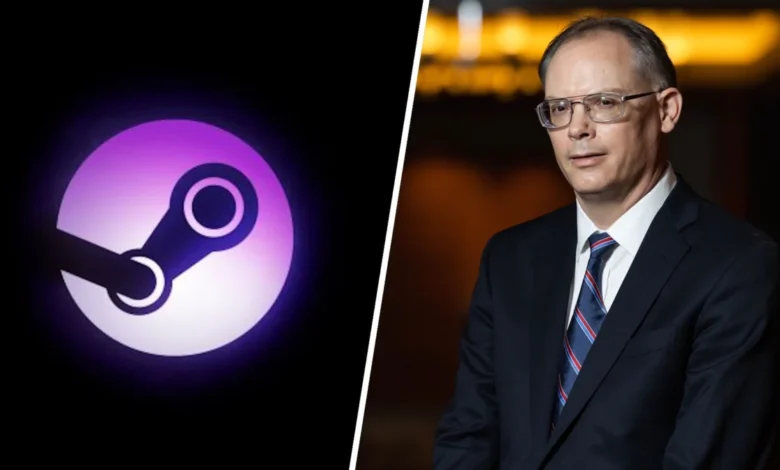
The long-standing tension between Epic Games and Valve Corporation reached a new intensity this week as Epic Games CEO Tim Sweeney launched a pointed critique against Steam, the world’s most dominant PC gaming storefront. In a series of social media exchanges, Sweeney alleged that Valve’s reliance on its proprietary "Steamworks" suite has stifled the industry by creating a "social walled garden" that isolates players from broader cross-platform communication and competition. This latest salvo highlights a fundamental philosophical and business divide between the two companies, touching on issues of revenue sharing, platform interoperability, and the future of digital distribution.
The Catalyst for Conflict
The controversy began with a public discussion initiated by Kiaran Ritchie, a former principal animation programmer at Epic Games. Ritchie argued that the standard 30% revenue share taken by major platforms like Steam is an archaic model that disadvantages developers. He suggested that building a distribution alternative is technically trivial in the modern era, citing the relative ease of managing server infrastructure and bandwidth compared to the early 2000s.
"You could vibe code a Steam alternative in a week," Ritchie posted on X (formerly Twitter). "The industry is in desperate need of a distribution platform that allows developers to keep their revenue."
Ritchie’s critique resonated with Sweeney, who has spent the better part of a decade challenging the business practices of major digital storefronts, most notably Apple’s App Store and Google’s Play Store, as well as Valve’s Steam. Sweeney’s intervention shifted the focus from distribution costs to the technical and social infrastructure provided by Steamworks. He argued that while Steam’s storefront is the point of sale, its true "lock-in" effect is the reliance on Steamworks, a collection of services that developers integrate into their games to handle features like matchmaking, achievements, and cloud saves.
The Argument Over "Walled Gardens"
Sweeney’s core contention is that Steamworks functions as a closed ecosystem. By integrating these tools, developers effectively bind their games to the Steam platform, often at the expense of seamless cross-platform functionality.
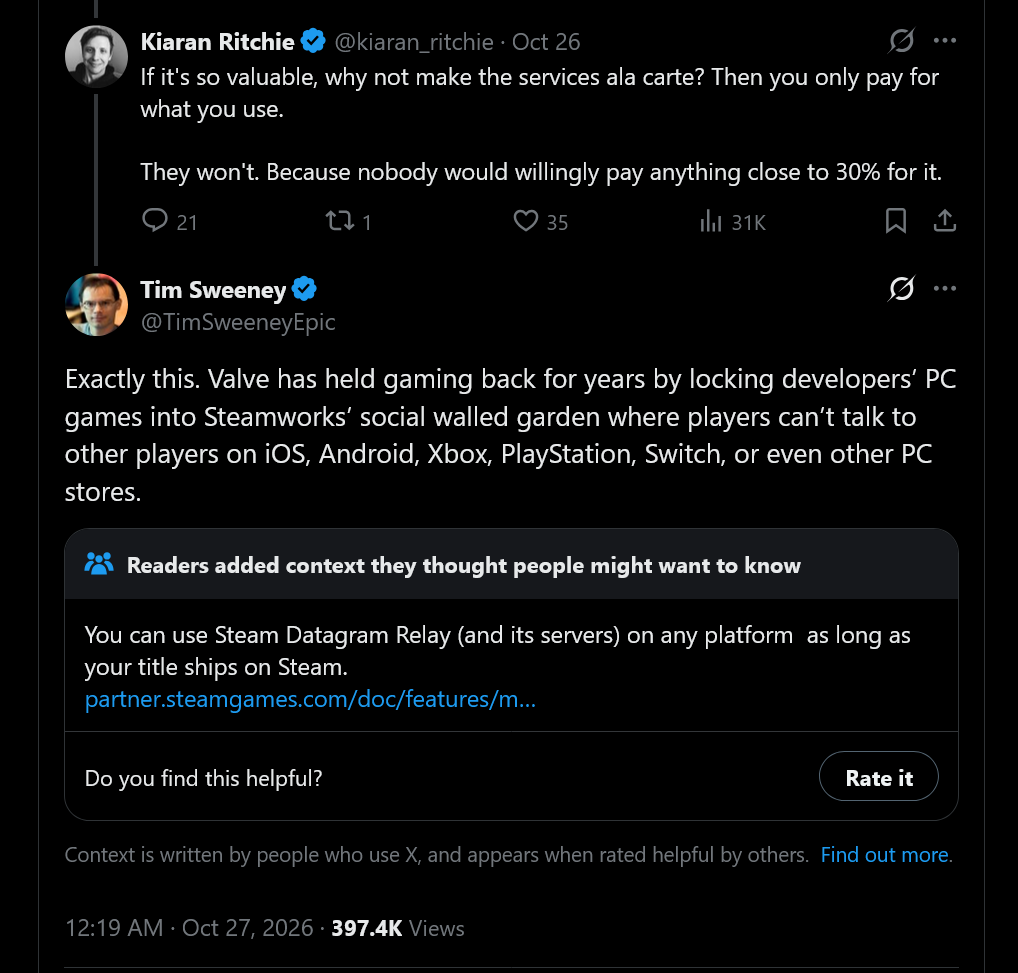
"Valve has held gaming back for years by locking developers’ PC games into Steamworks’ social walled garden where players can’t talk to other players on iOS, Android, Xbox, PlayStation, Switch, or even other PC stores," Sweeney stated.
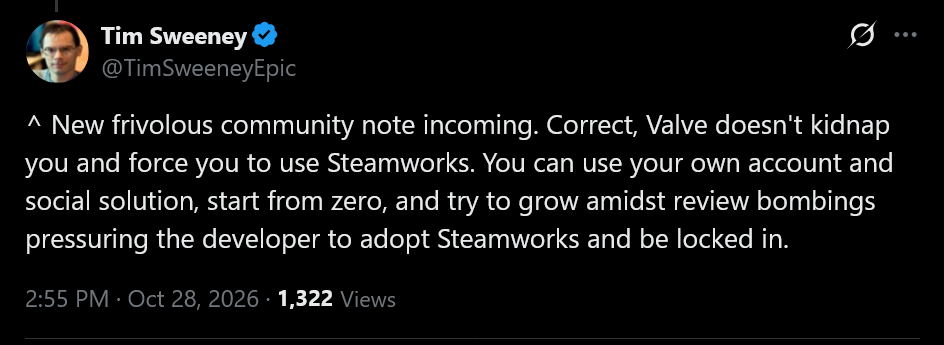
This assertion triggered a flurry of community notes and user rebuttals. Critics pointed out that many developers utilize Steamworks for its robust authentication and matchmaking services precisely because they are high-quality, reliable, and cost-effective for smaller teams. They argued that Valve does not mandate the use of Steamworks, and that the "lock-in" is a voluntary choice made by developers seeking to leverage the largest existing player base in the world.
Sweeney countered this by dismissing the idea that the alternative—building custom infrastructure from scratch—is a viable path for most studios. He noted that developers are often pressured into using Steamworks by a community that expects specific, unified social features, creating a feedback loop where the platform’s dominance dictates the technical requirements for every game released on it.
Historical Context and Financial Implications
To understand the significance of this dispute, one must examine the evolution of the PC gaming market over the last two decades. When Steam launched in 2003, it was a necessary digital delivery client for Valve’s own titles, such as Half-Life 2. Over the next twenty years, it transformed into the central hub for the PC gaming economy.
Valve’s 30% commission has been the industry standard for digital storefronts, a model adopted by Apple, Google, and the consoles. However, as the digital market matured, this percentage has come under fire. Critics, including Sweeney, argue that in a digital-only distribution model, a 30% cut is vastly disproportionate to the actual costs of hosting and bandwidth.
Epic Games has attempted to disrupt this model through the Epic Games Store (EGS), which charges a reduced commission of 12%. By offering a larger share of revenue to developers, Epic has attempted to court publishers and independent studios alike. Yet, despite these financial incentives, many consumers remain loyal to Steam, citing the platform’s superior features, such as the Steam Workshop, community hubs, robust refund policies, and the "Steam Library" effect—the tendency of users to prefer having all their games in a single, well-organized location.
The Role of Epic Online Services
In response to the criticism that he is merely attempting to push his own agenda, Sweeney has pointed to Epic Online Services (EOS). Unlike the Steamworks suite, which is tethered to the Steam platform, EOS is designed to be platform-agnostic. It provides matchmaking, cross-play, and account management services that can be used on any store, including Steam, GOG, or the Epic Games Store itself.
Sweeney’s argument is that the industry should move toward decentralized, interoperable services that allow developers to connect their players regardless of where the game was purchased. He views the current state of gaming as fragmented, where a player’s social connections are hostage to the specific storefront they use to launch the game.
Industry Implications and Future Outlook
The debate raises profound questions about the nature of platform competition. On one side, proponents of the current system argue that Valve’s integration of services is a value-add that has significantly lowered the barrier to entry for independent developers. Without the ease of Steamworks, many indie games might struggle to provide the multiplayer infrastructure required for modern success.
On the other side, proponents of Sweeney’s vision suggest that the "network effects" enjoyed by Steam have created a monopoly that hinders innovation. They argue that if developers were not so heavily dependent on Steam’s proprietary social layer, we would see a more vibrant, competitive market for game launchers and social platforms, potentially leading to lower prices and better terms for developers.
However, the industry’s response to these arguments remains divided. While many developers agree that the 30% commission is high, the reality of the market is that "visibility" is the most valuable commodity in gaming. Steam provides that visibility, and until an alternative platform can replicate the scale and the ease of the Steam experience, the platform is likely to remain the industry’s default.
Furthermore, the timing of these comments is notable. The gaming industry is currently grappling with a massive influx of AI-generated content and automated store clutter. Valve has been criticized for its hands-off approach to this "slop," yet it remains the primary gatekeeper for millions of players. As Epic continues to push for a more open ecosystem, the industry is left to wonder if the future of gaming lies in the convenience of consolidated ecosystems or in the radical openness proposed by leaders like Sweeney.
Ultimately, whether Steam has "held back" gaming or merely provided the infrastructure that enabled its current golden age remains a point of intense contention. What is clear is that as long as Valve holds the keys to the largest library of games in the world, it will continue to be the primary target for those who believe the current structure of the gaming economy is in need of a fundamental overhaul. Whether that overhaul comes through regulatory pressure, the rise of competing services, or a shift in developer priorities, the outcome will define the next decade of digital distribution in the PC gaming space.
Related posts: