When Jonathan Demme’s The Silence of the Lambs swept the major five categories at the 64th Academy Awards in March 1992—claiming Best Picture, Best Actor for Anthony Hopkins, Best Actress for Jodie Foster, Best Director, and Best Adapted Screenplay for Ted Tally—critics and audiences alike engaged in a concerted effort to elevate the film above its genre roots. To justify its unprecedented success as a psychological horror picture, observers pointed to Demme’s empathetic direction, the nuanced performances of its leads, and the restrained deployment of visceral terror. The picture’s most graphic elements—such as self-mutilation and forensic brutality—were treated as brief, necessary punctuation marks within a sophisticated crime procedural.
However, this critical insulation could not be applied to Thomas Harris’s subsequent 1999 literary follow-up, Hannibal, nor to its 2001 cinematic adaptation directed by Ridley Scott. Where The Silence of the Lambs relied on tight pacing and psychological implication—keeping Anthony Hopkins’ Dr. Hannibal Lecter confined behind glass for the majority of its runtime—Harris’s novel and Scott’s film embraced unfiltered Grand Guignol excess. The resulting motion picture dismantled the polite pretenses surrounding the franchise, offering a polarizing, visually opulent, yet deeply grotesque rejoinder to the prestige drama that preceded it.
Chronology and Production Turmoil
The path from the literary triumph of The Silence of the Lambs to the contentious release of Hannibal was fraught with creative friction. Following the massive box-office success of Demme’s 1991 film—which grossed over $272 million worldwide against a modest $19 million budget—pressure mounted on Thomas Harris to continue the narrative. Rumors consistently dogged the author’s writing process, suggesting that both his publishing house and producer Dino De Laurentiis heavily incentivized a continuation, while others claimed Harris experienced profound discomfort regarding the mainstream popularization and anti-hero romanticization of his antagonist.
Despite these pressures, Harris maintained a dialogue with Demme regarding a cinematic sequel. Yet, when the completed manuscript of Hannibal circulated among the core creative team, the reaction was swift rejection. Director Jonathan Demme, screenwriter Ted Tally, and lead actress Jodie Foster all declined to participate in the project. Their primary point of contention was Harris’s narrative trajectory, specifically the controversial denouement in which Clarice Starling and Dr. Hannibal Lecter abandon their respective sides of the law to become romantic partners.
With the original creative apparatus dismantled, producer Dino De Laurentiis turned to visionary filmmaker Ridley Scott. Alongside screenwriters David Mamet and Steven Zaillian, Scott undertook a significant structural overhaul of the source material. With Harris’s blessing, the overtly romantic conclusion was excised, alongside several of the novel’s most extreme set pieces—such as Mason Verger’s sister dispatching him by forcing a live eel down his throat. Nevertheless, the production retained the novel’s uncompromisingly dark tone, macabre imagery, and operatic violence.
Narrative Arc and Character Evolution
Released in February 2001 by Metro-Goldwyn-Mayer and Universal Pictures, Hannibal alters the spatial dynamics of the first film by removing Lecter from his secure confinement. Set a decade after the events of The Silence of the Lambs, the narrative finds the doctor living freely in Florence, Italy, working under the assumed identity of art curator and Dante scholar Dr. Fell.
Concurrently, the story tracks the fractured lives of its remaining principals. FBI Special Agent Clarice Starling, now portrayed by Julianne Moore following Jodie Foster’s departure, faces professional marginalization and intense political scrutiny in Washington, D.C., following a botched drug enforcement raid. Meanwhile, Mason Verger—a wealthy, sadistic pedophile who survived a horrific encounter with Lecter that left him faceless, paralyzed, and wheelchair-bound—dedicates his vast fortune to orchestrating a gruesome revenge plot. Gary Oldman assumes the role of Verger, encased in extensive prosthetic makeup.
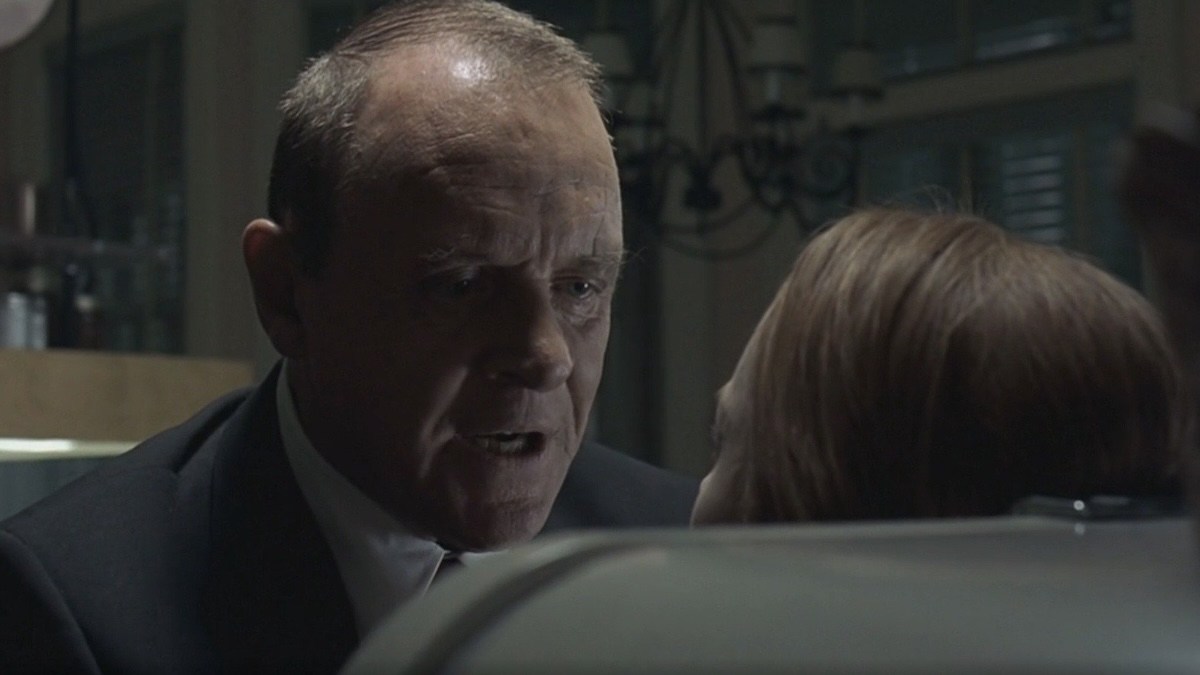
The plot expands internationally when a disgraced Florentine police inspector, Rinaldo Pazzi (Giancarlo Giannini), accesses restricted FBI databases to trade information on Lecter for Verger’s multimillion-dollar bounty. This digital trespass alerts Starling, setting off a convergence of interests that eventually culminates in a violent confrontation at Verger’s estate in Virginia and a final act set within the residence of corrupt Justice Department official Paul Krendler (Ray Liotta).
Visual Style and Aesthetic Contrasts
Despite its unwieldy narrative structure—which critics noted split its runtime awkwardly between Washington politics, Florentine tourism, and gothic horror set pieces—Hannibal represents a masterclass in atmospheric cinematography by director Ridley Scott and director of photography John Mathieson.
The film operates on a striking visual dichotomy: it is simultaneously repulsive and breathtakingly beautiful. In Florence, Scott leverages high architectural windows, classical statues, and sun-drenched piazzas to lend Lecter’s existence an aura of Renaissance luxury. Conversely, mundane or institutional spaces—such as the sterile, blue-lit federal computer basements in Washington or the decaying, shadowed corridors of Verger’s rural mansion—are framed with a chilling, clinical detachment that evokes Scott’s earlier sci-fi masterpiece, Alien.
This aesthetic opulence, however, serves only to heighten the impact of the film’s extreme violence. Rather than cutting away from brutality, Scott presents several unflinching sequences:
- A flashback detailing Mason Verger’s self-inflicted facial mutilation under Lecter’s hypnotic suggestion.
- The murder of Inspector Pazzi, who is disemboweled and hanged from a Palazzo window, his internal organs spilling as the rope snaps.
- The climactic sequence in which a drugged Paul Krendler has his skull partially opened by Lecter, who proceeds to slice, sear, and feed portions of Krendler’s prefrontal cortex back to him while the victim expresses a dazed, compliant euphoria.
Critical Reception and Cultural Legacy
Upon its theatrical release, Hannibal divided critics and audiences. While it performed strongly at the box office—accumulating roughly $351 million globally—reviewers pointed out the narrative contrivances and tonal inconsistencies resulting from its troubled development history. Many missed the psychological intimacy of the 1991 predecessor, arguing that transforming Hannibal Lecter into an active protagonist diluted the terror of his character.
Conversely, retrospective analyses have increasingly praised the film for its uncompromising rejection of Hollywood convention. By stripping away the protective veneer of prestige filmmaking that audiences had assigned to The Silence of the Lambs, Scott leaned directly into unadulterated Grand Guignol horror and pulpy melodrama.
Ultimately, Hannibal stands as a unique studio artifact: a big-budget sequel that refused to pander to audience comfort. By wedding high-art visual composition with transgressive, unflinching violence, Ridley Scott delivered a work that permanently dismantled the illusion that the exploits of Dr. Hannibal Lecter could ever be framed as anything other than pure, unapologetic horror.