The season premiere of Star Trek: Strange New Worlds, titled "Valles Marineris," has reignited a long-dormant concept within the Star Trek canon: the existence of intelligent humanoid life on Mars in the distant past. This revelation not only deepens the lore of the iconic science fiction franchise but also revisits a foundational idea conceived by the series’ creator, Gene Roddenberry, for the original Star Trek. The episode posits that over 65 million years ago, during the age of Earth’s dinosaurs, Mars was a vibrant, habitable world populated by an advanced, spacefaring humanoid civilization. This dramatic reintroduction of "Martians" to the Star Trek universe echoes Roddenberry’s initial vision for Mr. Spock, who was originally conceived as a Martian.
A Journey to a Prehistoric Mars
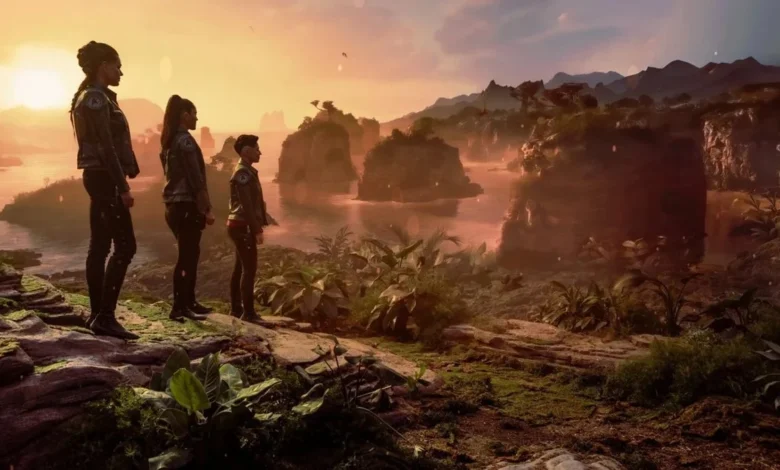
The narrative of "Valles Marineris" unfolds as the USS Enterprise, under the command of Captain Christopher Pike, encounters an unforeseen temporal anomaly. A powerful solar storm disrupts the ship’s systems, propelling it back in time approximately 65 million years. The crew finds themselves in a dramatically altered solar system, where Mars, far from being the arid, desolate planet known in the 23rd century, is a thriving world teeming with life.
During this epoch, Mars was not only habitable but also home to an advanced civilization of humanoids. These "Martians," as they are referred to, were engaged in a bitter conflict with a formidable insectoid species known as the Dol’Drim. The Enterprise’s intervention in this ancient conflict, though unintentional, ultimately leads to a catastrophic event that renders Mars devoid of intelligent life by the time the ship returns to its own era. However, the episode reveals that a select group of Martians managed to escape their doomed homeworld, seeding their genetic material across the cosmos. This act of interstellar preservation has profound implications for the future of galactic life, suggesting that remnants of this ancient Martian civilization may have contributed to the development of other sentient species.

The Genesis of the Martian Concept
The inclusion of a sophisticated Martian civilization in "Valles Marineris" is more than just a creative flourish; it is a direct nod to the earliest conceptualizations of Star Trek. In Gene Roddenberry’s initial pitch for the series in 1964, the character of Mr. Spock, the half-Vulcan science officer, was originally envisioned as a "half-Martian." Leonard Nimoy, who would go on to portray Spock, was even presented with this concept. Roddenberry’s original idea was for Spock to have a distinct reddish complexion, a visual characteristic intended to link him to the "red planet." This visual choice, however, presented significant production challenges for the era.
Navigating Production Challenges and Scientific Realities
The early 1960s were a transitional period for television technology. The majority of households still owned black-and-white sets. The producers of the original Star Trek series were concerned that a red complexion on screen might not translate effectively, potentially appearing as blackface or an unflattering shade on monochrome displays. Furthermore, there was a societal apprehension that an alien with pointed ears and a red hue might inadvertently evoke imagery of the devil, potentially alienating a significant portion of the American audience, which was largely religious at the time.
Beyond these aesthetic and cultural considerations, Roddenberry was also keenly aware of the impending scientific discoveries regarding Mars. NASA’s Mariner 4 mission was on its way to Mars, scheduled to orbit the planet in July 1965. The outcome of this mission held the potential to either validate or invalidate the concept of Martian life. If Mariner 4 returned images of a barren, lifeless world, Star Trek‘s premise of intelligent life on Mars would be relegated to the realm of pure fantasy rather than grounded science fiction.
The Pivot to Vulcan
Faced with these multifaceted challenges, Roddenberry made a pivotal decision. In early 1965, as production commenced on the first pilot episode, "The Cage," he altered Spock’s alien heritage from Martian to half-Vulcan. This strategic shift allowed for the introduction of a compelling alien character without the visual and scientific uncertainties associated with Mars. The creation of the planet Vulcan and its logical inhabitants provided a robust foundation for Spock’s character and the broader Star Trek universe, proving to be a more sustainable narrative choice.

This decision proved prescient. The Mariner 4 mission, upon its arrival at Mars, transmitted images of a cratered, arid surface, confirming the absence of any discernible life. Had Roddenberry stuck with his original Martian concept for Spock, Star Trek‘s scientific credibility would have been immediately undermined. Despite the creative success of Spock’s new Vulcan heritage, the first pilot, "The Cage," was ultimately rejected by NBC executives.
A Full Circle Moment for Star Trek
The subsequent production of the second pilot, "Where No Man Has Gone Before," and the eventual series pickup marked the beginning of Star Trek‘s enduring legacy. However, "Valles Marineris" signifies a remarkable narrative return to Roddenberry’s initial creative spark. By reintroducing intelligent humanoids on prehistoric Mars, the series not only pays homage to its creator’s original vision but also expands the known history of the Star Trek galaxy.
The implications of this episode are far-reaching. The revelation that Martian DNA was seeded across the cosmos suggests a potential ancestral link to numerous species, including the Vulcans. This implies that Spock, in a cosmic sense, might indeed be "part Martian" after all. The pointed ears, a signature feature of Spock and many Vulcan characters, could be a subtle, inherited trait from this ancient Martian lineage. This retroactive continuity elegantly bridges Roddenberry’s early concepts with the established lore of Star Trek.
Official Responses and Fan Reception
While no official statements have been released by Paramount+ or the Star Trek production team regarding the specific implications of "Valles Marineris" beyond what was presented in the episode, the fan reception has been overwhelmingly positive. The episode is being lauded for its bold storytelling, its commitment to exploring the foundational elements of the franchise, and its ability to weave new narratives into the existing tapestry of Star Trek lore. Online forums and social media platforms are abuzz with discussions about the potential ramifications of Martian DNA, the species evolution theories, and the future exploration of this newly canonized ancient civilization. The narrative has provided fertile ground for fan speculation, with many eager to see if future episodes or series will further explore the history of these ancient Martians and their impact on galactic evolution.

Broader Impact and Implications for Science Fiction
The reintroduction of a sophisticated Martian civilization in Star Trek taps into a rich vein of science fiction history. For decades, Mars has been a focal point of speculation and imagination in literature and film, often depicted as a world inhabited by advanced, sometimes enigmatic, beings. The "Martian" trope has evolved over time, from H.G. Wells’s terrifying invaders in The War of the Worlds to more benevolent or complex portrayals. Star Trek: Strange New Worlds has now added a significant chapter to this ongoing dialogue, presenting a scientifically plausible (within the context of the fictional universe) origin story for intelligent life in our own solar system.
This narrative choice also underscores the enduring appeal of exploring humanity’s place in the universe and the potential for life beyond Earth. By grounding this fictional discovery in our own solar system’s history, the episode adds a layer of gravitas and relatability. It challenges viewers to reconsider their perceptions of Mars and the vastness of cosmic time. The idea that a lost civilization from our own cosmic backyard could have played a role in shaping the galaxy’s sentient landscape offers a compelling perspective on the interconnectedness of life across the universe.
Ultimately, "Valles Marineris" is more than just a captivating episode of Star Trek; it is a testament to the enduring power of Gene Roddenberry’s original vision and the franchise’s ability to continuously reinvent itself while staying true to its core principles. The canonization of Martian humanoids, and their subtle integration into the lineage of beloved characters like Spock, represents a full-circle moment for Star Trek, demonstrating that the seeds of its most enduring concepts were planted long ago, waiting for the right moment to bloom in the fertile soil of the final frontier. The adventure of the USS Enterprise has once again taken us where no one has gone before, not only in space but also through the annals of science fiction history.