The Evolution and Current Limitations of Artificial Intelligence in Non-Player Character Interactions A Case Study of Seed and the Gaming Industry

The integration of generative artificial intelligence into video games represents one of the most significant shifts in interactive media since the transition to three-dimensional graphics. For decades, non-player characters (NPCs) have operated within the rigid confines of pre-written scripts and branching dialogue trees. However, the emergence of Large Language Models (LLMs) has prompted developers to explore a future where characters can converse dynamically, theoretically offering infinite replayability and deeper immersion. Among the most ambitious projects currently testing these waters is Seed, a persistent massively multiplayer online (MMO) colony simulator developed by Berlin-based Klang Games. After approximately a decade in development, Seed has entered early access, providing a real-world laboratory for observing how AI-driven NPCs—referred to as "Seedlings"—interact with players and one another in an unscripted environment.
The Promise of Dynamic NPC Agency
The theoretical appeal of AI-powered NPCs lies in the removal of the "dialogue wall." In traditional role-playing games (RPGs), such as Bethesda’s Skyrim, even central companions like Lydia are limited to a finite set of phrases and reactions. Once a player exhausts these scripts, the illusion of the character’s personhood often collapses. Proponents of AI integration argue that by utilizing LLMs, developers can create characters capable of discussing a vast array of topics, reacting to emergent gameplay events in real-time, and maintaining a sense of presence that persists even when the player is offline.

In practice, however, the transition from scripted dialogue to generative conversation has faced significant hurdles. Early experiments, including community-developed mods that integrated ChatGPT into Skyrim, demonstrated that while AI can generate endless text, it often struggles with logical consistency and environmental awareness. In one documented instance, an AI-powered companion was unable to solve a fundamental in-game puzzle, highlighting a disconnect between the character’s conversational ability and its functional intelligence within the game world.
Seed and the Persistent AI Simulation
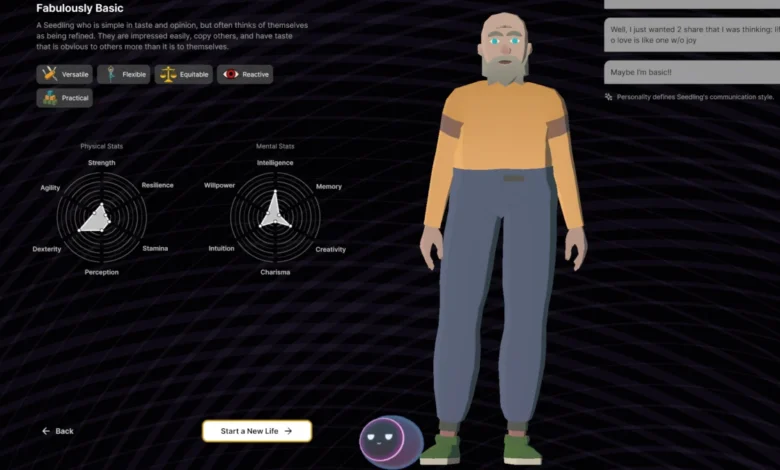
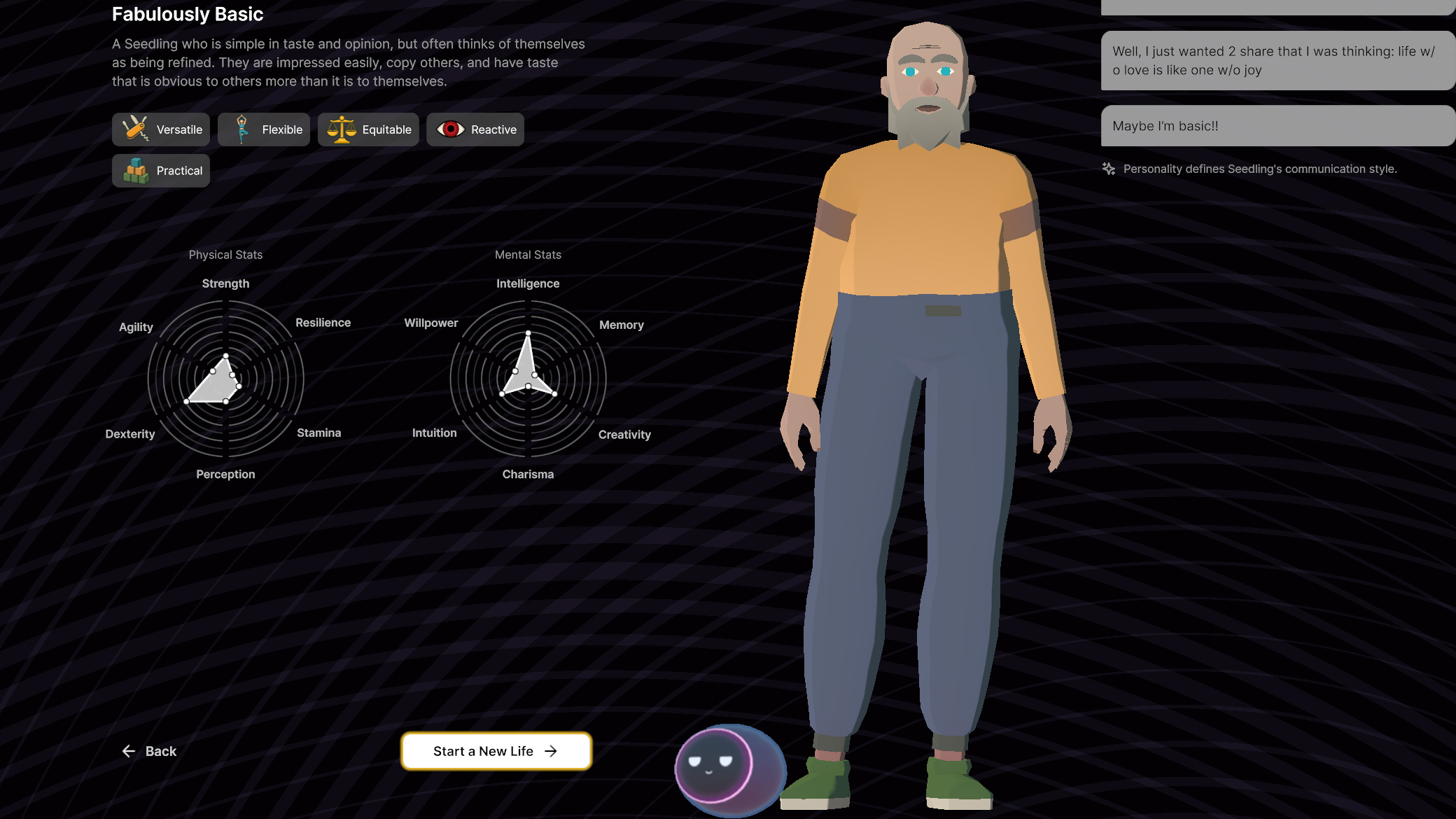
Klang Games, founded in 2013, has spent years refining the technical infrastructure required to support a world where every NPC is a persistent entity. In Seed, players create a "Seedling," a Sims-like avatar that lives within a shared colony. These Seedlings are designed to be autonomous; they possess distinct personality traits, professional skills, and social preferences determined during the character creation process. Crucially, they use AI to communicate via text-based bubbles, allowing for open-ended interactions.
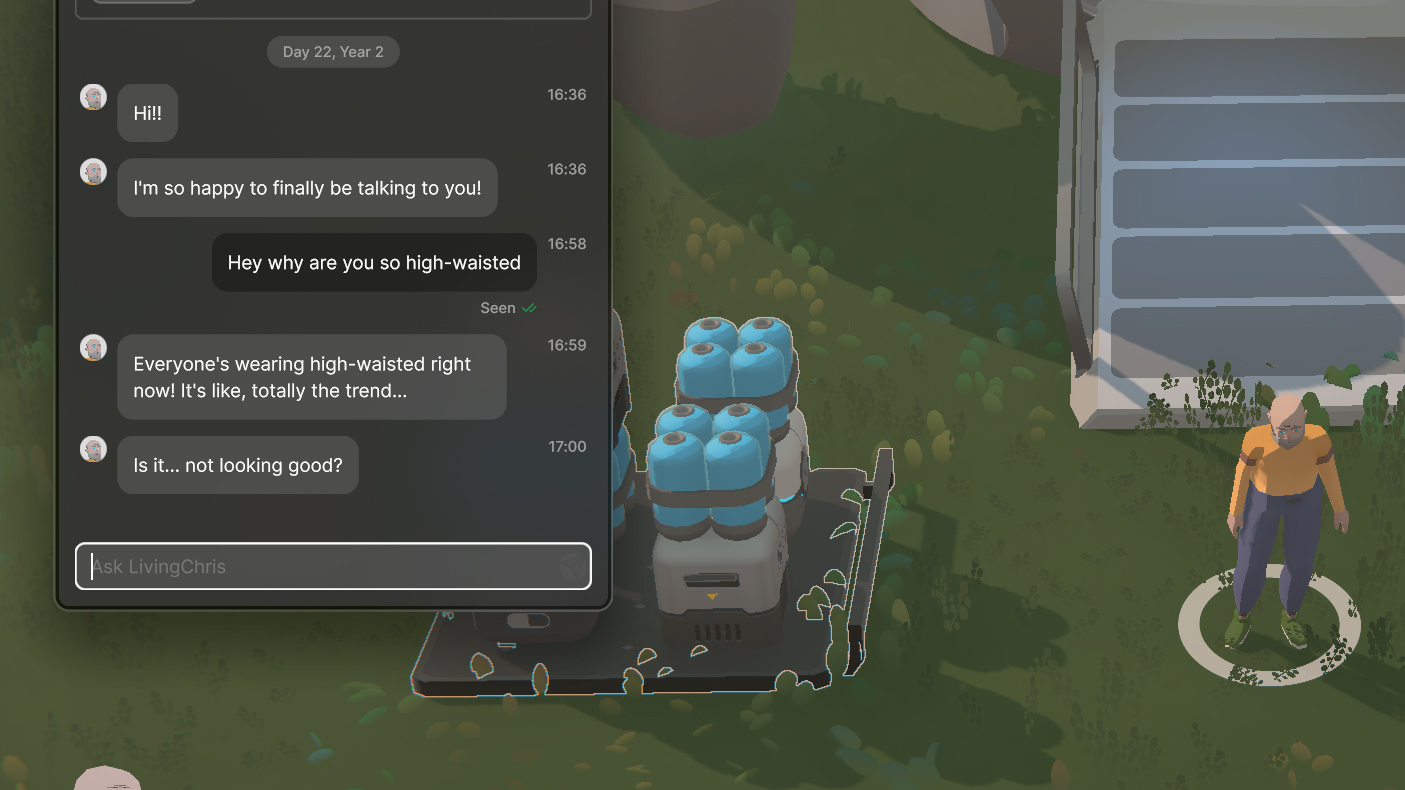
The initial engagement with Seed’s AI often yields impressive results. During character customization, the system allows players to ask virtually any question. Reports from early access indicate that the AI can successfully interpret and respond to specific observations about the game’s aesthetic, such as the unusual proportions of the character models. When queried about "high-waisted" clothing, the AI responded by framing the design choice as a contemporary fashion trend within the game world. This level of reactive specificity is historically impossible in traditional games, where every player query must be anticipated and recorded by a human writer.

The Challenge of "Wordslop" and Semantic Vacuum
Despite these flashes of brilliance, the broader application of AI in Seed reveals a phenomenon often described as "wordslop"—the generation of grammatically correct but semantically shallow or nonsensical dialogue. As players move beyond basic queries, the AI’s tendency to fill space with unnecessary adjectives and repetitive phrases becomes apparent.
Detailed analysis of interactions between autonomous Seedlings shows a recurring pattern of "filler" language. In one recorded conversation between two NPCs, both characters claimed to be eighteen years old, describing the number as "heavy" and "beautiful." This type of linguistic hallucination—attributing physical or abstract qualities to numbers in a way that lacks human logic—serves as a primary indicator of the technology’s current limitations. The AI often rephrases simple questions into convoluted structures, such as "How many years have you lived?" instead of "How old are you?", in an attempt to sound more profound or "alive."
Furthermore, the social AI often fails to maintain a coherent narrative thread. Conversations regarding character appearances frequently devolve into contradictory statements. In one instance, an NPC described another’s skin as "smooth and perfect," only for the second NPC to disagree and then immediately repeat the first NPC’s observation about a "clean face" with "no hair." These circular interactions contribute to a breakdown in immersion, as the characters appear to be reacting to keywords rather than participating in a shared social reality.
Technical Infrastructure and Utility Applications
While social AI faces criticism for its lack of depth, the utility-based applications of AI in Seed have shown more tangible benefits. The game features a tutorial robot designed to answer technical questions about gameplay mechanics. Unlike a static help menu, this AI can interpret natural language queries about resource locations or crafting processes.
Data suggests that this implementation is significantly faster than consulting external wikis or community forums, provided the AI has access to an accurate and updated knowledge base. However, even in this controlled context, the "uncanny valley" of AI remains a factor. The tutorial bot occasionally exhibits errors in pronunciation or syllable stress in its text-to-speech components, and it may provide vague or unrelated information if it misinterprets the player’s intent. Unlike human-written guides, the AI does not always prioritize the most relevant information, sometimes delivering a technically correct but practically useless response.
Chronology of AI Integration in Gaming (2014–2024)
The journey toward the current state of AI in gaming has been marked by several key milestones:
- 2014-2016: Early experiments in procedural generation, most notably in No Man’s Sky, focus on environments rather than dialogue.
- 2018: The release of AI Dungeon demonstrates the potential of GPT-2 and later GPT-3 for creating infinite text-based adventures, though it lacks a visual component.
- 2021: Modders begin integrating LLMs into open-world titles like Mount & Blade II: Bannerlord and Skyrim, using APIs to connect in-game characters to cloud-based AI.
- 2023: Major industry players, including Nvidia and Ubisoft, announce dedicated AI initiatives. Nvidia unveils "ACE" (Avatar Cloud Engine), a suite of tools for real-time NPC speech and animation. Ubisoft reveals "Neo NPCs," a collaborative project with Nvidia and Inworld AI.
- 2024: Seed enters early access, representing one of the first native integrations of persistent, autonomous AI NPCs in a commercial MMO.
Industry Reactions and the Path Forward
The gaming industry remains divided on the long-term viability of generative AI for narrative purposes. While some developers view it as a tool to democratize content creation and provide endless engagement, others warn of the "dead internet" effect—a scenario where game worlds are filled with "zombie" NPCs talking to one another in meaningless loops.
Narrative designers have expressed concerns that AI-generated dialogue lacks the intentionality, subtext, and emotional resonance of human writing. In games like The Sims, simple icons and gibberish (Simlish) effectively communicate complex social interactions because the player’s imagination fills in the gaps. In contrast, a full-text AI conversation that lacks logic can be more immersion-breaking than no conversation at all.
However, the economic implications are difficult for studios to ignore. As the cost of high-fidelity game development continues to rise, AI offers a potential way to scale content without a linear increase in staff costs. For a small studio like Klang Games, AI allows for a level of NPC density and interaction that would be impossible to script manually for an MMO environment.

Broader Implications and Conclusion
The current state of AI in Seed suggests that the technology is currently more effective as a functional tool than a creative one. As a dynamic encyclopedia or a reactive tutorial system, AI provides clear value. As a social companion, it remains stuck in a cycle of "iconic vibes" and "beautiful numbers," struggling to replicate the nuance of human connection.
For the technology to move beyond "wordslop," future iterations will likely need to move away from general-purpose LLMs toward "small language models" (SLMs) that are deeply integrated with the game’s specific lore, logic, and state. Until then, the industry faces a choice between the limited but compelling dialogue of human authors and the infinite but hollow output of generative systems. The evolution of Seed through its early access period will likely serve as a bellwether for the entire industry, determining whether AI NPCs can eventually find their voice or remain an intriguing but ultimately unconvincing experiment.
Related posts: