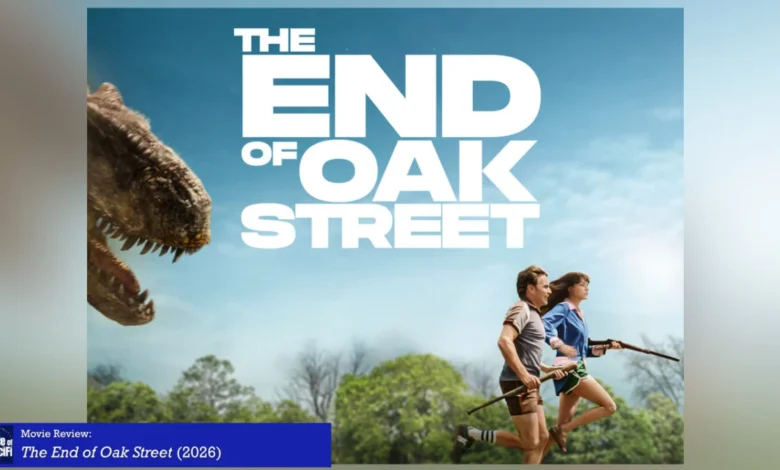
David Robert Mitchell, the acclaimed filmmaker behind the psychological horror hit It Follows, returns to the cinematic landscape with his latest venture, a high-concept science fiction adventure titled The End of Oak Street. Set against the stylistic and technological backdrop of 1982, the feature-length film explores a jarring premise: an ordinary suburban neighborhood abruptly torn from its modern reality and thrust into a hostile prehistoric ecosystem teeming with dinosaurs. Headlined by a prominent ensemble cast featuring Anne Hathaway, Ewan McGregor, Maisy Stella, and Christian Convery, the movie blends nostalgic period aesthetics with survivalist terror. While the feature excels in its visual effects, atmospheric tension, and visceral creature design, it simultaneously invites critical scrutiny regarding its domestic drama tropes, conventional character arcs, and a somewhat overly neat narrative resolution.
Main Facts and Premise
The narrative framework of The End of Oak Street anchors itself in the mundane realities of early 1980s suburban life before descending into evolutionary chaos. The story centers on the Platt family—comprising father Greg, portrayed by Ewan McGregor, and mother Denise, played by Anne Hathaway—alongside their children, Brian, played by Christian Convery, and Audrey, played by Maisy Stella. Greg maintains a hidden side job as a pizza delivery driver to make ends meet, a secret that strains his relationship with Denise, who is simultaneously attempting to cultivate a writing career by drafting a novel about domestic detachment.
The inciting incident of the film materializes as a localized, catastrophic displacement of space and time. A blinding nocturnal light accompanied by a violent atmospheric vortex isolates the Platt family’s residential block from the surrounding municipality. By morning, basic municipal services fail; water supplies vanish, ambient temperatures surge dramatically, and the physical geography of the neighborhood dissolves into an unfamiliar landscape dominated by prehistoric flora and fauna. As predatory dinosaurs begin to infiltrate the suburban streets, the residents are forced to transition from domestic disputes to an immediate, desperate struggle for biological survival.
Chronology of Events
The unfolding narrative of The End of Oak Street follows a distinct temporal progression, moving from social normalcy to ecological displacement and final confrontation.
The story commences on a tranquil weekend during a neighborhood block party. Tensions within the Platt household manifest early: Greg departs prematurely to fulfill a pizza delivery shift, causing friction with Denise, who expected him to manage the barbecue. Simultaneously, neighborhood friction arises when neighbor Mel, portrayed by P.J. Byrne, clashes with the Platts over their dog, Starbuck, trespassing onto his property.
In the days following the community gathering, anomalous phenomena begin to accumulate. A mysterious, hyper-accelerated prehistoric plant sprouts in the backyard of retired book editor Mrs. Huddleston, a neighbor encouraging Denise’s literary pursuits. Concurrently, strange meteorological disturbances occur, culminating in a powerful nocturnal flash of light and an accompanying wind gust. The following morning, inexplicable ecological anomalies appear, including massive organic waste deposits in Mel’s yard and abnormal subterranean heating that transforms local water pipes into geysers.
The crisis peaks when the neighborhood experiences a total blackout and complete infrastructural failure. Upon venturing outside to locate their missing dog, Greg and Denise encounter the stark reality of their new environment: a roaming dinosaur forces Greg into a frantic retreat, prompting immediate fortification efforts as the perimeter of the neighborhood becomes entirely encompassed by primeval jungle and canyon terrain. Carnivorous fauna begin systematically targeting human inhabitants, leading to tragic casualties, including the violent mauling of Mrs. Huddleston. The remaining residents are forced to navigate internal conflicts while confronting the apex predators of the Mesozoic era.
Supporting Data and Production Context
Clocking in with a robust production design, The End of Oak Street relies heavily on practical aesthetics and meticulous period-accurate world-building. Choosing 1982 as the narrative anchor serves both a thematic and aesthetic function. In an era predating smartphones, ubiquitous internet connectivity, social media, and digital navigation tools, the characters are stripped of modern safety nets. Communication is analog; information retrieval requires physical visits to local public libraries—featuring librarian Mrs. Valcourt, played by Emily Kuroda—or consulting home encyclopedia volumes. This pre-digital setting heightens the vulnerability of the protagonists, rendering their isolation absolute once the spatial displacement occurs.
Cinematically, the film utilizes expansive long shots to emphasize the surreal juxtaposition of suburban architecture against prehistoric wilderness. Visual effects teams deliver highly rendered dinosaur interactions, ranging from herbivorous feeding sequences to high-speed predatory chases. Critical reception regarding the film’s visual fidelity has been largely favorable, with reviewers noting that the scale and texture of the creature animations establish a high benchmark for modern creature features.
Official Responses and Critical Reception
Upon its theatrical rollout, The End of Oak Street garnered a polarized yet generally respectable critical consensus. Industry analysts and film critics have praised director David Robert Mitchell for his adept handling of dialogue pacing, suspense mechanics, and atmospheric dread. The integration of 1980s nostalgia—highlighted by period-appropriate costuming, production design, and a curated soundtrack—has been widely cited as an effective mood-setter.
However, narrative evaluations point to distinct structural vulnerabilities. The domestic subplots—focusing on marital friction, hidden employment struggles, and adolescent rebellion—have been characterized by some reviewers as predictable and secondary to the primary engine of the film: survival horror. Furthermore, the decision of the younger characters to independently venture into dangerous territory in search of their pet has drawn criticism for employing well-worn horror tropes that strain audience credulity.
Particular scrutiny has been directed toward the film’s third act and conclusion. Observers have noted that the resolution relies on a convenient deus ex machina device that abruptly reverses high-stakes narrative developments established earlier in the plot. Speculation within film critic circles suggests that studio preview screenings may have influenced a pivot away from a potentially bleaker, less conventional ending in favor of a more palatable, neatly wrapped finale. Despite these narrative compromises, the feature has achieved a favorable rating of three and a half out of five stars across multiple trade publications, recognized primarily for its visceral thrills and engaging pacing.
Broader Impact and Implications
The release of The End of Oak Street marks a notable stylistic departure for David Robert Mitchell, transitioning from intimate psychological thrillers and supernatural horror into high-concept science fiction adventure. By fusing suburban Americana with prehistoric menace, the film contributes to a long cinematic tradition of exploring the fragility of modern civilization when confronted with primal forces.
From a commercial standpoint, the film demonstrates the viability of mid-budget genre hybrids that prioritize atmospheric world-building over exhaustive digital spectacle. The deliberate restriction of technological crutches through the 1982 setting offers a masterclass in narrative constraint, forcing characters to rely on primitive deduction, physical endurance, and communal cooperation. While narrative conventions and a tidy resolution prevent the film from achieving absolute thematic transcendence, The End of Oak Street stands as a commercially viable, visually arresting cinematic entry that successfully revitalizes classic monster-movie mechanics for contemporary audiences.