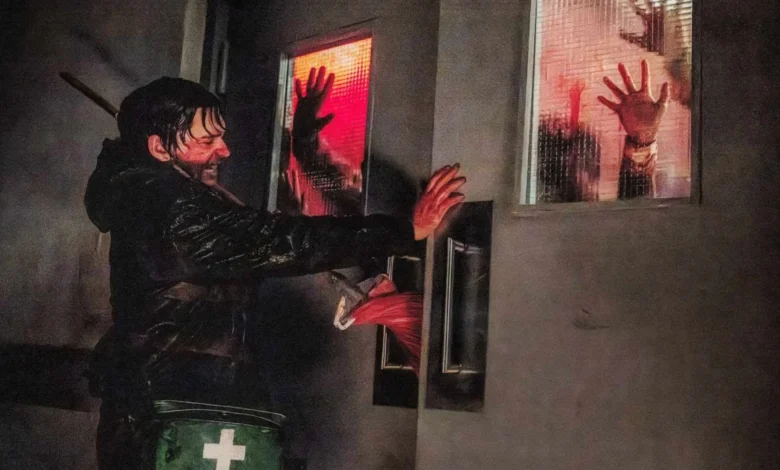
The cinematic legacy of Capcom’s foundational survival horror franchise, Resident Evil, has long been defined by high-concept action over genuine atmospheric dread. Following a succession of commercial yet critically maligned blockbusters directed by Paul W.S. Anderson, alongside subsequent reboot attempts, Sony Pictures is slated to release a fresh cinematic adaptation on September 18, 2026. Directed by Zach Cregger—whose previous genre entries, Barbarian and Weapons, earned him widespread acclaim among horror enthusiasts and mainstream critics alike—this latest installment attempts a radical tonal shift. Rather than relying on familiar canon characters like Leon S. Kennedy or Jill Valentine, the film shifts its focus entirely to a civilian outsider, offering an intimate yet terrifying vantage point into the collapse of Raccoon City.
The Main Facts and Narrative Premise
At the center of the narrative is Bryan, a beleaguered medical courier played by Austin Abrams. Working the tail end of his shift at a small-town Colorado hospital, Bryan is offered double pay to transport a mysterious, life-saving package to Raccoon City General Hospital. This professional obligation conveniently coincides with domestic turmoil; Bryan has just fled his home after his girlfriend, Michelle, revealed she was pregnant. Rather than facing the complexities of impending fatherhood, Bryan takes the driving shift, unwittingly steering himself toward an escalating biological catastrophe orchestrated by the shadowy Umbrella Corporation.
True to suspenseful filmmaking conventions, the plot establishes dramatic irony early. As Alfred Hitchcock famously noted, true suspense derives from the audience possessing knowledge of an impending threat while the characters remain oblivious. Cregger weaponizes this principle during the film’s first act. Viewers familiar with survival horror tropes instantly recognize the peril when Bryan stops his vehicle on a desolate, snowy night to assist a stranded stranger, invites her into his car, and drives closer to the quarantined perimeter of Raccoon City.
Chronology and Evolution of the Production
The development of this 2026 adaptation marks a deliberate pivot for Sony Pictures, which has historically treated the property as a vehicle for stylized, video-game-adjacent action spectacles. Following the underwhelming reception of 2021’s Welcome to Raccoon City, studio executives sought a filmmaker capable of restoring tension to the material. Cregger’s involvement was secured following the breakout success of Barbarian, positioning him to helm a project that honors the pacing and survival mechanics of the original 1990s and 2000s Capcom titles without becoming bogged down by excessive fan service or predictable narrative callbacks.
Production commenced quietly, focusing heavily on practical effects and claustrophobic set design to evoke the spirit of early franchise entries. By centering the story on an everyday civilian rather than a heavily armed tactical operative, the creative team deliberately recaptured the helplessness intrinsic to early survival horror video games, where ammunition is scarce and every dark corner presents a lethal unknown.
Supporting Data and Genre Analysis

The film operates largely as a hybrid of classic B-movie creature features and modern psychological horror. While structurally indebted to the action-heavy later entries of the video game series, such as Resident Evil 4, the movie successfully replicates the specific brand of anxiety experienced by players navigating constrained environments with limited resources.
Data regarding horror box office trends in the mid-2020s indicates a growing consumer appetite for mid-budget, character-driven genre films that prioritize atmosphere over bloated CGI spectacles. Cregger’s production aligns with this market shift, keeping its runtime fleet and narrative focus tightly bound to Bryan’s survival trajectory. However, analytical consensus among early reviewers points to a recurring structural friction: while the film excels during its pure survival sequences—such as an unsettling encounter with an infected child who has not yet fully transformed—it occasionally stumbles when attempting to weave half-baked thematic commentary on parenthood and responsibility into the carnage.
Industry Reactions and Stakeholder Perspectives
Studio representatives from Sony Pictures have expressed confidence that this grounded, outsider-perspective approach will revitalize the intellectual property for a new generation of cinemagoers while satisfying longtime fans of the source material. Industry analysts note that by distancing the narrative from the convoluted lore of previous film iterations, the studio has lowered the barrier to entry for casual audiences.
Early critical responses have generally lauded Cregger’s directorial choices, particularly his mastery of pacing and tension-building. Sequences featuring Bryan navigating urban landscapes while evading sophisticated biological threats have been singled out as masterclasses in modern horror choreography. Nevertheless, critics have noted that the film ultimately succumbs to a certain narrative shallowness, favoring relentless forward momentum and stylistic set pieces over deep thematic resonance.
Broader Impact and Market Implications
As the film prepares for its widespread theatrical launch on September 18, 2026, its performance at the box office will likely dictate the future trajectory of video game adaptations in Hollywood. The ongoing industry trend of treating gaming IPs with greater auteur-driven respect—evidenced by recent high-profile television and film adaptations—places considerable pressure on Cregger’s project to perform both commercially and critically.
Ultimately, while the film functions effectively as a high-velocity thrill ride, comparisons to arcade rail-shooters are difficult to dismiss entirely. It delivers immediate, visceral entertainment, consuming viewer attention with relentless momentum before leaving an impression defined more by its kinetic energy than its narrative depth. Whether this approach establishes a sustainable blueprint for future Resident Evil sequels remains to be seen, but for the immediate theatrical window, it stands as a competent and frequently terrifying addition to the franchise’s cinematic catalog.