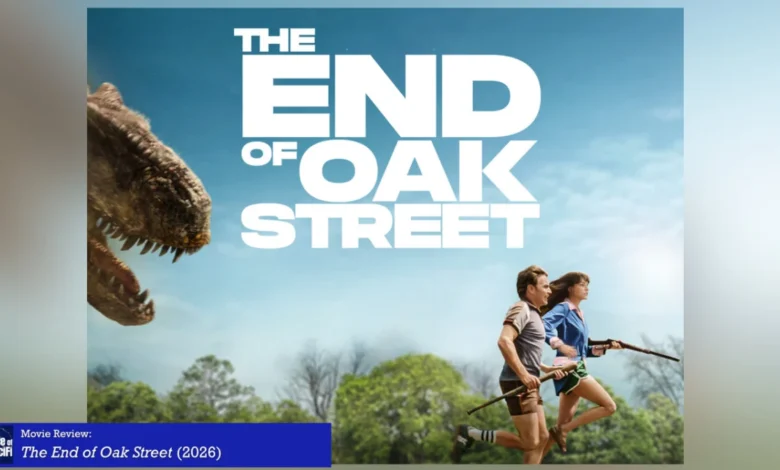
David Robert Mitchell’s science-fiction adventure feature, The End of Oak Street, presents a high-concept premise that merges suburban domestic friction with prehistoric survival. Set against the backdrop of 1982—an era defined by analog communication, limited personal computing, and emerging information technology—the film explores how an isolated community responds when suddenly displaced into an ancient, hostile ecosystem populated by dinosaurs. Despite its inventive core concept and striking visual effects, the motion picture navigates a familiar narrative path, balancing gripping survival sequences against conventional family drama and a polarizing, neatly packaged conclusion.
Main Facts and Production Overview
Written and directed by David Robert Mitchell, renowned for his work on the critically acclaimed thriller It Follows, The End of Oak Street features an ensemble cast led by Academy Award winner Anne Hathaway as Denise Platt and Ewan McGregor as Greg Platt. They are joined by supporting cast members Maisy Stella as Audrey Platt, Christian Convery as Brian Platt, P.J. Byrne as neighbor Mel, Ann Gee Byrd as Mrs. Huddleston, and Emily Kuroda as Mrs. Valcourt.
The narrative centers on the Platt family and their immediate neighbors in a typical American suburb who find their neighborhood inexplicably torn from its modern geography and thrust backward in time. The production leans heavily into period-accurate design, utilizing 1982 aesthetics—including vintage home decor, polaroid cameras, typewriters, home encyclopedia sets, and a nostalgic period soundtrack—to ground the surreal sci-fi phenomenon in tangible, tactile realism. While the human drama and domestic friction receive mixed reception from critics, the technical execution of the prehistoric environment, creature design, and atmospheric tension stand out as major elements of the production.
Chronology of Events within the Narrative
The sequence of events in The End of Oak Street unfolds over a rapid escalation from mundane suburban tension to catastrophic ecological displacement.
The story commences on a typical weekend at a neighborhood block party. The Platt family participates in community activities, though underlying domestic strains quickly surface. Greg Platt, struggling financially, must leave the event early to fulfill a side job as a pizza delivery driver—a decision that frustrates his wife, Denise, who expected him to manage the neighborhood barbecue. Further friction arises regarding their son, Brian, bringing his dog, Starbuck, to the gathering, while the children privately discuss the possibility of their parents divorcing.
Seeking solace, Denise visits her neighbor, Mrs. Huddleston, a former book editor who encourages Denise’s creative writing endeavors regarding a woman seeking independence. Mrs. Huddleston showcases an anomalous plant in her backyard that has grown to extraordinary heights in an impossibly brief timeframe, which Denise documents using an instant-print camera. Later, domestic and neighborly disputes compound when Mel, another local resident, threatens legal or physical action against Starbuck for trespassing and property damage, prompting a sharp defense from Denise.
The turning point occurs overnight when a brilliant flash of light accompanied by a severe atmospheric disturbance startles the neighborhood. The following morning manifests bizarre anomalies: Mel discovers an immense pile of unidentified animal excrement in his yard, prompting Greg and Brian to offer assistance with cleanup. Concurrently, Denise takes her photograph of the anomalous plant to the local library, where librarian Mrs. Valcourt hypothesizes that the foliage possesses prehistoric characteristics.
The ultimate displacement occurs shortly thereafter when a massive surge of luminosity plunges the neighborhood into a total blackout, accompanied by soaring temperatures and the sudden disappearance of municipal water supplies. When Starbuck goes missing, Denise and Greg venture out into the neighborhood to search for him, discovering geyser-like hot water spouts and noticing the landscape transformed into an unfamiliar, tropical expanse. Greg encounters a large carnivorous dinosaur near an overturned garbage can, narrowly escaping back to the family home as the community begins hastily boarding up windows.
As daylight returns, the neighborhood realizes it is completely encircled by dense prehistoric foliage, rugged canyons, and active predators. Human casualties mount quickly, highlighted by the discovery that Mrs. Huddleston has been mauled to death by wildlife. The narrative follows the residents’ desperate attempts to understand the geological anomaly, locate missing family members, and organize a collective defense against the prehistoric fauna.
Supporting Data and Contextual Analysis
The deliberate choice of a 1982 setting serves a specific narrative and aesthetic function. By placing the characters in a pre-internet, pre-smartphone era, the filmmaker removes reliance on modern digital connectivity and satellite tracking. Characters must physically travel to libraries, consult physical encyclopedias, and use analog cameras to decipher their predicament. Furthermore, the film implies that contemporary digital devices would be rendered useless by the cosmic electromagnetic shift that triggered the displacement, making the historical setting an organic fit rather than a superficial gimmick.
From a technical perspective, the visualization of the prehistoric ecosystem has drawn praise for its scale and realism. The long-range cinematography capturing the perimeter of the suburban grid abutting primordial canyons emphasizes the vulnerability of the human characters. The digital rendering of both herbivorous and carnivorous dinosaurs—particularly during feeding routines and high-stakes chase sequences—displays high production value, culminating in visceral, intense creature-action set pieces.
Critical Reception and Narrative Critique
While technical merits such as cinematography, period design, and creature effects have been widely lauded, the narrative structure has met with analytical scrutiny. Reviewers have noted that the domestic subplots—including marital strain, undisclosed financial troubles, and teenage rebellion—feel subordinate and occasionally tedious when juxtaposed against an immediate, life-or-death survival scenario. The decision by youthful characters to venture independently into a dinosaur-infested wilderness to search for a pet drew criticism for straining narrative plausibility.
Furthermore, the resolution of the film has been a focal point of discussion among critics. The narrative concludes with a relatively conventional, neatly tied-up resolution that allegedly undermines some of the heavier dramatic arcs established earlier in the story. Observers have speculated that studio or test-audience feedback may have steered the production away from a bleaker, more uncompromising conclusion in favor of a convenient narrative device, or deus ex machina, to resolve the temporal anomaly.
Broader Impact and Implications
The End of Oak Street exemplifies a modern trend in science-fiction cinema that combines high-concept speculative premises with intimate, character-driven survival narratives. By confining a modern (albeit period-specific) civilization inside an ancient ecosystem, the film explores themes of human adaptability, community cohesion, and the fragility of modern infrastructure against natural forces.
The film has been classified as appropriate for mature adolescents and tweens, though its intense creature-hunting sequences and graphic survival elements offer genuine frights. Despite minor narrative friction regarding pacing and predictable character arcs, the feature stands as an ambitious entry in creature-feature and sci-fi adventure cinema, offering audiences an engaging, visceral viewing experience backed by strong performances from its lead cast and impressive technical execution.