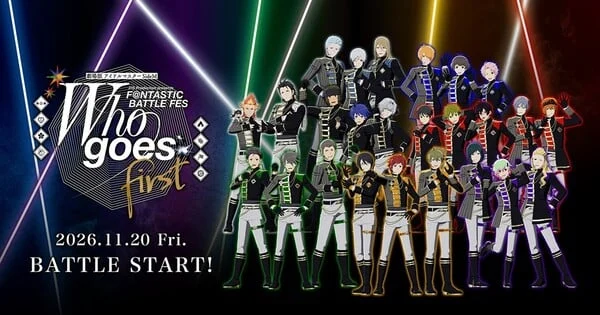
The sub-franchise of the long-running multimedia giant The Idolm@ster, known as SideM, is entering a significant period of revitalization. During the second day of the "The Idolm@ster SideM 11th Stage: Ever Ever After" concerts held this past Sunday, organizers officially unveiled a major cinematic project titled Gekijou-ban Idolm@ster SideM Fantastic Battle Fes: Who goes first. The film is slated for a wide theatrical release across Japan on November 20. This announcement serves as a strategic pivot for the franchise, which has spent the last year navigating a period of transition following the conclusion of its primary mobile service offerings.
Cinematic Production and Creative Direction
The upcoming film centers on the titular "Fantastic Battle Fes," a high-stakes event designed to showcase the talents of the idols within the 315 Production agency. The project is being spearheaded by Bandai Namco Entertainment, which is credited as both the original creator and the primary production entity.
The production team features a blend of industry veterans tasked with translating the high-energy performances of the idol units into a cinematic format. Takanori Urui of ManaMoA has been appointed as the film’s director, overseeing the project at the studios hotarubi and SIKAKU. The technical heavy lifting for the computer-generated imagery is being handled by director Zenta Yamazaki, while Asuka Fujimoto serves as the compositing director of photography and editor. To ensure the musical integrity—a hallmark of the Idolm@ster brand—Takatoshi Hamano is directing the sound, with Lantis producing the musical score.
Distribution will be handled by Shochiku ODS Jigyō-shitsu. In a move to engage the dedicated fanbase, the studio has confirmed that theaters will offer both standard screenings and "cheering screenings." The latter format, which has become a staple of idol-focused cinema in Japan, allows audience members to vocalize their support and utilize glowsticks during the film, effectively replicating the atmosphere of a live concert experience.
Console Gaming Expansion: A Strategic Shift
Beyond the silver screen, the most significant development announced during the 11th Stage concert was the revelation of the first-ever console game project for the SideM sub-franchise. In a move that underscores the long-term commitment of the parent company to the 315 Production intellectual property, D3 Publisher and Bandai Namco confirmed the game is in development for both the Nintendo Switch and the upcoming Nintendo Switch 2 hardware.
This title marks a departure from the franchise’s traditional reliance on free-to-play mobile apps. The game is framed as an adventure-driven production where the player assumes the role of a producer tasked with managing 16 distinct idol units, totaling 49 individual idols from the 315 Production agency. The narrative is set to be an original, standalone story that aims to introduce the complex dynamics of the agency to a broader audience while providing depth for established fans. By targeting console platforms, Bandai Namco is likely looking to capitalize on the longevity and stability of fixed hardware, moving away from the cyclical "service end" model that characterized the mobile iterations of the brand.
Historical Context and Franchise Evolution
To understand the significance of these announcements, one must examine the turbulent history of the SideM brand. Launched in 2014, the original smartphone game introduced the core concept of "idols you can produce," focusing specifically on male talent. The brand expanded rapidly, spawning multiple spin-offs, manga, and television anime.
The timeline of the franchise’s digital service life illustrates the volatility of the mobile gaming market in Japan:
- February 2014: The original The Idolm@ster SideM smartphone game launches.
- October 2017: The SideM television anime adaptation premieres, preceded by a prologue special featuring the Jupiter unit.
- June 2017: The Idolm@ster SideM: Live on St@ge! launches, shifting the focus toward performance-based gameplay.
- October 2018: The Wake Atte Mini! short-form anime series begins airing, based on the manga by Sumeragi.
- January 2021: Service begins to wind down for Live on St@ge!.
- October 2021: The Idolm@ster SideM: Growing Stars is released to modernize the gameplay experience.
- January 2023: The original 2014 smartphone game officially terminates service.
- July 2023: Growing Stars concludes its service, leaving the franchise without a flagship mobile presence for the first time in years.
The decision to transition into film and console gaming represents a calculated response to the saturation of the idol-gacha market. By shifting to premium-model software and theatrical experiences, Bandai Namco is insulating the SideM intellectual property from the operational costs and user-retention pressures inherent in the smartphone market.
Analytical Perspective: The 315 Production Strategy
The branding of "315 Production"—a play on the Japanese numbers 3-1-5, which can be read as "Saikou" (meaning "Ultimate" or "The Best")—has consistently been the focal point of the franchise’s marketing. The transition from mobile apps to console gaming suggests an attempt to "eventize" the franchise.
In the modern landscape of Japanese media, the "cheering screening" and console-focused content are strategies designed to cultivate a high-value, dedicated consumer base. Unlike mobile apps, which rely on microtransactions and constant content updates, the console game and film are "static" products. They do not expire in the same way a server-dependent game does, providing a more permanent home for the franchise’s characters and lore. This shift indicates that the stakeholders view SideM as a legacy brand that requires a shift toward more permanent, high-fidelity media rather than iterative mobile experiences.
Industry Implications
The involvement of Nintendo’s hardware—specifically the mention of the "Switch 2"—is particularly notable. By aligning with future-proof hardware, Bandai Namco is ensuring that the SideM console project will have a long shelf life. This aligns with a broader industry trend where major Japanese publishers are moving their flagship idol properties toward multi-platform releases to maximize visibility.
Furthermore, the involvement of diverse production partners like SIKAKU and hotarubi suggests that the film is being treated as a high-priority cultural event. The choice to include a "cheering screening" from the very start of the theatrical run indicates that the producers expect a highly engaged, community-driven turnout.
As the November 20 release date approaches, the industry will be watching to see if this pivot succeeds in maintaining the momentum of the 315 Production idols. Should the film and console game perform well, it may provide a roadmap for other mobile-centric franchises that have struggled with the decline of the smartphone gaming model. For the fans of The Idolm@ster SideM, the upcoming months represent not just a new chapter, but a potential stabilization of a brand that has been searching for a consistent platform for the better part of a decade.
The strategy is clear: focus on the community, prioritize the narrative, and move away from the temporal constraints of the mobile market. Whether the 315 Production agency can successfully transition from the small screen of a phone to the theater and the living room console will be the defining metric for the franchise’s future in the late 2020s.
Related posts: