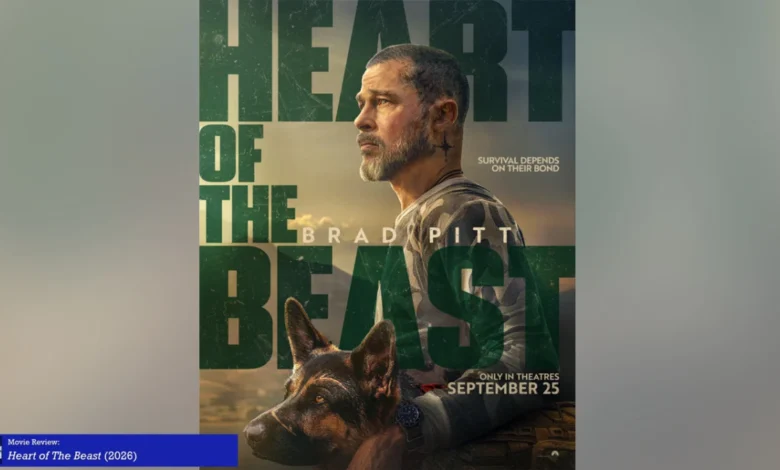
The cinematic landscape has long been populated by survival dramas depicting man versus nature, yet few recent releases have generated as much pre-release discussion regarding its central animal-human dynamic as Heart of the Beast. Directed by David Ayer and written by Cameron Alexander, the survival-adventure feature stars Brad Pitt as Special Forces veteran James Belmont alongside a German Shepherd named Odin, portrayed by a canine family consisting of four related dogs: Uber, Ryker, Hondo, and Zika. The film, which also features performances by J.K. Simmons and Anna Lambe, explores themes of active-duty military service, canine post-traumatic stress disorder, and wilderness survival. Produced with an eye toward both emotional resonance and high-stakes action, the project has drawn critical attention for its minimalist dialogue, breathtaking cinematography, and the unique physical challenges undertaken by its lead actors.
Main Facts and Production Background
At its core, Heart of the Beast follows James Belmont, an elite soldier returning from deployments in Iraq and Afghanistan, and Odin, a battle-scarred retired military working dog bearing a prosthetic foreleg and the invisible psychological wounds of combat. The narrative is framed by a modern-day bookend involving a traveler named Amber, played by Anna Lambe, whose highway encounter with a lone dog sets the story’s historical timeline into motion a week prior.
The production utilized extensive physical training regimens for its human lead, with Brad Pitt undergoing rigorous preparation to convincingly portray a member of the Special Forces. Meanwhile, the canine actors required specialized handling to bring authenticity to Odin’s tactical background and physical limitations. Although the film is explicitly set against the majestic, snow-dusted peaks and lush summer greenery of the Alaskan wilderness, principal photography was actually executed in New Zealand. This choice allowed the production to leverage New Zealand’s dramatic topography while utilizing advanced visual effects to seamlessly integrate iconic North American fauna, including bears, moose, and hyper-realistic wolf packs.
Chronology of the Narrative and Survival Arc
The narrative unspools systematically, establishing the deep, symbiotic relationship between James and Odin before plunging them into crisis.
Phase One: Into the Wild
The film opens with a framing sequence before transitioning to a Cessna pontoon aircraft soaring over expansive landscapes, ultimately touching down on a secluded alpine lake in Alaska. James and Odin embark on initial reconnaissance into the untamed backcountry. During these early days, viewers observe their routines: James tracking a moose without firing his weapon, and Odin successfully foraging and fishing to provide sustenance for the pair. It is during this quiet stretch that the film establishes their shared trauma, revealing that Odin experiences nightmares and PTSD symptoms mirroring those of his human handler.
Phase Two: The Encounter and the Escalation
A brief disruption occurs with the introduction of an extraneous conversationalist named Watkins, portrayed by J.K. Simmons. Watkins embeds himself in their camp overnight, rambling about the serenity of nature before departing down a misty river by canoe, never to return. This encounter serves primarily as a narrative device, offering James an isolated outlet to voice fragments of his past before the plot accelerates toward its central catastrophe.
Phase Three: The Crash and Isolation
As a severe weather front moves in, James hurriedly packs the campsite into his aircraft. He successfully pilots the plane above the turbulent storm clouds, only to be struck down mid-flight by a massive heart attack. Incapacitated by agonizing pain in his left arm, James loses consciousness. The aircraft descends rapidly, clipping tree branches and forcibly ejecting Odin through the passenger door before slamming violently into a remote lake.
Phase Four: The Struggle for Survival
Miraculously regaining consciousness just as the cabin fills with water, James finds an air pocket, frees himself, and plunges into the frigid depths to locate his canine companion. Finding Odin unconscious but structurally uninjured, James revives the dog. Realizing they are stranded miles from civilization, James dives back to the partially submerged wreckage to salvage cargo containers, fashioning a functional field pack from the recovered supplies. Armed only with a map, a compass, and an unbreakable bond, the man and dog begin a grueling cross-country trek toward the nearest highway.
Supporting Data and Technical Analysis
From a technical standpoint, Heart of the Beast distinguishes itself through restrained storytelling and masterclass craft services. Because the script relies heavily on non-verbal cues, the emotional heavy lifting falls squarely on the chemistry between Pitt and the canine ensemble. Film critics have noted that the lack of conventional dialogue elevates the necessity for precise editorial pacing and atmospheric sound design.
The production’s aesthetic achievements are largely driven by its cinematography, which captures both the sweeping, epic scale of primeval valleys and the quiet intimacy of man and dog fishing side-by-side. Night sequences are meticulously illuminated, featuring artificial auroras that enhance the visual poetry of the wilderness. Furthermore, the editing team has received widespread acclaim for the fluidity and composition of high-stress sequences—ranging from turbulent river descents without a vessel to the visceral intensity of close-quarters wildlife confrontations.
However, the film’s narrative mechanics have not escaped critical scrutiny. The inclusion of J.K. Simmons’s character has been debated by reviewers who view Watkins as a superfluous addition, likely born out of industry relationships rather than strict script necessity. Additionally, certain action set-pieces—such as James surviving a high-velocity impact against river rocks and outmaneuvering an outnumbering wolf pack—test the boundaries of audience credulity. While filmmakers lean heavily on James’s Special Forces conditioning to justify these physical feats, some analysts argue that these heightened action beats occasionally strain the otherwise grounded tone of the survivalist drama.
Official Responses and Industry Context
Neither director David Ayer nor screenwriter Cameron Alexander has shied away from the physical and emotional intensity required to bring Heart of the Beast to the screen. Speaking on the integration of military working dogs into modern action cinema, production insiders have emphasized a desire to shine a light on the often-overlooked contributions of K-9 units in active combat and their subsequent rehabilitation in civilian life.
Organizations dedicated to military working dogs have privately and publicly welcomed mainstream cinematic depictions that accurately reflect canine PTSD—a very real medical condition diagnosed in animals returning from high-stress combat theaters. By centering Odin not merely as a plot device or a cute companion, but as a traumatized veteran working through parallel psychological injuries alongside his handler, the film bridges the gap between conventional Hollywood adventure and socially conscious storytelling.
Broader Impact and Implications
Heart of the Beast arrives at a time when audiences increasingly gravitate toward grounded, character-driven narratives that eschew excessive CGI spectacle in favor of tangible, visceral stakes. By pairing an A-list actor of Brad Pitt’s caliber with a quartet of expertly trained animal performers, the production sets a new benchmark for cross-species cinematic chemistry.
The film’s broader implications extend to the ongoing conversation surrounding animal welfare in media production and the recognition of military working animals. By humanizing—or rather, deeply validating—the emotional inner life of a battle-scarred German Shepherd, the movie encourages viewers to reflect on the real-world sacrifices made by K-9 units in global conflicts.
Ultimately, while the feature incorporates familiar narrative beats from classic wilderness survival templates, its fusion of high-stakes action, emotional vulnerability, and technical mastery ensures its place as a notable entry in the modern adventure genre. As audiences prepare for its widespread release, Heart of the Beast stands as a testament to the enduring power of companionship when humanity and nature collide in their most unforgiving forms.