Narrative Premise and Core Conflict
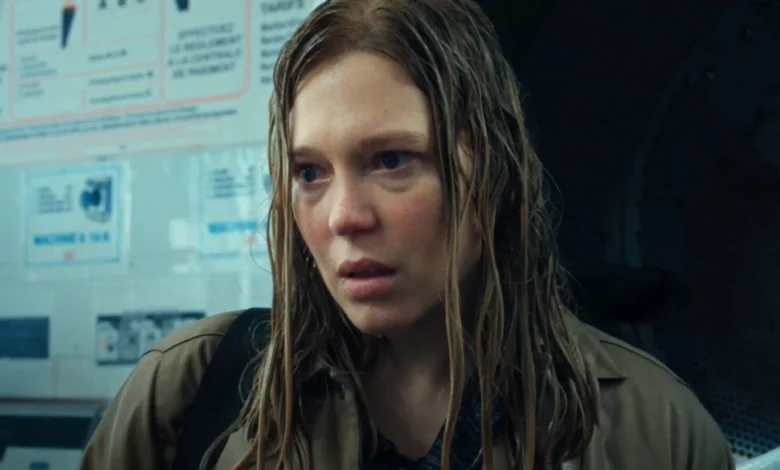
The film centers on David Zimmerman, a solitary and somewhat aimless Parisian photographer portrayed by Niels Schneider. His life is defined by a penchant for voyeurism and an obsession with documenting the architectural evolution of Paris, often juxtaposing vintage photographs of the city’s streets with their modern counterparts. His life is upended during an atmospheric artsy party when he encounters a mysterious woman, played by Léa Seydoux. The encounter culminates in a wordless, ritualistic sexual act that serves as a catalyst for a supernatural body swap.
Upon reaching climax, the characters undergo a total physiological displacement. David’s consciousness is effectively trapped within the body of the woman, who is later identified as Eva Helsinger, a German-born individual. Simultaneously, the woman’s consciousness inhabits David’s former vessel, leaving him to navigate a reality where his own identity is being worn by a stranger. This narrative conceit serves as the foundation for an inquiry into the nature of the self: If the body is the primary vehicle for our existence, what remains of the individual when that vessel is usurped?
Chronological Development and Artistic Vision
The film’s development can be traced back to the 2024 collaborative writing sessions between Arthur and Lucas Harari. The graphic novel served as a storyboard for what would eventually become a technically demanding film production. Cinematographer Tom Harari, working in tandem with his brother, utilized a restless, paranoid visual language to reflect the protagonist’s internal instability.
The film is structured into two distinct, unequal parts. The first half focuses on the immediate, often frantic realization of the displacement. David’s initial attempts to reconcile his new physical reality with his previous life are marked by a blend of confusion and illicit curiosity. He finds, perhaps momentarily, that the anonymity of his new form provides a reprieve from the social pressures and expectations he faced in his original life, including the intrusive presence of his mother and social circle.
The second half of the film descends into a more isolated, existential malaise. As David-as-Eva attempts to track down his original body, he discovers a trail of others affected by similar phenomena. The narrative structure becomes increasingly elliptical, prioritizing the "sense" of the mystery over providing concrete answers. This choice has polarized initial critical reception, with some praising the film’s refusal to explain its supernatural mechanics, while others note the potential for audience alienation.
Technical Analysis and Stylistic Choices
The production of The Unknown is noteworthy for its departure from the "blood and guts" expectations of body horror. Harari avoids the traditional prosthetics and grotesque transformations seen in the works of directors like David Cronenberg. Instead, the horror is found in the uncanny nature of the performances.
Léa Seydoux’s performance as the inhabitant of David’s body is a masterclass in controlled, agitated physicality. The film utilizes "perspective rug-pulls," where the audience is forced to re-evaluate the identity of characters based on subtle behavioral cues rather than explicit exposition. The editing—characterized by jarring crash zooms and sudden silences—reinforces the theme of a reality that is fundamentally "out of sync."
The use of still photography throughout the film acts as a meta-commentary on the medium of film itself. David’s photographic project, which captures buildings that no longer exist, mirrors his own status as a person who has effectively ceased to exist in his own life. The visual contrast between the static, fading images of old Paris and the chaotic, kinetic energy of the post-swap world underscores the film’s thesis on the relentless, often cruel nature of change.
![‘The Unknown’ Review: Disturbing, Bewitching Body Horror [London Film Fest]](https://www.dreadcentral.com/wp-content/uploads/2026/10/thumb_CCA279A4-F579-44D2-80FE-D6005C5DC670-1600x900.jpg)
Thematic Implications: Body vs. Identity
At its core, The Unknown poses an uncomfortable question: Are our bodies merely tools we inhabit, or are they inextricably linked to the essence of our being? The characters in the film, upon realizing they have been displaced, quickly adopt a strategy of "rational deception." They assume that friends and family will not believe the truth, choosing instead to lie to maintain their place in the world.
This behavioral choice suggests that identity is, in part, a performance managed for the benefit of others. When David finds that he cannot communicate his true self to those who knew him, he is forced to confront the reality that his relationships were perhaps tethered to his physical presence rather than his internal consciousness. The film suggests that the "self" is a fragile construct that can be dismantled by the removal of its physical anchor.
Supporting Cast and Secondary Narrative Arcs
The supporting cast, including Valérie Dréville as David’s mother and Lilith Grasmug as the young woman Malia, serves to highlight the protagonist’s growing isolation. Malia’s interaction with David-as-Eva provides one of the film’s most disturbing sequences, as it confronts the audience with the horror of being perceived as someone else by those you care about. The disgust and confusion expressed by these secondary characters serve as a reflection of David’s own self-loathing.
By the film’s conclusion, the entity responsible for the switch has vanished, leaving the victims to navigate a fragmented existence. The lack of a "fix" for the situation is a deliberate choice by the screenwriters to emphasize the permanence of the trauma. It transforms the film from a standard genre piece into a meditation on alienation and the loss of agency.
Broader Industry Impact and Reception
The film has been categorized by industry observers as a "festival-driven" project that challenges mainstream distribution models. Its reliance on abstract dread rather than plot-driven resolution makes it a difficult sell for general audiences, yet it occupies a crucial space in contemporary European cinema. The "Oscar-to-Auteur" trajectory taken by Arthur Harari highlights a growing trend of established filmmakers returning to niche, high-concept projects after mainstream successes.
Statistically, the film’s performance at initial screenings suggests a strong appeal to audiences interested in the "new wave" of psychological horror. While it lacks the explosive box-office potential of blockbuster horror franchises, its cultural footprint is likely to be measured by its influence on the sub-genre of "possession without spirits," focusing instead on the corruption of the self.
Conclusion: A Legacy of Dread
The Unknown does not seek to provide comfort or clarity. It is a film that demands the audience surrender to its irrational logic. Through its focus on the disappearance of the self and the terrifying possibility that our bodies might one day feel entirely foreign, it strikes a chord with the modern experience of digital and social alienation.
The film ultimately serves as a reminder that the most profound horrors are often those that occur within the skin, unseen by the outside world. By the time the credits roll, the viewer is left with the lingering, uncomfortable feeling that the identity they claim as their own is, perhaps, more temporary than they would like to believe. Whether or not the film’s ambiguous ending resonates with viewers, its technical prowess and conceptual audacity ensure its place as a significant entry in the 2026 horror landscape. The Unknown is not merely a story about a body swap; it is an interrogation of the very mechanisms of human existence, performed with the clinical detachment of a photographer and the emotional intensity of a nightmare.