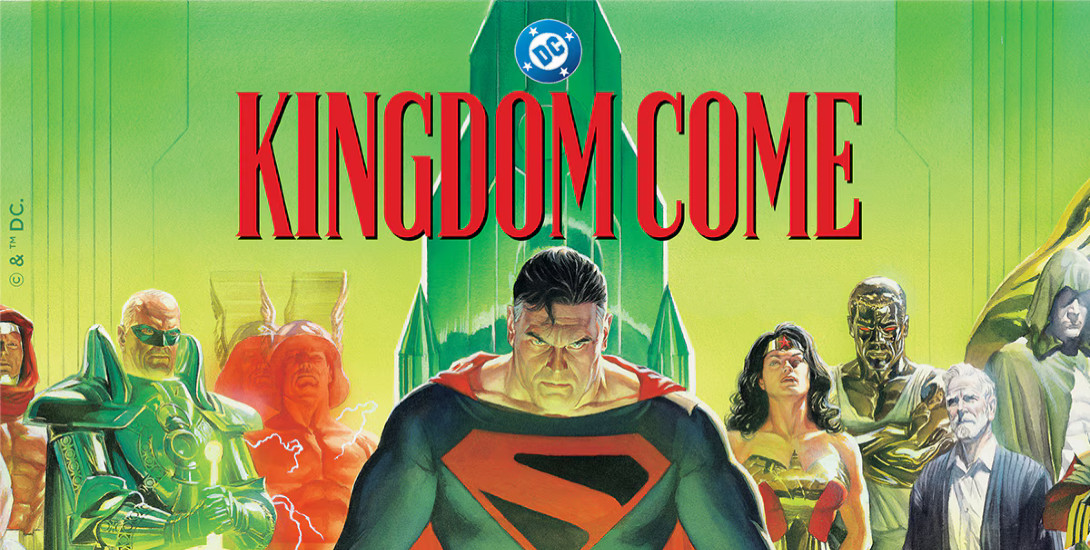
The ongoing essay series, "The Precedented Times: Reading Kingdom Come in 2026," continues its retrospective examination of Mark Waid and Alex Ross’s seminal 1996 graphic novel, Kingdom Come. This analytical endeavor, viewed through a 2026 lens, aims to interrogate the timeless questions posed by the narrative regarding power, authority, and societal control, particularly in a world increasingly shaped by advanced technology and shifting geopolitical landscapes. Chapter Two of this four-part saga plunges readers into a disquieting future, where the lines between heroism and vigilantism blur, and the very foundations of democratic governance are challenged by both super-powered beings and sophisticated technological solutions.
Kingdom Come, published by DC Comics, is a four-issue comic book miniseries set in a near-future DC Universe. It depicts a world where the established generation of superheroes, including Superman, Batman, and Wonder Woman, have retired, replaced by a new, more violent, and reckless cohort of metahumans. The narrative explores themes of generational conflict, the nature of heroism, the role of divine power in human affairs, and the delicate balance between freedom and order. The current retrospective series critically re-evaluates these themes, positing how a thirty-year-old work of fiction can offer profound insights into contemporary societal dilemmas, from the proliferation of surveillance technology to debates surrounding immigration and the erosion of traditional political authority.
Chronology of Chapter Two Events
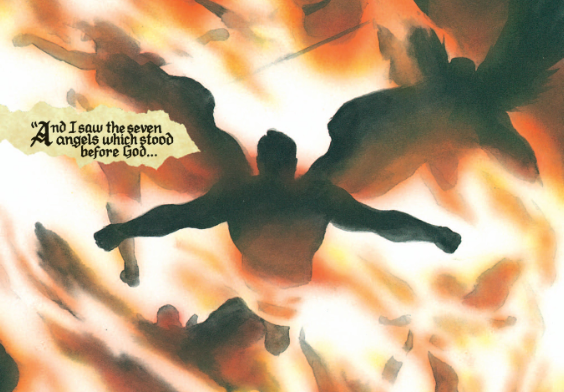
Chapter Two commences with a vivid vision experienced by the narrative’s human observer, Pastor Norman McCay, guided by the Spectre. McCay witnesses shadows of heroes soaring through the flames of Lady Liberty’s torch, a scene ominously prefaced by lines from the Book of Revelation: "And I saw the seven angels which stood before God…" This apocalyptic imagery immediately sets a tone of impending judgment and divine intervention, hinting at the profound moral and ethical conflicts that will unfold.
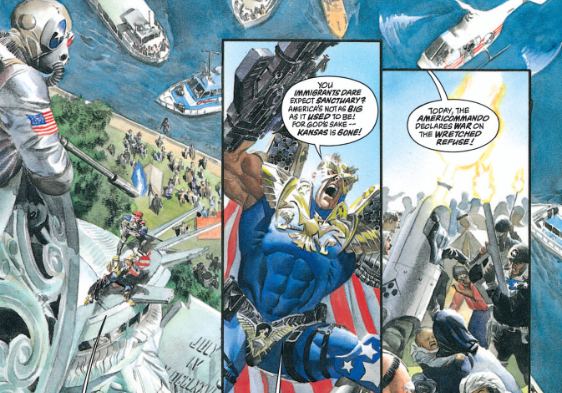
The vision transitions to a chaotic scene at the Statue of Liberty, where a crumbling structure is encircled by boats and helicopters. Americommando, a figure clad in a blue jumpsuit with a red and white striped cape and a gilded eagle emblem, brandishes a weaponized hand and vehemently declares the United States "HIS country." He confronts an alarmed throng of newly arrived immigrants, accusing them and their families of being the "most insidious menace" to the nation. Americommando and his "Minutemen," who claim to have defended the country from foreign threats, then declare war on these immigrants. This volatile situation is further complicated by the arrival of another group of robotic vigilantes, also adorned in patriotic colors, who assert their own claim to defend the land.
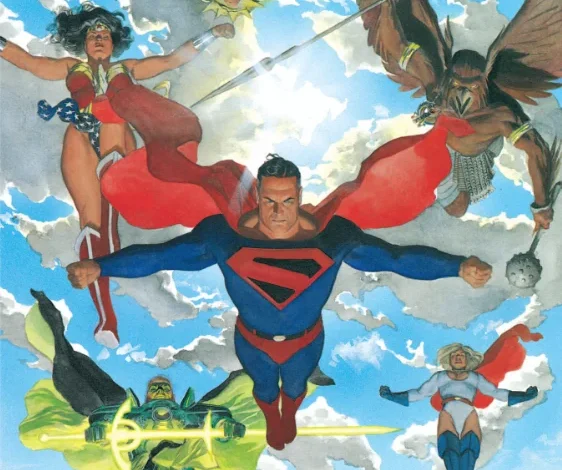
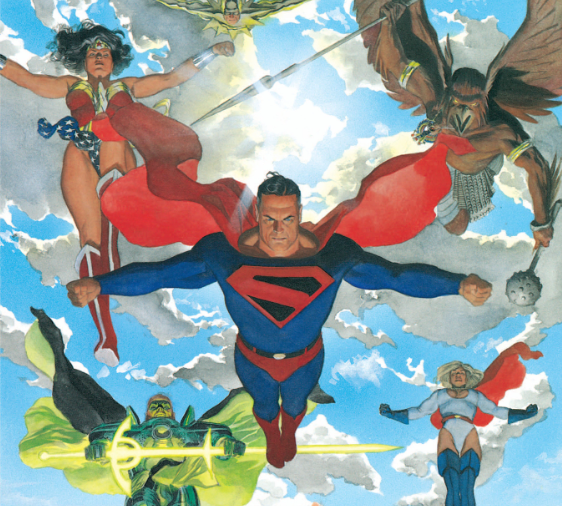
As projectiles and flames erupt, innocent civilians, including families with frightened children, are caught in the escalating crossfire. Both factions—Americommando’s group and the robotic vigilantes—claim to be acting in defense of the nation, yet neither demonstrates any concern for the human lives imperiled by their conflict. Norman McCay, observing the horror, expresses a desperate need for intervention. In a dramatic turn, the reunited Justice League descends, swiftly neutralizing the combatants. Superman disarms Americommando, while Green Lantern and other League members focus on rescuing civilians from the water and providing protective cover. McCay initially perceives the League as "angels," agents of divine righteousness, but quickly corrects himself, recognizing them as "Gods"—beings of immense power who operate by their own will and ideals, a distinction that carries significant thematic weight regarding their self-appointed authority.
High above the unfolding chaos, two figures in metallic suits, later identified as the "Brain Trust," panic as their mental link to the patriotic robots is disrupted. This brief interlude suggests that not all the metahuman conflicts are spontaneous acts of anarchy; some are orchestrated by unseen forces for undisclosed objectives. Before they can re-establish control, Red Robin, identified as Dick Grayson, incapacitates them. This reveal introduces a layer of clandestine manipulation, indicating that the escalating global instability is, in part, a calculated strategy. The immediate conflict concludes with Wonder Woman heroically saving panicked bystanders from a falling section of the Statue of Liberty, just as the press arrives, their primary question echoing public sentiment: "Where have you been?"
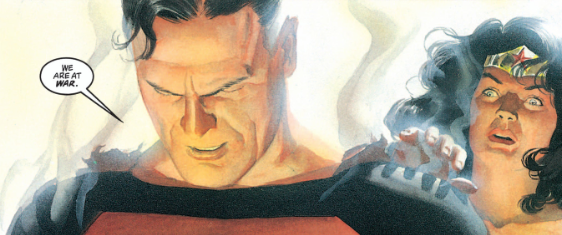
To preempt speculation and assert their renewed presence, Superman holds a press conference at the United Nations. He publicly acknowledges the Justice League’s previous withdrawal as a mistake and vows that he and his counterparts will teach the new generation of metahumans "the meaning of truth and justice." He promises that order will be restored through wisdom, but chillingly adds, "if necessary, with force." Superman’s stated objective is to "make things right again," yet his plan remains vague, effectively leaving the definition and enforcement of law and order to the discretion of the vigilantes. Reporters raise critical questions about potential confrontations with figures like Magog and, more broadly, how metahumans who do not align with the Justice League’s principles will be handled. Wonder Woman abruptly concludes the conference, leaving these crucial questions unanswered.
The reaction from the United Nations leadership is notably negative. These government officials express profound displeasure at Superman’s unilateral return and his declarations. They perceive his resurgence and the League’s determination of future actions, without consultation with any political or legal body, as a severe threat to human self-governance. This highlights a critical flaw in the Justice League’s approach: while they possess unparalleled power, they lack democratic legitimacy or legal authority. Superman, despite intending to reassure the public, inadvertently reinforces the perception that powerful metahumans can bypass established legal frameworks at will. Norman McCay, though initially relieved by Superman’s return, grows increasingly anxious as his visions imply Superman’s entanglement in a coming evil, deepening his apprehension about the future.
The narrative then shifts to the dilapidated and seemingly abandoned Wayne Manor. Superman, however, knows better, descending into the waterlogged Batcave to confront Bruce Wayne. Batman, surrounded by advanced technology and live feeds of Gotham, greets Superman with characteristic cynicism. He dismissively explains that Bane and Two-Face destroyed the manor after his identity was leaked, indicating his detachment from the superficial aspects of his former life. The tension between the two iconic heroes is palpable as Superman informs Bruce that Arkham, Belle Reve, and Blackgate prisons have been annihilated by a metahuman, resulting in significant casualties among prisoners and personnel. Despite this devastation of most of his rogues’ gallery, Bruce appears preoccupied, which is his concise response to Superman’s invitation to rejoin the Justice League.
Predictably, Bruce Wayne holds a vastly different perspective on the unfolding crisis. While remotely controlling a bat-eared robot to apprehend a robber, he argues that the exponential growth of metahuman numbers has resulted in them holding primary control of the world. He advocates for "finesse and meticulous, careful planning," dismissing the Justice League’s "punch now, ask questions later" approach as counterproductive. Superman retorts that Bruce’s "new Gotham" is nothing more than a police state, where constant surveillance and robotic agents foster a perpetual atmosphere of fear and paranoia among its citizens. Unfazed, Bruce reveals his surveillance network extends beyond Gotham to Star City and that he has cultivated his own network of allies more attuned to humanity’s needs. He labels Superman and the League "totalitarian," seemingly unaware of the inherent paradox of criticizing their authority while operating a privately-controlled, comprehensive surveillance state without public oversight.
Upon Superman’s departure, Bruce’s hidden allies reveal themselves, though they suspect Superman was aware of their presence. This covert group includes Dinah Lance (Black Canary), Oliver Queen (Green Arrow), and Ted Kord (Blue Beetle), among others. They concur that Superman and the Justice League’s actions will ultimately cause more harm than good and disclose their contingency plan: a metahuman team of their own designed to counter the League. Norman McCay and the Spectre observe this development, with McCay questioning the historical friendship between Superman and Batman. The answer, the Spectre implies, is complex: perhaps not friends in the traditional sense, but certainly "unlikely equals" bound by a shared, albeit divergent, commitment to justice.
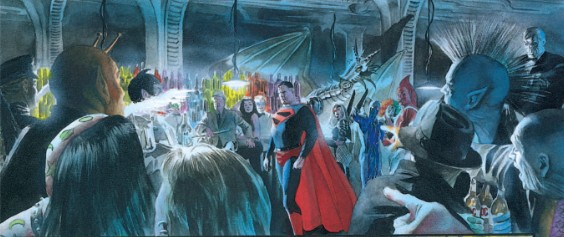
As days pass, Superman and the Justice League exert their efforts globally to resolve conflicts and mitigate damage, attempting peaceful negotiations but resorting to force when agreements fail. Their methods become increasingly assertive, as demonstrated by their infiltration of a metahuman nightclub. After needlessly destroying the premises, they "encourage" all present to join the League, leaving an implicit threat of consequences for non-compliance.
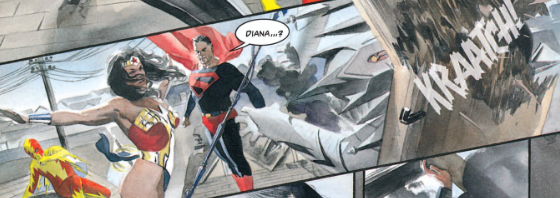
The League’s expanding reach extends beyond the United States, eliciting mixed reactions. While many initially express hope, Norman McCay observes an unsettlingly militant undertone in their operations. Wonder Woman, in particular, appears to be nearing a breaking point. During a confrontation, when a new metahuman offers unwanted assistance, Diana hurls them through the sky in a fit of rage. Superman attempts to calm her, but the incident painfully reveals the immortal Amazon princess’s frustration with untrained individuals engaging in reckless combat and the endless cycle of cleanup. While Superman acknowledges the problem posed by these new metahumans, his reminder of the "sacred nature of human life" comes across as a subtle rebuke of her extreme methods. This quiet fracture in their alliance foreshadows deeper ideological rifts.
The narrative confirms the survival of Lex Luthor, who has established the "Mankind Liberation Front," a coalition of former supervillains seeking to exploit the escalating metahuman conflict for their own advantage. Ostensibly, they focus on providing relief to victims of the Kansas disaster, but Luthor’s surface-level altruism masks hidden motives. Capitalizing on Superman’s previous absence, Luthor expanded his influence. It is revealed that his cohort has taken metahuman survivors from Arkham and Belle Reve, rebranded them, and outfitted them as new "superheroes." Although these manipulated individuals constitute only 8% of the new vigilantes, they are strategically deployed to escalate problems and further erode public trust in all superheroes. Despite some unease among Liberation Front members about arming more metahumans, Luthor insists the risk is justified if it galvanizes humanity to completely reject and oust all super-powered beings. The Justice League’s resurgence is an unexpected obstacle, but Luthor reveals he already has a contingency in motion, centered on Billy Batson.
The timeline then jumps to a near future where America has managed to stabilize, though the situation remains precarious. The League shifts its focus to international metahuman issues. While many are awestruck by Superman and immediately yield, others resist, and each escalation to violence further aggravates Superman. His lack of formal diplomatic training increasingly becomes a liability. His attempts to forge alliances with figures like Arthur Curry (Aquaman) and Orion (now controlling Apokolips) prove futile. As Superman and Wonder Woman debate the increasingly totalitarian methods they feel compelled to employ, they receive news that Magog has finally been located. This development promises to shed light on the pivotal events that led to Superman’s decade-long withdrawal.
Magog is discovered in the desolate landscape that was once Kansas, attempting, with a touch of futility, to rebuild. Superman confronts him, exuding moral superiority, but Magog remains defiant. He expresses certainty that Superman will not harm him, a certainty that fuels his blame for the current state of the world. A flashback reveals that ten years prior, after the Joker murdered the staff of the Daily Planet, including Lois Lane, Magog executed the Joker in the street. Despite his profound personal loss, Superman, committed to upholding the law, believed Magog had no right to act as judge, jury, and executioner. He brought Magog in for trial, only for him to be acquitted. Public sentiment, frustrated by a justice system that repeatedly failed to contain the Joker, largely sided with Magog, who was perceived as having the courage to do what Superman would not. Rather than engage in the ensuing debate or steadfastly uphold his principles, Superman retreated from the world, leaving humanity vulnerable to the influence of those who idolized Magog’s brand of vigilante justice. Magog asserts that Superman’s retreat was born of fear of the future Magog represented, a future he now starkly illustrates by gesturing to the wasteland around them, before attacking Superman.
Following their confrontation, Magog is defeated and broken, begging Superman for death to escape the "million ghosts" haunting him. This moment forces Superman to confront the inescapable question of what to do with metahumans who defy the League or commit unforgivable acts. His answer: a "Big Prison." While the concept of containing dangerous individuals is inherently sound, a prison controlled solely by the Justice League effectively bypasses standard legal protocols for arrest, trial, and sentencing, removing human agency from the metahuman situation. Norman McCay astutely observes an even greater danger: concentrating a vast array of volatile, super-powered individuals under one roof creates a "ticking time bomb."
Chapter Two concludes with the formation of an unthinkable alliance: Bruce Wayne and Lex Luthor. Bruce, now aware of the Justice League’s new super-prison and their expanding, unchecked authority, feels he can no longer tolerate their methods. His disdain for Superman’s unilateral actions seemingly outweighs decades of animosity between himself and the villains now allied with Luthor, including former members of his own rogues’ gallery such as Catwoman (Selina Kyle) and The Riddler (Edward Nigma). By establishing a prison where the Justice League can arbitrarily detain perceived threats, Superman has inadvertently positioned the League as judge and jury over the world. Bruce, unwilling to wait for their authority to extend to executioner, initiates this chilling alliance, setting the stage for a profound ideological conflict.
Thematic Analysis: Power, Authority, and Governance
Chapter Two of Kingdom Come profoundly explores the tension between raw power and legitimate authority. The Justice League, in its return, wields immense power, capable of swiftly ending conflicts and imposing its will. However, their actions, particularly Superman’s unilateral declarations at the UN, highlight a fundamental lack of democratic mandate. They are not elected officials, appointed law enforcement, or representatives of any legal or political body. Their authority is self-appointed, based on their perceived moral superiority and capacity for action. This directly challenges the principles of constitutional checks and balances and human sovereignty.
The concerns voiced by the UN leaders are a critical commentary on the erosion of traditional governance. In a world where super-powered individuals can dictate global policy and enforce their own brand of justice, the role of human institutions becomes marginalized. This scenario mirrors contemporary debates about the influence of powerful non-state actors, whether corporations or highly influential individuals, on national and international affairs, often operating outside conventional democratic accountability. The "Big Prison" concept further concretizes this shift, illustrating a system where detention and judgment are meted out by a powerful few, rather than through established legal processes.
The Ethics of Surveillance and Security
Bruce Wayne’s "utopian" Gotham, maintained through pervasive surveillance and robotic enforcement, serves as a chilling allegory for modern concerns regarding privacy and civil liberties. His network, extending beyond Gotham, operates without transparent safeguards or democratic oversight. While presented as a solution for order, it effectively creates a police state where citizens are under constant monitoring, and their data is presumably collected and analyzed without consent.
This aspect of Kingdom Come resonates powerfully in 2026, a year where discussions around the ethical implications of advanced technology, artificial intelligence, and corporate surveillance are at their peak. The narrative prompts a critical examination of the trade-off between security and freedom, asking at what cost order is truly achieved. The idea of unelected billionaires controlling vast surveillance networks and privately operated security forces, even with benevolent intentions, raises profound questions about potential abuses of power, data privacy, and the fundamental right to individual autonomy in an increasingly digitized world. The comic’s foresight in depicting such a scenario decades ago underscores its enduring relevance to contemporary technological and ethical dilemmas.
The Shifting Landscape of Heroism and Villainy
The lines between heroism and villainy, and indeed between different factions of "heroes," become increasingly blurred in Chapter Two. The Americommando incident illustrates how even those claiming patriotic defense can devolve into xenophobic violence, mirroring real-world extremist groups who justify harmful actions under the guise of national protection. The Justice League, while intervening for a greater good, increasingly adopts militant tactics, exemplified by Wonder Woman’s rage and the implied threats at the metahuman nightclub. This suggests a dangerous path where even noble intentions can lead to authoritarian methods.
Lex Luthor’s "Mankind Liberation Front" cleverly exploits this ambiguity. By rebranding former villains as "superheroes" and using them to escalate chaos, Luthor manipulates public perception, further eroding trust in all super-powered beings. This strategy highlights the cynical exploitation of societal instability and the power of narrative control. The ultimate irony is Batman’s alliance with Luthor and his rogues’ gallery. This unprecedented partnership underscores the deep ideological chasm that has opened between Batman and Superman, demonstrating that for Batman, the unchecked authority of the Justice League poses a greater, more fundamental threat than the traditional supervillains. This development forces readers to question the very definition of heroism and villainy in a world devoid of clear moral absolutes.
Conclusion: Enduring Relevance and Foreshadowing
Chapter Two of Kingdom Come solidifies the graphic novel’s status as a prophetic work, particularly when viewed through the lens of 2026. It moves beyond simply depicting chaos to meticulously dissecting the origins and implications of that chaos, revealing how even well-intentioned actions by powerful individuals can lead to a state of profound instability and the erosion of fundamental liberties. The central conflict—not merely between heroes and villains, but between differing philosophies of governance and order—becomes starkly evident.
The narrative skillfully explores how the Justice League, in seizing the reins of society without legal authority, inadvertently strips ordinary humans of their power to influence world events through democratic processes. Simultaneously, Bruce Wayne’s high-tech surveillance state, while aiming for safety, sacrifices privacy and personal freedom, embodying a different, yet equally problematic, form of unchecked power. The series compels readers to confront the uncomfortable truth that the very heroes we are conditioned to trust can, through their interpretation of authority, become complicit in, or even the genesis of, the chaos they seek to prevent. As factions vie for control in a world overrun with metahumans, each offering their own solutions, the overarching implication is clear: power is increasingly consolidated in the hands of an untouchable few, regardless of their intentions. The quiet ideological fractures within the Justice League itself, particularly between Superman and Wonder Woman, further underscore the inherent instability when the safety and well-being of humanity are entrusted to individuals who operate above the law. Kingdom Come thus remains an urgent and compelling narrative, a cautionary tale about the perils of unchecked power and the delicate balance required for a just and free society.
Related posts: