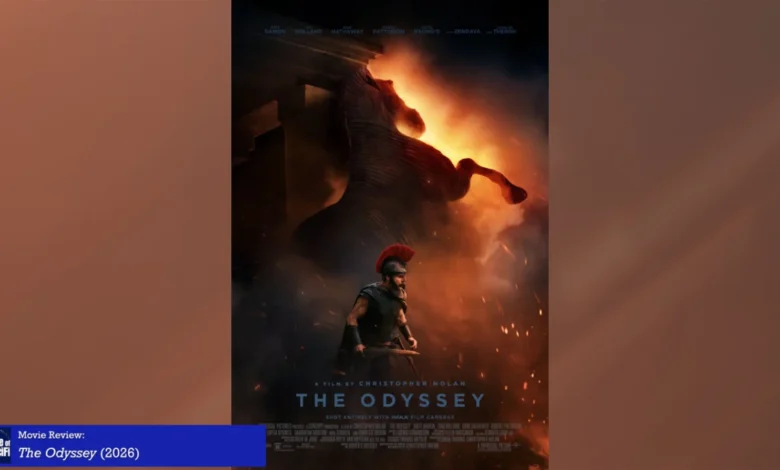
Christopher Nolan’s ambitious adaptation of Homer’s ancient Greek epic, "The Odyssey," has arrived in cinemas, fulfilling its considerable hype and solidifying the director’s reputation as a modern auteur. This cinematic rendition is not merely a retelling of a foundational Western narrative but a profound exploration of timeless themes, masterfully executed through Nolan’s signature blend of intellectual depth and visual spectacle. The film delves into the harrowing price of war, the moral compromises inherent in survival, and the enduring human cost of abandoning one’s principles, offering a compelling and resonant experience for audiences.
The source material, Homer’s "The Odyssey," has captivated imaginations for approximately 2,700 years. Given its antiquity and widespread familiarity, the concept of "spoilers" in a cinematic adaptation might seem paradoxical. However, Nolan’s approach transcends mere plot revelation. The film’s power lies not in surprising audiences with narrative twists, but in the innovative and often visceral ways it portrays familiar events. The director eschews the need for explicit plot summaries within the film itself, implicitly trusting that the audience will either be familiar with the epic or can seek out synopses through traditional means or, as the original review suggests, via artificial intelligence. This allows the film to focus on the experiential and thematic rather than the purely narrative.
A striking aspect of Nolan’s "The Odyssey" is its thoughtful engagement with the evolution of storytelling. The transition from Homer’s oral and written traditions to the modern cinematic medium is a central undercurrent. The enduring appeal of Homer’s work is attributed to its compelling nature, a quality that cinema has long sought to emulate. By drawing from such a primeval source, Nolan’s adaptation feels particularly significant, bridging millennia of human narrative through a contemporary visual language. The film’s faithfulness to the Homeric text, particularly in its meticulous re-creation of sets, costumes, and weaponry, contributes to an immersive and believable ancient world. This is far removed from the often-superficial grandeur of earlier "sword-and-sandal" epics, opting instead for an earthy, gritty realism that grounds the fantastical elements.
Visualizing the Unseen: The Trojan Horse and Beyond
Nolan’s interpretation of iconic moments, such as the Trojan Horse, offers a particularly arresting departure from conventional depictions. The emphasis on the claustrophobic, terrifying experience of being concealed within the belly of the massive wooden structure provides a raw and visceral perspective, challenging preconceived notions of this legendary ruse. This commitment to detail extends to the depiction of the various sea vessels, which are rendered with an authenticity that evokes the period, including the humble raft upon which Odysseus undertakes a significant portion of his journey.
Narrative Structure and Psychological Depth
While Homer’s "The Odyssey" is famously non-chronological, Nolan’s adaptation introduces a nuanced narrative framework. In this iteration, Odysseus’s (Matt Damon) recounted memories are framed as tales told to the nymph Calypso (Charlize Theron) during his prolonged sojourn on her island, a departure from the original text’s structure. This narrative device allows for a more introspective exploration of Odysseus’s psyche, particularly his prolonged isolation and the psychological toll of his experiences.
The Mythic Realm: Monsters and the Supernatural
The film opens with the tagline, "A time of apparent magic," setting the stage for the fantastical elements that define Odysseus’s arduous journey. As Odysseus recounts the horrors faced by his now-deceased crew, audiences encounter the mythical creatures familiar from the epic: the Cyclops, the sorceress Circe, the alluring Sirens, and the perilous whirlpools of Scylla and Charybdis. The film presents these entities not with overt explanations for their existence, but as accepted components of Odysseus’s reality. The visual effects employed to render these creatures are described as "top-notch," seamlessly integrating the supernatural into the film’s otherwise grounded aesthetic.
A particularly striking inclusion are the Laestrygonians, a race of giants with a penchant for consuming humans. While their distinctive uniforms were featured in promotional materials, the film’s portrayal offers a more complex visual, eschewing a simplistic association with Greek or Trojan soldiers and presenting a unique and imposing visual identity for this formidable race.
The scenes depicting Odysseus and his crew summoning the dead are imbued with a profound sense of dread and unease. The ritualistic sacrifice of two goats to attract spirits, and the subsequent appearance of Tiresias (James Remar), are rendered with an eerie efficacy. Tiresias, portrayed as both creepy and prophetic, contributes to the unsettling atmosphere. The panicked flight of the shipmates from the summoned dead back to their vessel is a testament to the film’s ability to evoke palpable fear and disquiet.
The Scars of War and the Weight of Principles
The sack of Troy, depicted in the latter half of the film, serves as a stark reminder of the brutal realities of warfare. Odysseus’s own observation that "ten years of rage were unleashed on the Trojans by the Greeks" underscores the film’s thematic exploration of violence and its consequences. The wanton bloodshed and violation of wartime ethics are presented as actions that not only offend mortal sensibilities but also incur the displeasure of the gods, highlighting the film’s engagement with divine justice and human accountability.
One of the most compelling thematic threads woven throughout "The Odyssey" is the notion that Odysseus’s extended stay on Calypso’s island is a manifestation of post-traumatic stress disorder (PTSD). The film suggests that his deep-seated trauma, stemming from the horrors of the Trojan War and the loss of his entire crew, leaves him disinclined to return to a home whose ethical foundations he perceives as tarnished. This psychological dimension adds a layer of modern relevance to the ancient narrative, portraying Odysseus not merely as a hero on a quest, but as a man grappling with profound internal struggles.
Penelope’s Enduring Strength and the Suitors’ Desperation
The scenes involving the suitors mirror the original text’s portrayal of desperation and greed. Anne Hathaway’s performance as Penelope is particularly lauded, as she expertly embodies a woman caught between widowhood and uncertainty. With Odysseus absent for twenty years—ten at Troy and ten on his protracted journey—Penelope’s plight is amplified. Her infamous act of weaving by day and unraveling by night, a symbol of her grief and defiance, is poignantly depicted. The film also captures the tender moments of love between Odysseus and Penelope before his departure for the war, a stark contrast to the grim reality of his eventual return. Hathaway’s portrayal is central to conveying Penelope’s unwavering strength of will in the face of immense pressure to remarry, a testament to her enduring character.
Stellar Performances Across the Board
The acting in "The Odyssey" is consistently praised as superb. Matt Damon delivers a pragmatic, ingenious, and physically powerful performance as Odysseus, particularly evident in the climactic slaying of the suitors, which is likened to observing a Viking berserker in action. His nuanced interactions with Charlize Theron are highlighted as a significant strength.
Charlize Theron, though in a role that is primarily conversational with Odysseus, imbues Calypso with a compelling complexity. She effortlessly portrays a character torn between her desire for Odysseus to remain and her understanding of his need to confront his internal issues.
Tom Holland’s portrayal of Telemachus is noted for its surprising effectiveness. Despite appearing physically slight in comparison to the suitors and his father, Holland imbues Telemachus with determination and nascent warrior spirit, his loyalty to his mother unwavering. The film’s depiction of Telemachus’s journey to visit Menelaus (Jon Bernthal) is well-executed. Lupita Nyong’o’s brief appearances as Helen of Troy are also highlighted as memorable.
John Leguizamo delivers an "effortless and brilliant" performance as Eumaeus, the loyal, blind swineherd. His ability to fully inhabit the character was so profound that he was initially unrecognizable, a testament to his immersive portrayal. Samantha Morton is commended for her captivating turn as the witch Circe, lauded for her blend of coyness and ruthlessness. Her pronouncements, such as the observation that "all men are pigs," are delivered with a hard-earned wisdom.
A Cinematic Triumph
Clocking in at three hours, the film is described as "riveting, captivating, and superbly adapted," with "great acting" cementing its status as a cinematic triumph. The overall experience is one of profound engagement, where the vast scope of the epic is translated into a deeply human and visually stunning narrative.
The Odyssey | Official New Trailer
Film Synopsis:
"The Odyssey" is a cinematic adaptation of Homer’s seminal ancient Greek epic poem. Following the devastating Trojan War, the legendary hero Odysseus embarks on a perilous, decade-long voyage home to Ithaca. His journey is fraught with encounters with mythical creatures and formidable challenges, including the one-eyed giant Polyphemus, the enchanting but deadly Sirens, the sorceress Circe, and the fearsome sea monsters Scylla and Charybdis.
Key Cast:
Matt Damon, Tom Holland, Anne Hathaway, Robert Pattinson, Lupita Nyong’o, Zendaya, Charlize Theron
Directed and Written by: Christopher Nolan