Press 1 for Adventure: 9 to 5 Warriors Reinvents the Phone Menu and Puts You Inside the Story

The intersection of nostalgic entertainment and modern interactive media has yielded an unexpected format: the automated telephone tree. Set to launch on October 8, 2026, a new weekly audio adventure titled Command Central is redefining how fans interact with the collectible universe known as 9 to 5 Warriors. Developed by creator Brandon Braswell, the project converts a standard telephone call into a dynamic, "dial-your-own-adventure" narrative where the audience serves as the ultimate decision-maker for operatives on the ground.
By utilizing legacy telecommunication technology—specifically the touch-tone phone menu—Command Central merges old-school interactivity with contemporary audio-drama production, complete with professional voice acting, atmospheric sound design, and original scoring. This initiative effectively bridges the gap between static action-figure displays and sprawling, serialized storytelling, offering collectors and casual listeners alike a novel way to engage with a homegrown pop-culture property.
Anatomy of the Operation: How Command Central Works
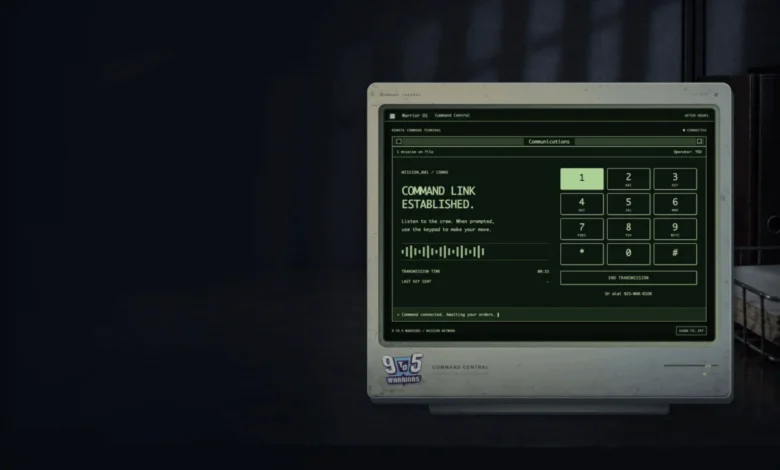
The operational mechanics of Command Central are designed to be immediately familiar to anyone who has ever navigated a corporate customer service line. Participants dial the dedicated hotline at (925) WAR-RIOR (925-927-7467) to clock in as remote Command Operators.
Once connected, listeners are briefed on unfolding crises involving the Water Cooler Commandos, the fictional frontline operatives of the 9 to 5 Warriors universe. As each scenario develops through audio narration and character dialogue, callers reach critical junctures that require immediate tactical intervention. Using a standard telephone keypad, participants press corresponding numbers to issue commands. These inputs directly influence the trajectory of the mission, determining whether operatives execute a stealthy infiltration, initiate a frontal assault, request emergency backup, or completely alter their operational strategy.

Every choice branches the narrative into alternate pathways, yielding distinct outcomes and consequences. Successful navigation results in mission completion, while poor tactical decisions or botched execution invite reprimands from authority figures within the storyline, such as the formidable Major Eraser. Because multiple outcomes exist for each weekly scenario, callers are encouraged to redial and explore alternative decision trees, significantly enhancing the replay value of the audio series. For international audiences or those who prefer digital interfaces over traditional telephone lines, a browser-based access point has been established at 9to5warriors.com/commandcentral, ensuring global accessibility.
Background and Evolution: Expanding the 9 to 5 Warriors Universe
To understand the genesis of Command Central, one must examine the origins of 9 to 5 Warriors as a creative property. Conceived and developed by Brandon Braswell, the franchise has long specialized in transforming mundane office supplies, stationery, and break-room leftovers into an imaginative landscape of miniature warfare and collectible action figures.
For years, Braswell authored written narratives and background lore to flesh out the personalities, rivalries, and conflicts of characters inhabiting this white-collar battleground. While the physical action figures and display dioramas captured the visual essence of the brand, the creator sought a more immersive medium that would allow fans to actively participate in the ongoing saga.
Interactive fiction has a rich history, dating back to the print-based "Choose Your Own Adventure" books of the 1980s and 1990s, as well as early text-based computer games. However, translating this concept into a serialized audio format delivered via telephone represents a unique artistic choice. The medium echoes the telephone-based storytelling experiments and automated hotline novelties popular in late-20th-century pop culture, updating those vintage mechanics with modern narrative pacing and high-production-value soundscapes.
Chronology of Development and Launch Schedule

The rollout of Command Central follows a carefully structured timeline aimed at building anticipation within the toy-collecting and independent-creators communities:
- Pre-Production and Lore Building: Brandon Braswell spends several years developing the overarching narrative arcs, character voices, and branching script matrices that form the backbone of the audio adventures.
- Interface Design and Setup: Technical infrastructure is established around the primary telephone access point, securing the memorable vanity number (925) 927-7467, alongside the parallel development of the browser-based streaming platform for international fans.
- Official Launch Date: October 8, 2026 marks the public debut of Command Central, opening the phone lines for the first wave of remote Command Operators.
- Weekly Content Rollout: Following the initial launch, fresh missions, character interactions, and narrative dilemmas are scheduled to drop on a weekly basis, maintaining ongoing engagement with the audience.
Industry Reception and Broader Media Implications
The announcement of Command Central has generated notable curiosity within independent toy and niche media circles. Analysts note that toy manufacturers and independent creators are increasingly looking beyond traditional marketing strategies—such as static social media posts and conventional advertising—to build deeper emotional connections with their consumer base.
By transforming a consumer-facing hotline into an interactive entertainment product, 9 to 5 Warriors has successfully weaponized nostalgia. The tactile, ritualistic act of dialing a phone number and pressing physical keys on a keypad evokes a distinct retro sensibility that resonates strongly with adult collectors who grew up during the analog era of telecommunications and 1980s toy lines.
Furthermore, the choice to offer Command Central as a free-to-access service (subject only to standard calling rates or internet data usage) lowers the barrier to entry, functioning both as a standalone piece of entertainment and as a top-of-funnel engagement tool for the broader 9 to 5 Warriors brand. By giving fans a recurring, weekly role in the survival and success of the office commandos, the project fosters a communal sense of investment that traditional media formats struggle to replicate.
Fact-Based Analysis of the Interactive Audio Landscape

While modern interactive entertainment is dominated by high-end video games, virtual reality, and complex branching video platforms like Netflix’s interactive specials, low-tech interactive audio occupies a fascinating niche. Telephone-based audio dramas utilize the theater of the mind, relying entirely on vocal performances, sound effects, and audience imagination to construct the virtual environment.
This stripped-down approach offers several distinct advantages. Without the requirement for visual rendering, creators can iterate rapidly on storylines, introducing complex scenarios and rapid plot developments without the prohibitive budgets associated with animated or live-action video production. For independent creators like Braswell, the telephone tree format serves as a cost-effective, highly scalable medium for world-building.
At the same time, the format presents unique technical challenges, particularly regarding user interface design. Because callers must remember numeric prompts or make split-second decisions based purely on auditory information, scriptwriting must remain concise and intuitive. The integration of a web-based alternative at 9to5warriors.com/commandcentral mitigates potential accessibility issues for users on modern VoIP systems or in regions where dialing specialized domestic numbers might be restricted or cost-prohibitive.
Looking Ahead: The Future of Office Warfare
As the October 8, 2026 launch date approaches, attention turns to how the audience will respond to the initial batch of missions. If successful, Command Central could pave the way for expanded narrative arcs, crossover events featuring new factions of office-supply combatants, and potentially live-event call-in specials.
The initiative proves that innovative storytelling does not always require cutting-edge graphics or complex hardware. By repurposing a ubiquitous, everyday communication tool into a portal for imaginative play, 9 to 5 Warriors has crafted a compelling experiment in participatory audio fiction. Whether callers successfully guide their operatives to victory or suffer the bureaucratic wrath of Major Eraser, the experiment demonstrates that imaginative world-building can thrive in the most unexpected digital and analog spaces.