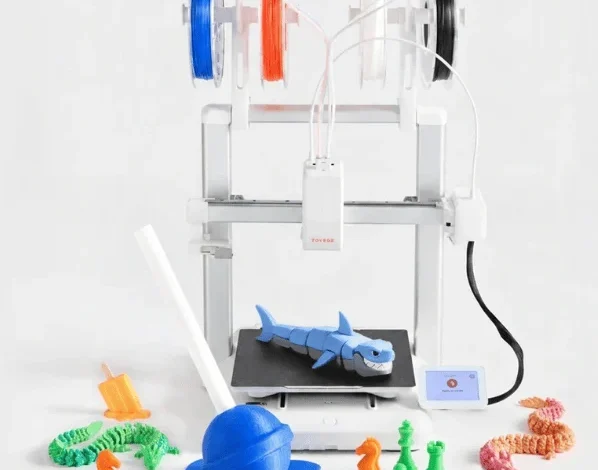
Oakland, California — Toybox, a pioneering developer of accessible consumer manufacturing technology, has officially announced the launch of its latest flagship hardware, the Luna 3D printer. Engineered specifically to bridge the vast gap between complex hobbyist machinery and intuitive consumer electronics, the Luna introduces a four-color printing capability equipped with a larger build volume, an integrated onboard camera for real-time print monitoring, and automated clog detection. By eliminating the manual slicing, intricate color calibration, and multi-channel filament management that have historically hindered consumer-grade multi-color 3D printing, Toybox aims to democratize physical fabrication for households, educational institutions, and everyday makers.
The release arrives at a transformative juncture for both the consumer electronics and toy manufacturing sectors. Over the past decade, 3D printing has evolved from an industrial prototyping method into a burgeoning consumer market. However, multi-color fabrication has remained notoriously difficult, often requiring users to manually pause jobs, swap filament spools, and execute precise digital color mapping known as "slicing." The Luna addresses these pain points head-on by feeding four distinct spools into a single automated workflow. The machine manages color transitions autonomously, guided by the proprietary Toybox Creator Studio platform.
Revolutionizing Accessibility and Design Through AI
At the core of the Luna’s user experience is the Toybox Creator Space, an integrated design and generation platform. Users—ranging from elementary school students to seasoned hobbyists—can conceptualize objects through text prompts, hand-drawn sketches, photo uploads, or direct 3D file imports. A built-in artificial intelligence engine subsequently processes these inputs, transforming raw concepts into color-optimized, print-ready designs that require only a single click to execute.
This streamlined workflow represents a fundamental shift in how physical objects are realized at home. Historically, multi-color 3D prints yielded monochrome approximations of complex subjects, stripping objects like licensed characters, architectural models, or scientific replicas of their identifying visual markers.
"A Hogwarts crest needs four house colors, and an Artemis rocket needs the orange core against the white boosters," said Ben Baltes, co-founder and Chief Executive Officer of Toybox. "A kid should be able to print either one correctly without ever learning why that used to be hard."
Beyond mere aesthetic improvements, the multi-color capability introduces educational dimensions rooted in planning, sequencing, and spatial reasoning. Malcolm Bird, Chief Operating Officer of Toybox, emphasizes the cognitive benefits of tactile manufacturing in an era dominated by instantaneous digital gratification.
"Designing a toy and printing it is planning, sequencing, and problem-solving with a physical object at the end," Bird explained. "Four colors give a kid more to decide before they start. Forty years in the kids’ business, and I haven’t found a better way to teach any of it."
Data Privacy, Child Safety, and Regulatory Compliance
As consumer technology increasingly integrates artificial intelligence and cloud connectivity, data privacy—particularly concerning minors—has emerged as a paramount regulatory concern. Recent months have seen heightened scrutiny from federal agencies such as the Federal Trade Commission (FTC), alongside legislative actions including state-level moratoria targeting conversational AI toys that engage in open-ended dialogues with children.
Toybox has structured the Luna and its supporting software ecosystem to proactively sidestep these controversies. The device itself features no conversational or voice-interactive interfaces designed to "speak" to children. Furthermore, the company maintains a strict data privacy architecture: no personally identifiable information belonging to children is stored on its servers, and all user data is hosted within the United States. Parental oversight is mediated through a dedicated parent portal.
From a regulatory standpoint, the Toybox hardware and platform are engineered to comply with a comprehensive suite of international and domestic safety standards. These include the Children’s Online Privacy Protection Act (COPPA) and the Children’s Privacy and Safety rules in the United States, alongside the European Union’s General Data Protection Regulation for Children (GDPR-K). Physical safety standards are equally rigorous, with compliance certified under ASTM F963-23 and the Consumer Product Safety Improvement Act (CPSIA).
Material safety is another critical consideration for indoor and educational deployment. Traditional desktop 3D printers often utilize acrylonitrile butadiene styrene (ABS), a petroleum-based plastic that requires heated enclosures due to the emission of potentially harmful styrene fumes during melting. In contrast, the Luna operates exclusively with polylactic acid (PLA), a biodegradable, plant-derived thermoplastic manufactured from renewable resources such as cornstarch. PLA melts at significantly lower temperatures, produces negligible odor, and eliminates the need for specialized ventilation or enclosed chambers.
Integrating Into Educational Curriculums
The adoption of 3D printing within educational settings has accelerated steadily, with thousands of K-12 schools across the United States currently incorporating Toybox ecosystems into their STEM and STEAM curriculums. The Luna is designed to integrate seamlessly into modern classrooms, allowing educators to push a single verified design across an entire room of networked printers or direct multiple student accounts toward a centralized machine.
Crucially, the platform relies on a heavily moderated digital library rather than an open-ended internet scrape. This curation ensures that students can navigate the platform independently, managing the entire lifecycle of a project from conception to physical realization without requiring constant adult supervision. By embedding engineering and design principles into intuitive play, the platform equips students with foundational spatial and computational skills relevant to future technological workforces.
Exclusive Intellectual Property and Market Positioning
The launch of the Luna coincides with a broader market surge in licensed consumer goods. According to data from market research firm Circana, global sales of licensed toys grew by 15 percent in 2025, capturing an all-time high of 37 percent of a worldwide toy industry valued at $123 billion.
Toybox occupies a distinct commercial advantage in this space through strategic intellectual property partnerships. Over the past year, the Toybox platform has facilitated the production of more than 20 million toys drawn from a proprietary catalog exceeding 25,000 printable models across more than 11,000 distinct toy categories.
The company maintains exclusive consumer 3D printing licenses for major entertainment and scientific franchises, including Harry Potter, Warner Bros., Universal Pictures, Paramount, NASA, Cartoon Network, DreamWorks, Nickelodeon, and Sanrio. Because these entertainment conglomerates restrict unauthorized digital dissemination of their characters, competing consumer 3D printing manufacturers are legally barred from offering comparable model libraries, positioning Toybox as a singular entity within the consumer fabrication market.
Broader Industry Implications and Economic Outlook
The introduction of the Luna reflects a broader macroeconomic trend toward consumer appliance simplification. For over a decade, desktop 3D printing remained pigeonholed as a niche hobbyist pursuit, constrained by steep learning curves, calibration failures, and maintenance overhead. By automating complex mechanical processes—such as color switching, bed leveling, and error detection—manufacturers are increasingly transforming 3D printers from experimental project kits into consumer appliances comparable to standard 2D paper printers.
Industry analysts suggest that the success of user-friendly multi-color platforms could catalyze broader mainstream adoption, particularly within family households and academic environments where time constraints preclude troubleshooting technical hardware failures. The ability to produce high-fidelity, multi-colored physical items on demand also points toward a future of decentralized manufacturing, where replacement parts, educational aids, and custom toys are fabricated locally rather than shipped globally.
Pricing and Availability
The Toybox Luna is available for purchase immediately through the official company website, toybox.com. Introductory retail pricing begins at $349, positioning the device competitively against both single-color hobbyist printers and traditional mass-market entertainment merchandise. As shipments commence to households, schools, and independent makers globally, the Luna stands as a test case for whether fully automated, multi-material desktop manufacturing can successfully transition from professional engineering labs into the everyday domestic mainstream.
Related posts: