The release of the high-octane action-thriller Mutiny marks another prominent entry into the modern cinematic landscape, starring veteran action lead Jason Statham in a tense, claustrophobic narrative set against the stark backdrop of the open ocean. Directed by Jean-François Richet and penned by screenwriting duo Lindsay Michel and J.P. Davis, the 95-minute feature adopts a streamlined approach to storytelling, minimizing extraneous subplots to maintain a relentless focus on high-stakes confrontation, tactical combat, and maritime suspense. Featuring an international ensemble cast that includes Annabelle Wallis, Roland Møller, Ramon Tikaram, Chaneil Kular, Simon Kluth, and Adrian Lester, the film blends traditional genre tropes with modern geopolitical and criminal conspiracies.
Main Facts and Plot Overview
At its core, Mutiny follows Cole Reed, portrayed by Jason Statham, a seasoned security professional whose life is upended during a routine assignment in Bangkok, Thailand. Reed is tasked with protecting billionaire shipping tycoon Tibu Campallo, played by Ramon Tikaram, and his son, Kameron, portrayed by Chaneil Kular, as they finalize the lucrative sale of their family-owned maritime enterprise.
What begins as a standard security detail rapidly deteriorates into a coordinated assassination. Following a celebratory dinner where Campallo formally integrates Reed into his inner circle, the patriarch is ambushed and killed at a roadblock by heavily armed assailants. Simultaneously, the shadowy architect of the plot, Jaran Daniles—played by Simon Kluth—orchestrates a framing campaign, issuing a widespread All Points Bulletin (APB) designating Reed as the primary suspect in Campallo’s murder.
Driven by a pragmatic pursuit of justice and the need to clear his name, Reed traces the origins of the ambush to the cargo ship Artemis. Utilizing clandestine methods to infiltrate the vessel disguised as a crew member, Reed discovers a sinister human trafficking ring operating out of the ship’s cargo containers. His path crosses with Angie Ellis, a third mate portrayed by Annabelle Wallis, who is eager to complete her maritime rotation and return to Los Angeles for court-mandated custody time with her daughter. Together, Reed and Ellis uncover a vast conspiracy implicating the ship’s captain, Marko Madsen—played by Roland Møller—and the entire primary crew, setting the stage for a desperate battle for survival on the Andaman Sea.
Chronology of Events
The narrative unfolds through a tightly wound sequence of events designed to maximize pacing and tension:
- Initial Incidents: The film opens abruptly with a vehicular collision in an unnamed location, providing no immediate context before cutting to Bangkok, where Cole Reed assumes security duties for the Campallo family.
- The Escalation: Following the finalization of the shipping business sale, a celebratory evening is disrupted by clandestine orders from Jaran Daniles to halt the corporate transaction permanently.
- The Ambush: Kameron Campallo departs via an alternate route, while Tibu Campallo and Cole Reed encounter a calculated roadblock. Tibu is assassinated by automatic-weapon fire, and Reed secures a vital piece of physical evidence linking one of the deceased attackers to the cargo vessel Artemis.
- Infiltration and Discovery: While Daniles initiates a manhunt framing Reed for the homicide, Angie Ellis reluctantly accepts a forced maritime assignment aboard the Artemis. Reed infiltrates the vessel covertly, discovers captive human beings inside a cargo container, and is subsequently joined in his investigation by Ellis.
- The Crisis at Sea: Captain Marko Madsen attempts to suppress the discovery by promising to contact authorities, but Ellis recognizes the shipboard conspiracy and flees to the bridge. She dispatches an emergency distress call intercepted by a U.S. Navy vessel commanded by an officer played by Adrian Lester. Although Madsen temporarily subdues Ellis and cancels the transmission under the guise of an accidental activation, the U.S. Navy command elects to investigate the anomaly in the Andaman Sea.
Supporting Data and Production Metrics
Running at a concise 95 minutes, Mutiny exemplifies a growing cinematic preference for efficient, fast-paced action features that eschew bloated runtimes in favor of direct narrative momentum. The production heavily relies on practical stunt work and confined interior set pieces to evoke psychological tension.
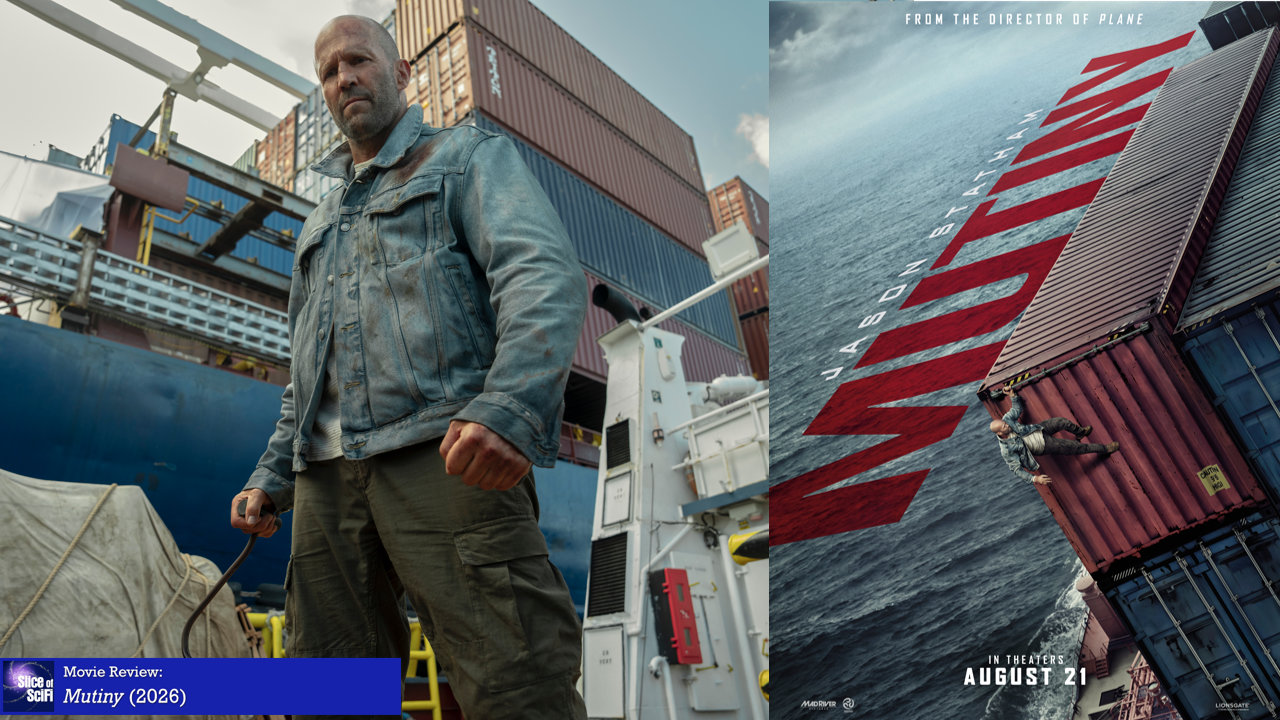
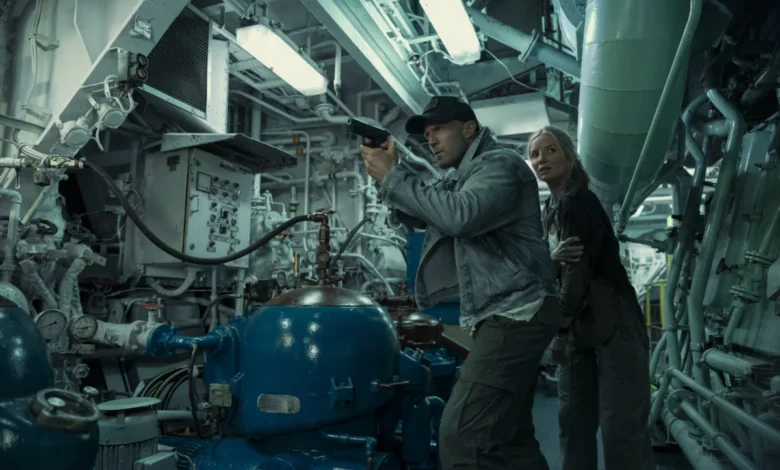
Most of the narrative takes place aboard the cramped decks, corridors, and cargo holds of the Artemis, creating a deliberate sense of spatial restriction. Cinematography by the production crew emphasizes tight framing during close-quarters combat and dynamic lighting within the vessel’s lower decks, contrasted against aerial reconnaissance sequences involving the U.S. Navy response unit. The weapon arsenal utilized throughout the film extends beyond conventional firearms, integrating maritime-specific implements such as harpoons to amplify the environmental lethality of the setting.
Character Dynamics and Performances
Jason Statham delivers a characteristically grounded performance as Cole Reed, moving away from hyper-stylized vigilantism toward a more calculated, sorrow-driven pursuit of accountability. Statham’s portrayal incorporates subtle emotional beats, reflecting past grief and loyalty to the family he was hired to protect.
Annabelle Wallis anchors the co-lead role of Angie Ellis as an independent, morally steadfast professional. Eschewing traditional damsel-in-distress archetypes, Wallis portrays a character who exhibits immediate tactical awareness and moral conviction, balancing her primary objective of reuniting with her daughter in Los Angeles with a humanitarian impulse to liberate the trafficking victims.
Roland Møller provides a formidable antagonistic presence as Captain Marko Madsen, serving simultaneously as a commercial mariner and the operational leader of the criminal syndicate onboard. Meanwhile, Adrian Lester anchors the external military subplot, portraying a composed U.S. Navy captain navigating tactical uncertainty as intelligence analysts decode the blurred signals originating from the Andaman Sea.
Broader Impact and Genre Implications
Within the contemporary action-thriller ecosystem, Mutiny reinforces the viability of mid-budget, high-concept genre films driven by established international stars. By anchoring the narrative within the closed ecosystem of a commercial container ship, the film capitalizes on the enduring appeal of nautical thrillers—a subgenre historically recognized for generating high suspense through isolated settings and restricted mobility.
The integration of transnational human trafficking elements within the screenplay by Lindsay Michel and J.P. Davis adds a layer of contemporary relevance to standard revenge-thriller mechanics. Furthermore, the inclusion of naval intervention provides a strategic counterbalance to the relentless close-quarters violence aboard the Artemis, expanding the scope of the conflict beyond a solitary protagonist.
Conclusion
Mutiny succeeds as a focused, disciplined addition to the action-thriller genre. Through efficient pacing, committed performances from a recognizable ensemble cast, and a claustrophobic maritime setting, the film delivers on the core expectations of its audience while maintaining structural integrity throughout its 95-minute runtime. Under the direction of Jean-François Richet, the project stands out as a study in economic storytelling, prioritizing visceral combat choreography and environmental tension over unnecessary exposition.