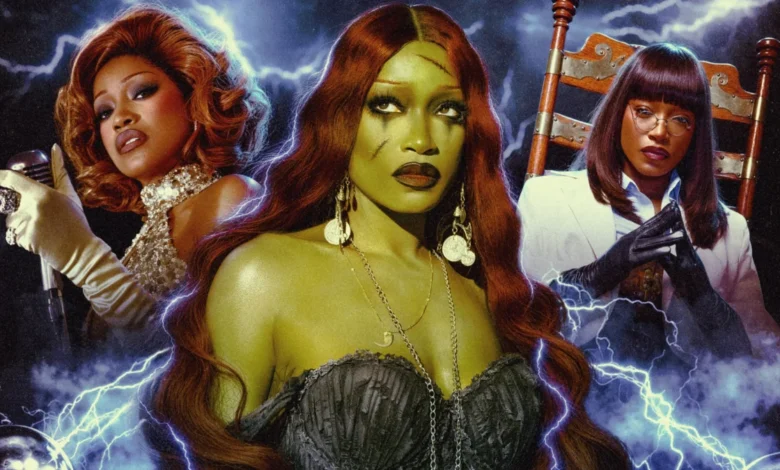
The multi-hyphenate entertainer Keke Palmer has officially leaned into the macabre with the release of her latest single, "Keke Frankenstein," an October 30 drop that serves as both a seasonal celebration and a metaphorical exploration of personal rebirth. Known for her prominent roles in Jordan Peele’s science-fiction horror film Nope and the Peacock series The ’Burbs, Palmer has increasingly positioned herself at the intersection of Hollywood pop culture and the horror genre. The release of "Keke Frankenstein" marks a significant evolution in her artistic output, blending high-concept lyrical storytelling with the aesthetic sensibilities of classic monster cinema.
A Narrative of Rebirth and Resilience
The lyrical content of "Keke Frankenstein" functions as an allegory for the public and private challenges Palmer has navigated in recent years. Following a highly publicized separation from her former partner, Darius Jackson—with whom she shares her son, Leo—Palmer has utilized her creative platforms to process the emotional toll of transition.
"So when you witness this rebirth, know that it’s divine / I was cut apart and rebuilt, I was water redefined," Palmer sings in the track. The lyrics explicitly connect the horror trope of the stitched-together creature with the reality of healing after trauma. By framing her personal evolution through the lens of Mary Shelley’s classic creature, Palmer shifts the narrative from one of victimhood to one of agency. The song’s bridge—"I ain’t running from the shadows, I’ll be dancing with the freaks"—suggests a reclamation of power, positioning the "monster" not as a villain to be feared, but as a version of the self that has been fortified by adversity.
The Evolution of a Spooky Aesthetic
Palmer’s fascination with horror is not a recent development, but rather a cultivated brand identity that has spanned several years. The trajectory of this interest can be traced through her various professional and personal milestones:
- October 2023: Palmer made her debut into the horror-enthusiast space by dressing as "The Monster’s Mate" for her son’s first Halloween, while casting her son as Dr. Frankenstein. This public homage to Universal Monsters signaled a deeper engagement with the source material of the genre.
- September 2025: Palmer served as the cover star for Dread Central, where she spearheaded "Dread Manor," an anthology series modeled after classic horror programming like Tales from the Crypt. This project served as her formal entry into horror production and curation.
- October 2026: The release of "Keke Frankenstein" arrived as the culmination of this two-year immersion, with Palmer announcing that she would star as both the titular doctor and the creation in the accompanying music video.
Industry Context and Horror Tropes in Music
The utilization of horror imagery in modern pop music is a recurring phenomenon, yet Palmer’s approach is distinct for its focus on the "Universal Monster" era of the 1930s and 40s. Unlike the more contemporary slasher-inspired aesthetics adopted by many of her peers, Palmer’s aesthetic—characterized by gothic laboratory settings and themes of reanimation—harkens back to the foundational texts of the genre.
From an industry perspective, this pivot is savvy. Horror remains one of the most stable and high-performing genres in both film and digital media, characterized by a dedicated fan base and a high degree of "rewatchability." By aligning herself with the horror community, Palmer is effectively diversifying her audience reach, moving beyond the traditional constraints of pop music and mainstream television.
In her interview with Dread Central during her September 2025 cover appearance, Palmer identified the original IT miniseries and the film Candyman as primary catalysts for her lifelong interest in the genre. She noted that Tim Curry’s portrayal of Pennywise fundamentally altered the cultural perception of clowns, a sentiment that speaks to her analytical understanding of how horror functions as a mirror to societal anxieties.

KeyTV and the Future of Horror Production
Beyond her musical output, Palmer is actively leveraging her media production company, KeyTV, to increase her footprint in the horror space. The company, which seeks to amplify underrepresented voices, is reportedly looking to develop original horror content.
This move is strategically significant. As major studios continue to struggle with the high costs of tentpole films, mid-budget horror projects have become the bedrock of box office profitability. By transitioning from an on-camera talent to a creative producer, Palmer is positioning herself to control the narrative of her horror projects. Industry analysts suggest that this shift allows her to bypass traditional casting hurdles and create roles that specifically cater to her strengths as a performer who thrives in high-tension, genre-specific environments.
Analysis: The "Villain Era" as Creative Catalyst
In the context of contemporary celebrity culture, the "villain era" is often a label applied to artists who prioritize their own needs and boundaries over public expectations. Palmer’s lyrics—specifically the line, "Now the girl you thought was fragile could go terrorize the streets"—suggests she is fully aware of this cultural trope.
By adopting the iconography of Frankenstein’s monster, she is subverting the idea of the "fragile" woman. In the original Shelley novel, the monster is a misunderstood entity seeking belonging; in the modern, filtered world of social media, Palmer is using this archetype to express a desire for autonomy. The music video, which promises to show her as both the creator and the creation, serves as a literal visual representation of self-actualization: she is the one who "made" herself, and she is the one who now commands the stage.
Broader Implications for the Genre
The mainstreaming of horror by high-profile artists like Palmer contributes to the ongoing "elevated horror" movement. This movement, which emphasizes thematic depth, psychological resonance, and aesthetic rigor, has brought the genre into the mainstream fold, earning critical acclaim and significant commercial success.
Furthermore, Palmer’s commitment to the genre serves as an invitation for her fan base—which skews younger and is heavily engaged with social media—to explore classic horror cinema. When an artist of her stature highlights the importance of films like The Bride of Frankenstein or A Nightmare on Elm Street, it bridges the gap between classic monster cinema and modern digital content creation.
Conclusion
"Keke Frankenstein" is more than a seasonal music release; it is a declaration of intent. By weaving her personal narrative into the fabric of one of horror’s most enduring myths, Keke Palmer has solidified her standing as a legitimate voice within the genre. Whether through her anthology work, her production ventures at KeyTV, or her musical explorations, it is clear that Palmer intends to remain a significant presence in the horror landscape for the foreseeable future. As the industry continues to evolve, her ability to blend artistic vulnerability with genre-specific tropes provides a blueprint for how modern celebrities can successfully navigate—and own—their own "monster" transformations.