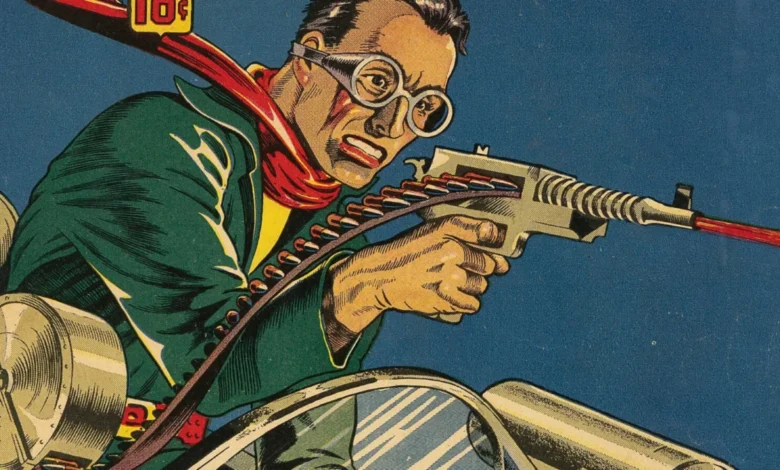
The intersection of World War II history and Golden Age comic books continues to captivate vintage paper collectors and historians alike, offering a unique window into how wartime propaganda and real-world diplomacy shaped popular culture. A premier example of this fusion is currently hitting the auction block: a CGC Universal VG 4.0 graded copy of Dynamic Comics #9, published by Harry "A." Chesler in 1944. Featuring striking cover artwork by legendary artist Mac Raboy, this particular issue highlights a gripping wartime narrative in which the heroic Master Key—operating under his civilian alias as Federal Bureau of Investigation agent Ray Cardell—is dispatched to the Kremlin to thwart a high-stakes Nazi conspiracy targeting the historic 1943 Moscow Conference.

Sourced from the renowned collection of vintage comic aficionado Jon Berk, this rare collector’s item is slated to cross the auction block on November 5, 2026, during the Golden Age Century Comics Showcase Auction VI (Event #40378) hosted by Heritage Auctions. For enthusiasts of mid-century comic books, World War II ephemera, and rare CGC-census items, the offering provides a fascinating opportunity to examine how publishers of the era utilized unfolding global headlines to craft patriotic narratives.
The Real-World Diplomacy That Inspired the Master Key Saga
To fully understand the narrative weight of Dynamic Comics #9, one must examine the geopolitical landscape of late 1943. From October 19 to October 30, 1943, Allied leadership converged in the Soviet capital for the Moscow Conference. This high-level diplomatic summit brought together U.S. Secretary of State Cordell Hull, British Foreign Secretary Anthony Eden, and Soviet People’s Commissar for Foreign Affairs Vyacheslav Molotov. Later sessions also saw direct engagement with Soviet Premier Joseph Stalin.

The conference was a monumental milestone in the coordination of the Grand Alliance. Its primary objectives were to shorten the duration of the war against the Axis powers, establish a framework for post-war international cooperation, and lay the groundwork for the impending Allied invasion of northern France—an operation that would materialize the following year as D-Day.
Real-world news media treated the conference as a transformative moment in the global conflict. Major publications ran triumphant headlines celebrating the solidarity of the Allied nations. For instance, a report in The Baltimore Sun on November 2, 1943, boldly declared that the resulting pact represented a "most staggering setback of the war" for Nazi propagandists, who had long attempted to sow discord between Western democracies and the Soviet Union.

Comic book publishers, operating under a mandate of total national mobilization, were quick to incorporate these earth-shattering headlines into their monthly serials. In Dynamic Comics #9, Chesler’s creative team seized upon the drama of the Kremlin meetings. The plot hinges on a sinister Nazi espionage plot designed to infiltrate the conference by replacing a high-ranking U.S. State Department official—believed to be Secretary of State Cordell Hull or a close deputy—with a meticulously trained imposter. Agent Ray Cardell, utilizing his Master Key persona, must navigate the treacherous diplomatic corridors of Moscow, unmask the saboteur, and safeguard the critical intelligence being developed at the highest levels of Allied command before the Axis powers can exploit it.
Mac Raboy and the Artistic Legacy of Chesler Publications
Beyond its historical and narrative significance, Dynamic Comics #9 derives substantial value from its association with master illustrator Mac Raboy. Born in 1914, Raboy was one of the premier draftsmen of the Golden Age of comic books, celebrated for his clean, dynamic linework, sophisticated rendering of human anatomy, and cinematic framing.

Before achieving widespread acclaim for his work on Fawcett Publications’ Captain Marvel Jr. and eventually taking over the legendary Flash Gordon newspaper strip in 1948, Raboy contributed significant interior and cover art for various publishers, including Harry Chesler’s shop. His cover illustration for Dynamic Comics #9 features a tense, action-packed tableau—a goggled aviator aggressively firing an aircraft-mounted machine gun—capturing the high-octane kinetic energy that defined wartime comic book covers.
Chesler’s publishing house occupied a unique space in the Golden Age ecosystem. Operating primarily as a "comic packager" that supplied complete stories, covers, and art packages to other publishers before eventually launching titles under his own imprint, Chesler fostered an environment where emerging and established talents could hone their craft. The inclusion of Raboy’s artwork elevates Dynamic Comics #9 from a standard piece of wartime propaganda into a recognized collectible of notable artistic merit.

Auction Details, Condition, and Market Valuation
The copy coming to market in the upcoming Heritage Auctions event carries impressive provenance, originating directly from the esteemed collection of Jon Berk, a well-known name among vintage comic book connoisseurs. Professionally evaluated and certified by the Certified Guaranty Company (CGC), the issue is graded as Universal VG 4.0 with off-white pages, bearing certification number 1485531005.
Market data underscores the extreme scarcity of high-grade copies of this particular issue. According to the current CGC census data, there are only five Universal copies graded higher than a 4.0. Furthermore, market liquidity for upper-tier grades is remarkably thin; only a single higher-graded copy—a CGC 6.0—has ever appeared on the public auction block, where it commanded a notable price of $16,800.

This scarcity positions the Jon Berk collection copy as an attractive acquisition target for dedicated investors and advanced collectors of Golden Age superhero and patriotic titles. Complete with its original vintage advertisements—such as the back-cover promotion for the Wonderscope telescope offering signal flags and code instructions—the book serves as an intact artifact of mid-20th-century American popular culture.
Broader Impact and Historical Implications
The intersection of comic books and espionage thrillers during World War II played a vital psychological role on the American home front. By translating complex diplomatic summits like the Moscow Conference into accessible, high-stakes superhero adventures, comic books helped reinforce national unity, bolster public confidence in military leadership, and demonize the Axis threat for younger demographics.

While characters like Master Key may not enjoy the enduring household-name status of Superman or Batman today, these localized wartime narratives provide contemporary historians with invaluable insights into the social consciousness of the era. They demonstrate how fast-moving print media reacted in real time to global events, transforming the diplomatic triumphs of statesmen like Cordell Hull and Joseph Stalin into morality plays where American ingenuity and vigilance always won the day.
As collectors prepare for the November 5, 2026, auction, Dynamic Comics #9 stands as a testament to a bygone era when the fate of the free world was fought out not only on the beaches of Normandy and the plains of Eastern Europe, but also across the four-color pages of newsstand comic books.