The $50 Million War Conspiracy in Amazing-Man Comics #16 Highlights Golden Age Parallels to Pre-WWII Geopolitics

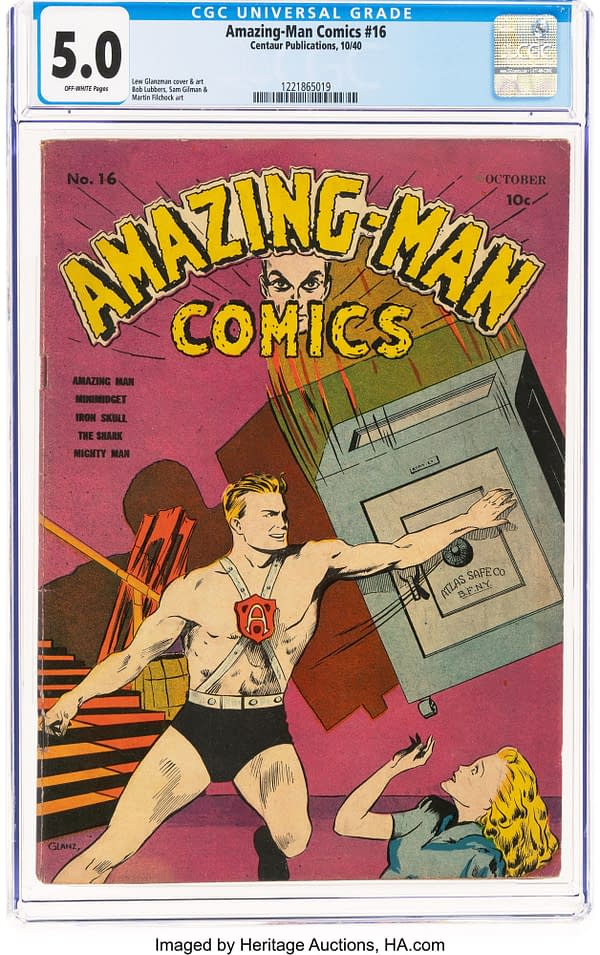
Published by Centaur Publications with an October 1940 cover date and hitting newsstands on August 2 of that same year, Amazing-Man Comics #16 stands as a fascinating historical artifact of the American Golden Age of comic books. Long before the United States entered the Second World War following the attack on Pearl Harbor, comic book publishers frequently engaged with the tense geopolitical climate unfolding in Europe and the Atlantic. In this specific issue, creator Martin Filchock crafted a narrative for the hero Mighty Man that intertwined high-stakes maritime insurance fraud with a dark, calculated conspiracy to drag the United States into the global conflict against its will.
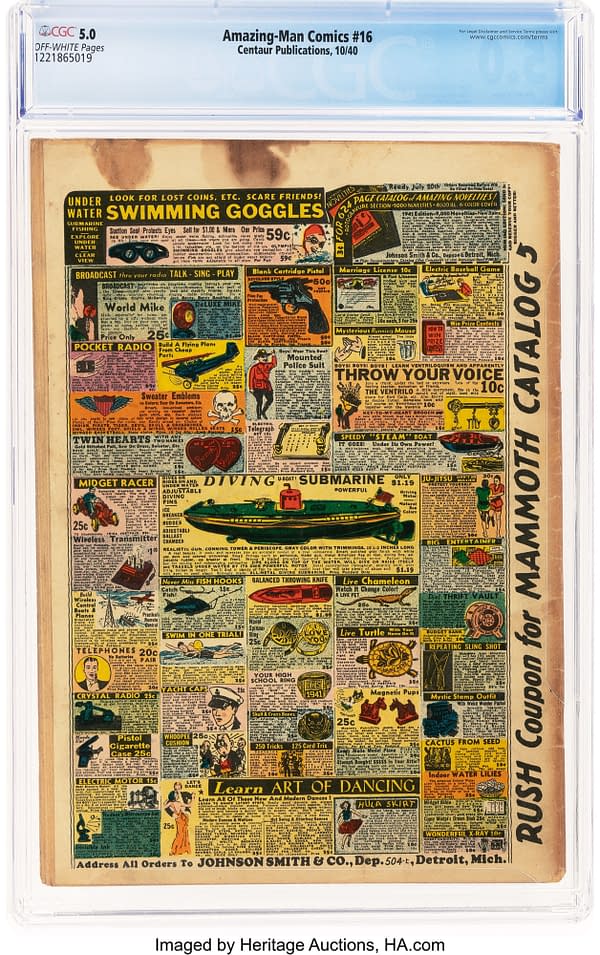
Today, this rare piece of vintage paper has captured the attention of comic book historians and collectors alike, with a high-grade CGC Universal VG/FN 5.0 copy slated to cross the auction block on November 5, 2026, at Heritage Auctions’ Golden Age Century Comics Showcase Auction VI.

Anatomy of a $50 Million Maritime Conspiracy
The plot of the Mighty Man adventure featured in Amazing-Man Comics #16 begins on the bustling streets of New York City, specifically at a Sixth Avenue employment office. In a time when the economic scars of the Great Depression were still visible, desperate and unemployed American men are targeted with a lucrative offer: $200 a week to work aboard a foreign luxury ocean liner. Unbeknownst to these recruits, they are walking into a trap orchestrated by agents of an unidentified foreign government.
The mechanics of the conspiracy are twofold and brilliantly devious. First, the conspirators arrange for the luxury liner to be heavily insured, anticipating a massive $50 million payout upon its destruction. Second, and far more sinister, the vessel is to be deliberately sunk within striking distance of the American coastline while crewed entirely by U.S. citizens. The resulting loss of American lives is intentionally engineered to provoke public outrage and force the United States government to abandon its neutrality, dragging the nation into the war on the side of the conspirators’ adversaries.
Martin Filchock utilizes the size-changing abilities of Mighty Man to drive the narrative forward dynamically. The hero operates both as a microscopic spy infiltrating the enemy’s inner circles and as a colossal powerhouse capable of physically grappling with immense ocean-going vessels. When a hostile submarine breaks the surface 100 miles off the coast of New York, the confrontation appears to validate the protective measures outlined in official U.S. policies of the era. The plot thickens when a wounded conspirator ultimately confesses to the scheme, laying bare the chilling intersection of corporate greed and geopolitical manipulation.
Real-World Precedents: The S.S. Iroquois and the Shadow of War
While Amazing-Man Comics #16 presents these events through the lens of superhero fiction, the themes running through Filchock’s story were torn straight from contemporary front-page headlines of 1939 and 1940. The fear of a targeted liner disaster involving American citizens was a very real, tangible anxiety for the Roosevelt administration.
On October 5, 1939, President Franklin D. Roosevelt issued a formal public statement regarding the threatened sinking of the S.S. Iroquois. The American-chartered passenger ship was returning home from Ireland, carrying U.S. citizens eager to escape the outbreak of war in Europe. The White House intervened after German naval commander Erich Raeder issued ominous warnings suggesting the vessel might meet a mysterious fate near the American eastern seaboard. Raeder’s warnings explicitly invoked the earlier sinking of the British liner Athenia, which had already sparked fierce international debate and accusations of foul play.
In response to the perceived threat against the Iroquois, U.S. authorities mobilized extensive protective measures, arranging for naval escorts and conducting rigorous searches for explosives before the ship could dock safely. The convergence of a passenger liner carrying Americans, the looming threat of a coastal disaster, and the high-stakes risk of an international incident formed the exact public anxiety that comic book writers of the era channeled into their fiction.
Conflating Policy: The Neutrality Act and the Declaration of Panama
Filchock’s narrative in Amazing-Man Comics #16 goes beyond merely referencing general fears; it actively weaves specific legislative and diplomatic frameworks into the dialogue. Within the story, characters make direct references to President Roosevelt’s Neutrality Act, while simultaneously invoking the geographical boundaries established by the 1939 Declaration of Panama.
The Neutrality Acts passed by the United States Congress in the mid-1930s were designed to keep the nation out of foreign conflicts by limiting American economic and maritime engagement with belligerent nations. Specifically, the Neutrality Act of November 1939 placed strict prohibitions on American ships carrying passengers or goods to any nation engaged in war.
Simultaneously, the Declaration of Panama—established in October 1939 by American republics—sought to create a vast security zone surrounding the Americas, keeping belligerent naval operations out of waters adjacent to the Western Hemisphere. State Department maps and diplomatic notes from the era carefully constructed a defensive boundary stretching 300 nautical miles from the coast.
In Amazing-Man Comics #16, the fictional conspirators explicitly target the 300-mile zone for their deadly attack, cleverly—or perhaps conveniently—conflating the maritime restrictions of the Neutrality Act with the geographic parameters of the Panama Declaration. For readers in 1940, these policy nods grounded the outlandish superhero adventures in a frighteningly recognizable reality.
Production Credits and Publishing Context
Published by Centaur Publications—a notable independent comic book publisher of the Golden Age known for producing distinct, often harder-to-find titles compared to industry giants like DC or Fawcett—Amazing-Man Comics #16 represents a collaborative effort by several notable creators of the period.
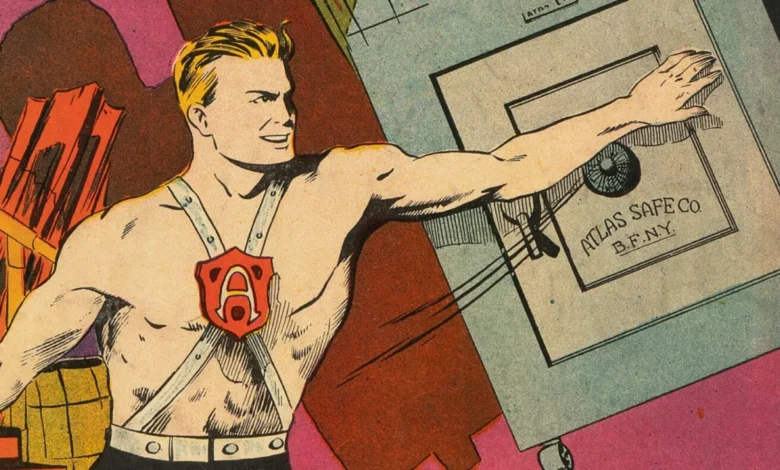
- Cover Art: Executed by Lew Glanzman, the striking cover of issue #16 features the titular hero, Amazing-Man, bracing his outstretched hand against a heavy, falling office safe while protecting a civilian companion named Zona. Glanzman’s dynamic composition captured the kinetic energy that defined superhero comics on the eve of America’s entry into World War II.
- Lead Feature: The main feature of the issue was penciled by Allen L. Kirby and inked by Sam Decker, anchoring the book’s lineup before transitioning into the various backup features, including Martin Filchock’s Mighty Man adventure.
Market Rarity and Collector Valuation
Centaur books from this era are notoriously difficult to find in high-grade condition, owing to lower print runs, paper recycling drives during the war, and the ephemeral nature of comic books in the 1940s. According to the Certified Guaranty Company (CGC) census, Amazing-Man Comics #16 is an exceptionally scarce commodity. The census records only 20 Universal entries total for the issue, with a modest distribution of four copies graded at 5.0 and just eight copies holding higher grades.

Because of this inherent scarcity and the rich historical context embedded within its pages, vintage paper collectors view the issue as a prime target. The upcoming auction of a CGC Universal VG/FN 5.0 copy with off-white pages at Heritage Auctions provides a rare window for institutional archives and private investors to secure a physical piece of early comic book history that documented the shifting mindset of a nation on the precipice of war.