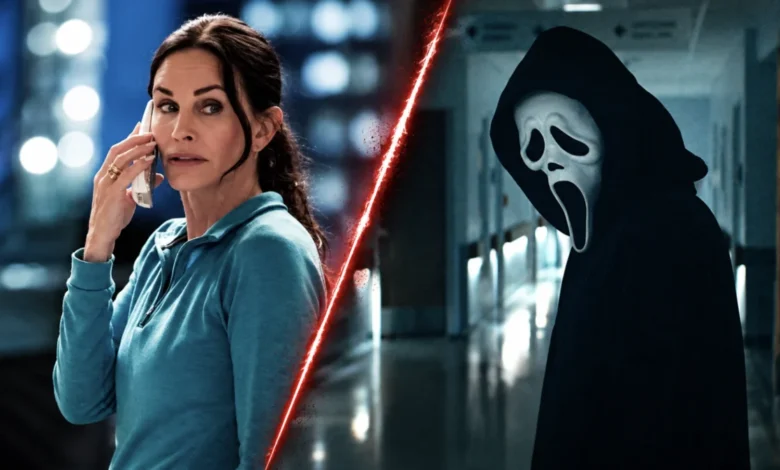
The landscape of the long-running slasher franchise Scream is once again in flux as production discussions for the eighth installment move forward. During the 2026 Toronto International Film Festival (TIFF), actress Courteney Cox, a cornerstone of the series since its inception in 1996, publicly signaled her interest in transitioning from the role of Gale Weathers to the director’s chair for the upcoming sequel. Her comments, made during a Deadline Studio session, have reignited speculation regarding the creative direction of the franchise following the recent departure of Kevin Williamson from the director’s role for the eighth film.
A Legacy Spanning Three Decades
Courteney Cox is one of the few actors to maintain a continuous presence throughout the history of the Scream franchise. As the ambitious reporter Gale Weathers, Cox has appeared in every installment, serving as both a primary target and a recurring survivor of the Ghostface persona. Her tenure spans three distinct creative eras: the original quartet helmed by horror visionary Wes Craven, the successful revival by the Radio Silence collective, and the most recent entry directed by franchise architect Kevin Williamson.
This deep-rooted history provides Cox with an intimate understanding of the series’ tonal shifts, meta-commentary, and mechanical tropes. During her TIFF appearance, Cox articulated this perspective, noting that her familiarity with the franchise’s DNA makes her a logical candidate for the production. "I think I should, honestly. Nobody knows more about that movie than I do," Cox remarked. While acknowledging the foundational influence of Craven and the contributions of various writers, she emphasized that the prospect of directing represents a natural progression for her involvement in the series.
Chronology of the Scream Franchise
The trajectory of the Scream series serves as a case study in modern horror longevity. The timeline of the franchise can be segmented into several key phases:
- 1996–2011: The Wes Craven Era: The inaugural film, written by Kevin Williamson, redefined the slasher genre by incorporating self-aware humor. Craven directed the original film and its three subsequent sequels, concluding with Scream 4, which explored the impact of social media on the horror landscape.
- 2012–2021: The Dormant Period: Following the death of Wes Craven in 2015, the franchise remained largely inactive, with fans and industry analysts debating the viability of a reboot without the original director’s specific stylistic touch.
- 2022–2023: The Radio Silence Revival: Filmmakers Matt Bettinelli-Olpin and Tyler Gillett successfully revitalized the brand with 2022’s Scream and the 2023 follow-up, Scream VI. Their work focused on expanding the mythology while introducing a new generation of survivors, effectively bridging the gap between legacy characters and new protagonists.
- 2024–Present: The Post-Radio Silence Transition: Following their departure to focus on other projects, such as the monster film Abigail and an upcoming installment of The Mummy, the director’s chair was filled by Kevin Williamson for the seventh entry. With Williamson confirming he will not return for Scream 8, the franchise is currently seeking a new creative lead.
Evaluating the Feasibility of a Director Transition
The transition of a long-term cast member to a director is a well-documented, though infrequent, occurrence in Hollywood. In the horror genre, such a shift can provide a unique continuity of vision. Cox, who has extensive experience in television production and directing, would be stepping into a high-stakes environment. Scream 8 represents a significant intellectual property for the studio, and the selection of a director is critical to maintaining the series’ box office performance.
Industry analysts note that while Cox’s interest is clear, the production team faces a complex decision-making process. The primary challenge for any incoming director is balancing the expectations of a dedicated, multi-generational fan base with the necessity of evolving the narrative. Cox’s stated interest provides the studio with a potential marketing advantage; her deep familiarity with the character of Gale Weathers and the franchise’s history could serve as a selling point to viewers who prioritize brand loyalty.
Production Context and Studio Requirements
The studio overseeing the franchise is currently in a "recalibration" phase. As Scream 8 moves toward pre-production, the search for a director is prioritized to ensure that the tone established in the most recent films is either maintained or strategically pivoted. The logistical hurdles include aligning the director’s creative vision with the existing screenplay, managing the budget of a major studio horror film, and coordinating with the ensemble cast.

Statistically, the Scream franchise has proven remarkably resilient. Despite the 11-year gap between the fourth and fifth films, the series maintained its status as a profitable enterprise. According to industry tracking data, the revival films generated significant domestic and international revenue, confirming that the franchise maintains high audience demand. This financial security allows the studio more flexibility in selecting a director, as the brand itself acts as the primary draw.
Broader Implications for the Franchise
The potential hiring of a legacy actor as a director could alter the meta-narrative nature of the series. Throughout its run, Scream has consistently critiqued the horror industry through the characters’ own knowledge of film tropes. If Cox were to direct, the "meta" layers of the film could reach a new level, as she would be a director who is also a character—and a survivor—within the world she is depicting.
However, there are also professional considerations. Transitioning from an actor to a director involves navigating the internal politics of the studio, the expectations of the crew, and the technical demands of a high-production-value slasher film. If the studio proceeds with an offer, it would likely involve a structured development period to ensure the transition is seamless.
Public and Industry Response
The public reaction to Cox’s comments, particularly on social media platforms, has been largely favorable. Fans have long speculated on the future of the series, and the prospect of a "legacy" director has generated significant discourse. In the professional sphere, the announcement has been met with measured interest. Industry commentators have noted that while the idea is unconventional, it aligns with the franchise’s history of embracing surprising creative choices.
As of late 2026, there is no official confirmation that the studio has entered formal negotiations with Cox. The search for a director remains a confidential process, and multiple candidates are likely under consideration. Nonetheless, the public nature of the statement serves to keep the franchise in the public eye during a period where concrete details regarding the eighth installment are scarce.
Conclusion and Future Outlook
The future of Scream 8 remains a subject of intense industry scrutiny. With the franchise having successfully transitioned through different eras and leadership styles, the addition of a director with an intimate, three-decade-long history with the series presents a compelling narrative for the studio. Whether or not Courteney Cox ultimately secures the position, her interest highlights the ongoing evolution of the series and the deep personal investment that both the cast and the audience hold for the franchise.
As the production team continues to hold meetings and evaluate creative proposals, the industry will be watching to see how they balance the need for fresh perspectives with the necessity of preserving the iconic, self-referential style that has defined the Ghostface legacy for thirty years. For now, the prospect of a "Gale Weathers" directed feature remains a distinct, if not officially confirmed, possibility that has added a new layer of intrigue to the upcoming sequel.