A New Enigmatic Banksy Sculpture Emerges in Central London, Sparking Public Debate and Official Accommodation.

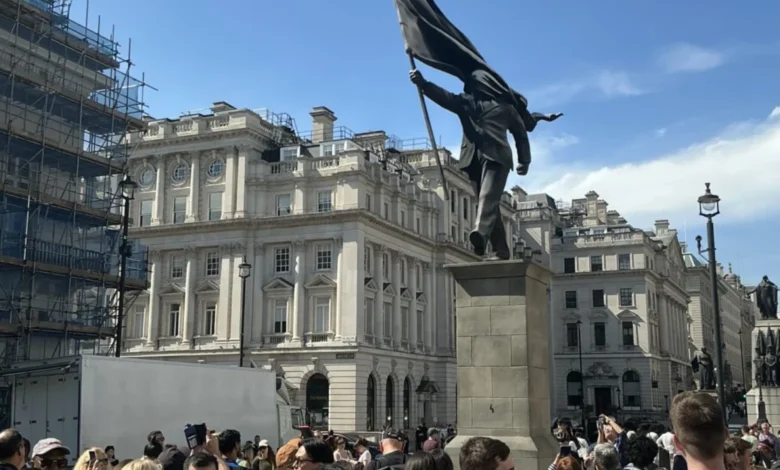
In early May 2026, the heart of London witnessed the unannounced arrival of a new, thought-provoking sculpture attributed to the elusive street artist Banksy. Discovered overnight at Waterloo Place, a prominent public space adjacent to Trafalgar Square and leading to the Royal Mall, the artwork quickly drew significant public attention and prompted an unusual response from city authorities. This latest piece, characterized by its stark symbolism and strategic placement, has ignited widespread discussion regarding its meaning, the nature of public art, and the evolving relationship between urban governance and unauthorized artistic expression.
The Sudden Appearance of a New Banksy Masterpiece
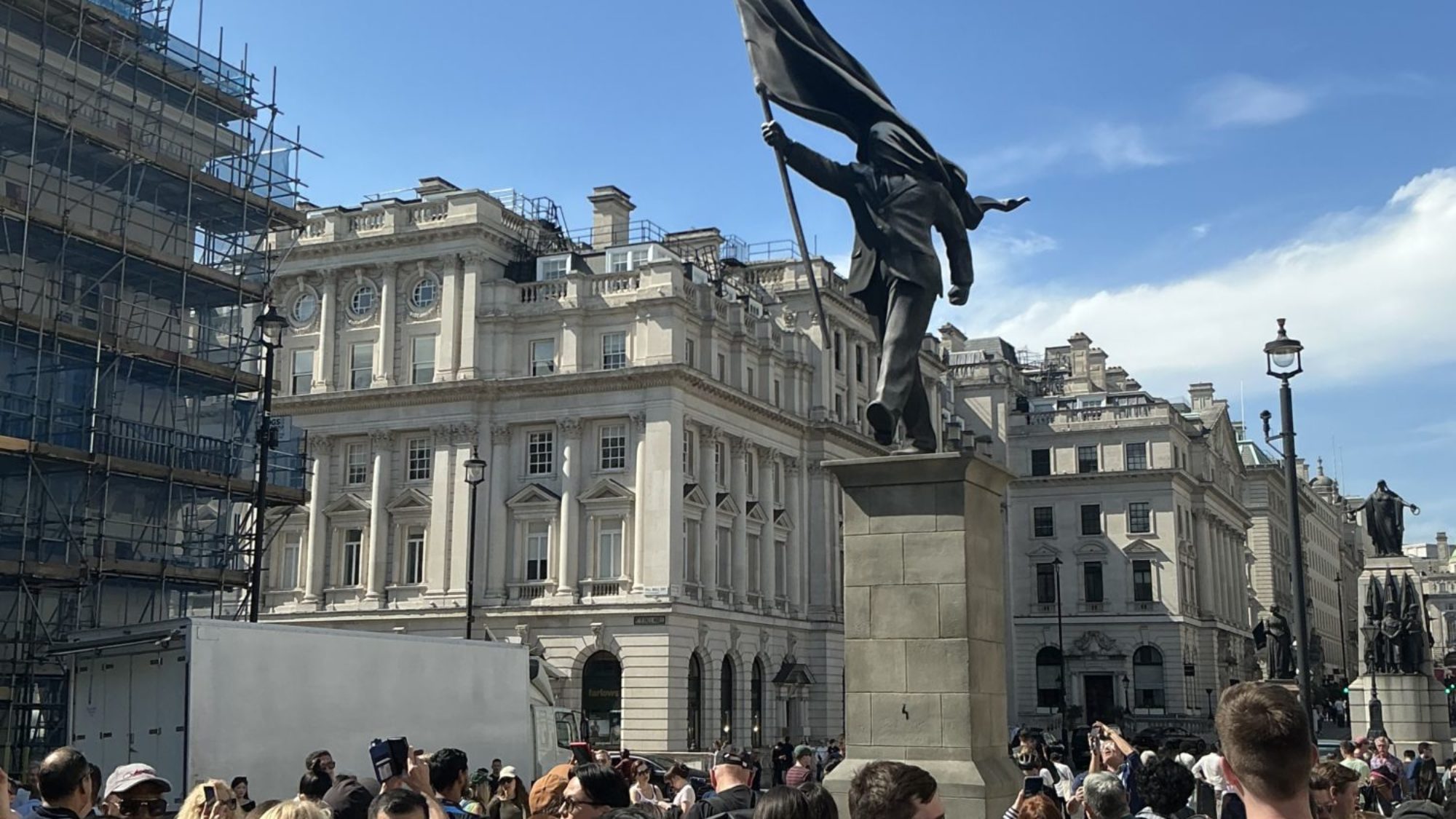
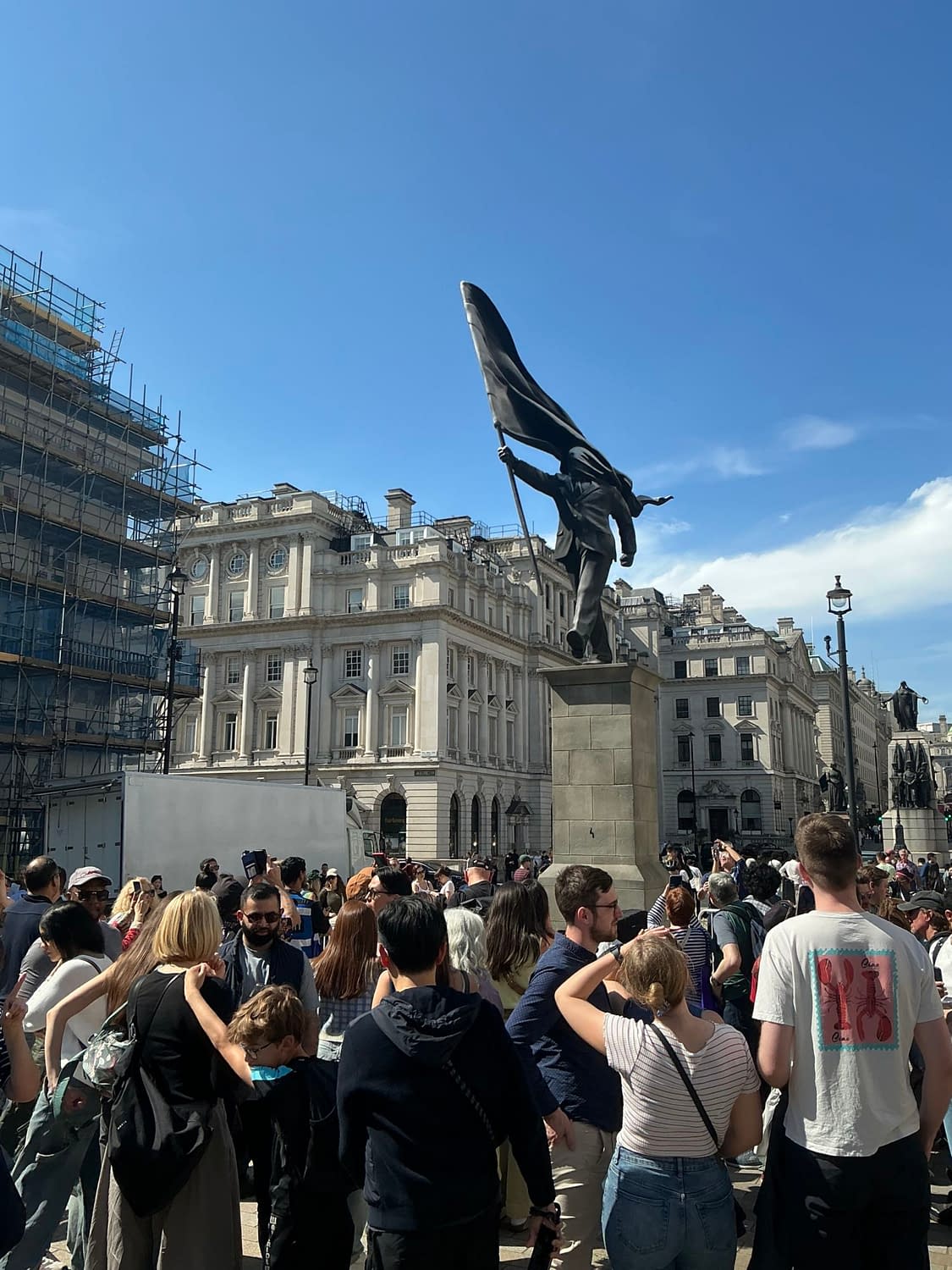
The sculpture, which has informally been dubbed "The Blindfolded Patriot" or "Flag Bearer," materialized sometime during the night preceding Free Comic Book Day, a global event typically held on the first Saturday of May, ensuring a bustling Central London for its reveal. Unlike many of Banksy’s previous interventions, which often take the form of graffiti or stenciled murals, this artwork is a three-dimensional installation. It depicts a life-sized, monochromatic figure standing atop a plinth, blindfolded by a blank flag it holds, seemingly stepping off into an empty void. The entire installation, including its base, was securely affixed to the pavement, suggesting a meticulous and clandestine operation. Its location, Waterloo Place, is a historically significant site, often serving as a focal point for both celebratory national events and fervent political demonstrations, from royal processions and the London Marathon to diverse protest marches encompassing environmental, social, and political causes. The immediate public reaction was one of curiosity and engagement, with crowds gathering to photograph and speculate on the artwork’s message.
Deciphering the "Blindfolded Patriot": An Artistic Interpretation
The artistic composition of the "Blindfolded Patriot" is deliberately ambiguous, designed to provoke universal contemplation rather than singular interpretation. The figure itself is rendered in a neutral, almost featureless manner, devoid of specific cultural or ethnic markers, enhancing its universality. The most striking element is the flag, which, rather than bearing any national emblem or political insignia, is entirely blank. This absence of specific identity is crucial to Banksy’s message. The figure’s posture – stepping forward, blindfolded, into an unknown space – powerfully symbolizes the dangers of tribalism, uncritical allegiance, and the potential for collective identity to obscure clear vision and rational thought. It suggests a society or individual marching blindly forward, guided solely by the banner they carry, oblivious to potential pitfalls or consequences.
The sculpture’s blankness allows it to resonate with myriad contemporary issues. Initial interpretations swiftly linked it to recent geopolitical events and national debates, such as Brexit, where the figure could be seen as representing the United Kingdom blindly navigating its post-EU future. However, the artist’s choice to leave the flag blank deliberately broadens the scope, inviting viewers to project their own affiliations and criticisms onto the artwork. This deliberate ambiguity ensures that the piece functions as a potent, adaptable symbol against any form of ideological rigidity or groupthink. By placing it among London’s established monuments – from Nelson’s Column to various statues commemorating military and political figures – Banksy subtly critiques the inherent biases and historical narratives embedded in traditional public art, offering a contemporary counterpoint that urges introspection over veneration.
Banksy’s Enduring Legacy and London’s Public Art Landscape
Banksy, the pseudonymous English street artist, political activist, and film director, has cultivated a global reputation for his distinctive satirical street art, often executed with a dark humor. His works typically combine graffiti with a unique stenciling technique, appearing unannounced in public locations around the world. Since rising to prominence in the early 2000s, Banksy’s art has consistently challenged established norms, critiqued consumerism, anti-capitalism, authority, and warfare, and often features poignant social commentary. His anonymity is a cornerstone of his mystique, allowing his art to speak for itself without the distraction of celebrity.
London has frequently been a canvas for Banksy’s interventions. Past works in the city have included "Girl with Balloon" (2002), a stencil first appearing in Shoreditch, and various pieces critiquing surveillance and poverty. The fate of these works has been varied; many have been removed by authorities, some have been vandalized, and a few have been preserved and even auctioned for significant sums, blurring the lines between vandalism, street art, and high art. This history provides crucial context for the official response to the Waterloo Place sculpture. Typically, unauthorized public art in London is subject to removal by local councils or property owners, particularly if deemed unsightly, offensive, or a nuisance. The city’s public art landscape is rigorously managed, with new installations usually requiring extensive planning permission, public consultation, and formal commissioning processes. The existence of thousands of historical statues and monuments across London, each with its own story and symbolic weight, makes the arrival of an uncommissioned, politically charged piece like "The Blindfolded Patriot" a remarkable event, especially when considering the unprecedented official response.
Official Response: Accommodation Over Annihilation
Perhaps the most surprising aspect of the "Blindfolded Patriot"’s appearance was the swift and uncharacteristic reaction from London authorities. In stark contrast to the immediate removal of other recent Banksy works, such as graffiti that appeared on the Royal Courts of Justice, officials elected not to dismantle the Waterloo Place sculpture. Instead, within hours of its discovery, temporary bollards and railings were erected around the artwork, effectively creating a protective perimeter and managing the flow of curious onlookers. This decision marks a significant departure from standard protocol for unauthorized installations.
The rationale behind this accommodation appears to stem from several considerations. Firstly, the nature of the artwork itself: a statue on a plinth, rather than graffiti directly on a building, might be perceived as less intrusive or damaging. Secondly, its location in a highly visible public square, already accustomed to large gatherings and temporary installations for events, may have played a role. It is plausible that city officials, likely a collaboration between Westminster City Council, the Greater London Authority, and potentially the Metropolitan Police, made a calculated decision to avoid the negative publicity and potential public backlash that a swift removal might generate. The artwork is seemingly deemed "not too offensive" and "not actually a work of desecration." Furthermore, by managing the crowds rather than removing the art, authorities implicitly acknowledge its cultural significance and the public’s right to engage with it. This response suggests a growing recognition of Banksy’s status as a major contemporary artist, even when operating outside conventional frameworks. The current stance indicates that the sculpture will remain in place "until it gets damaged, worn or torn, or actually becomes a danger or obstacle to someone," implying a temporary reprieve rather than permanent acceptance, but a reprieve nonetheless.
The Multifaceted Message: Tribalism, Identity, and Self-Reflection
The core message of the "Blindfolded Patriot" transcends specific political events, offering a profound commentary on human nature and societal divisions. Banksy, through this artwork, challenges viewers to examine their own allegiances and identities. The blank flag serves as a canvas for self-reflection, urging individuals to consider whether their own deeply held beliefs, nationalistic sentiments, or group affiliations might be blinding them to broader truths or potential perils. In an increasingly polarized global landscape, where tribalism and identity politics often dominate discourse, the sculpture acts as a powerful reminder of the dangers of uncritical adherence to any single ideology or group.
The artwork’s impact is further amplified by its reception on social media. While Banksy’s intent seems to be to inspire self-examination, many online users have paradoxically employed the image as a weapon against opposing viewpoints. Utilizing artificial intelligence tools, individuals have been observed digitally altering the blank flag to display the symbols of causes or nations they wish to criticize, effectively turning the artwork into a generalized stick to "beat others with." This phenomenon, while perhaps an unintended consequence, ironically reinforces Banksy’s central theme: the difficulty of genuine self-reflection when deeply entrenched in tribal loyalties. It underscores the human tendency to externalize critique rather than internalize it, highlighting the pervasive challenge of confronting one’s own biases. The piece, therefore, not only critiques blind loyalty but also exposes the very mechanisms through which such blindness is perpetuated in the digital age.
Broader Implications and the Future of Unauthorized Public Art
The preservation of Banksy’s Waterloo Place sculpture carries significant broader implications for both the art world and urban governance. For public art, it potentially sets a new precedent, suggesting that certain unauthorized works, if deemed culturally significant and non-disruptive, might be accommodated rather than immediately removed. This could encourage other artists to engage in similar interventions, albeit with the understanding that such accommodation is not guaranteed and remains at the discretion of authorities. It also highlights the evolving definition of public art, moving beyond commissioned statues to embrace more ephemeral, guerrilla forms of expression.
Economically, Banksy’s works command substantial value, and the public display and official protection of this sculpture could further enhance its artistic and monetary significance. Culturally, it reinforces London’s reputation as a dynamic hub for contemporary art and social commentary, capable of embracing unconventional artistic expressions. Socially, the artwork serves as a powerful catalyst for dialogue, encouraging public engagement with complex themes of identity, allegiance, and critical thinking. The sheer volume of media coverage and public interaction surrounding the sculpture ensures that its message reaches a vast audience, sparking conversations in homes, workplaces, and online platforms far beyond Waterloo Place.
However, the long-term fate of the "Blindfolded Patriot" remains uncertain. While currently protected, its future hinges on its condition and whether it eventually poses an obstacle or becomes subject to significant damage. The decision to protect it also raises questions about equity: why this piece and not others? What criteria will be applied to future unauthorized installations? These are questions that city officials and art critics will undoubtedly continue to grapple with. Ultimately, Banksy’s latest intervention in Central London is more than just a statue; it is a profound artistic statement that continues to challenge, provoke, and inspire, solidifying his place as a master of contemporary social critique and an enduring enigma in the art world.
A Catalyst for Dialogue: Banksy’s Continuing Impact
In conclusion, the unheralded arrival of Banksy’s "Blindfolded Patriot" at Waterloo Place is a multifaceted event with significant artistic, social, and political ramifications. Its stark imagery, coupled with its strategic placement in a historically charged location, offers a potent commentary on the perils of blind allegiance and tribalism in modern society. The unprecedented decision by London authorities to protect, rather than remove, the unauthorized installation speaks volumes about the evolving perception of street art and the undeniable cultural weight of Banksy’s work. As the sculpture continues to draw crowds and fuel debate, it serves as a powerful testament to the artist’s enduring ability to provoke self-reflection and catalyze critical dialogue, ensuring that its message resonates deeply within the public consciousness long after its initial appearance.