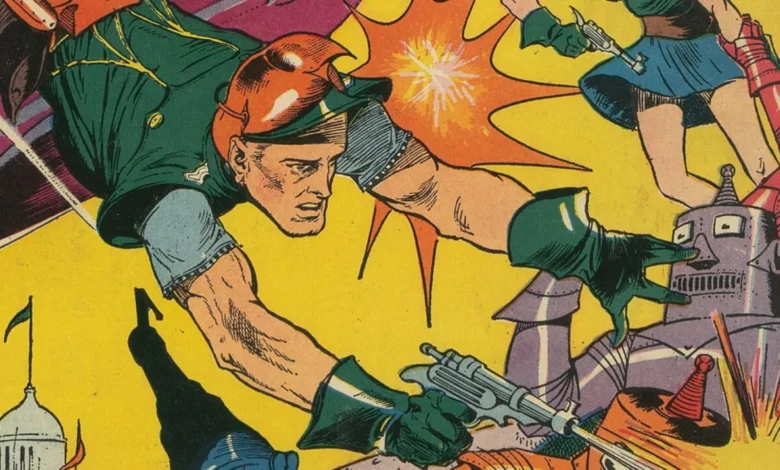
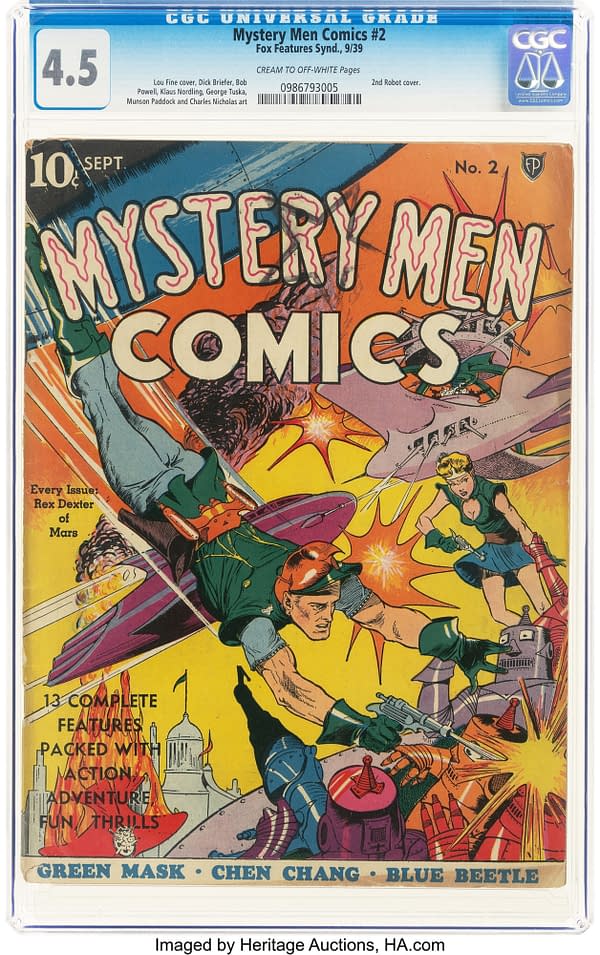
The golden age of comic books continues to captivate vintage paper collectors and historians alike, with rare issues commanding significant attention on the secondary market. A prime example of this enduring fascination is scheduled to cross the auction block: a CGC Universal VG+ 4.5 graded copy of Mystery Men Comics #2, published by Fox Feature Syndicate with a cover date of September 1939. This historic issue pairs an iconic, mechanical-mayhem cover by legendary artist Lou Fine with an ambitious cosmic adventure written and illustrated by Dick Briefer. As vintage comic books from the late 1930s become increasingly scarce in higher grades, the offering of this particular issue provides a compelling window into the formative years of the American comic book industry, blending real-world historical anxieties with unbridled science fiction imagination.

Main Facts of the Offering
The item heading to auction is Mystery Men Comics #2, featuring cream-to-off-white pages and certified by the Certified Guaranty Company (CGC) with a Universal grade of 4.5. It is slated to be sold during the Golden Age Century Comics Showcase Auction #40378, presented by Heritage Auctions.
The comic book is historically significant for two major creative contributions. First, it showcases early interior work by Dick Briefer, specifically centering on his recurring science fiction character, Rex Dexter. In this particular installment, the narrative tackles a massive global crisis: a severe terrestrial radium shortage that threatens the lives of patients suffering from cancer and other critical illnesses. Rather than relying on conventional terrestrial solutions, Briefer’s protagonist orchestrates an extreme measure—moving an entire alien planet, Capris, whose crust contains abundant pitchblende (referred to in the issue as "pitchblend"), directly into Earth’s vicinity.
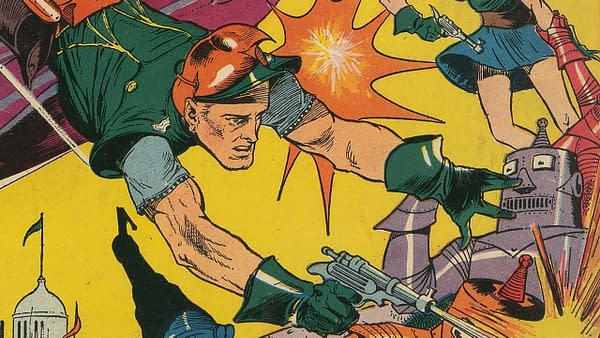
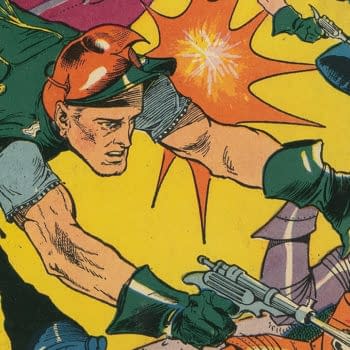
Second, the issue is anchored by a standout front cover illustrated by Lou Fine. Depicting a dynamic clash of armed adventurers, menacing robots, and aerial combat, Fine’s artwork established a visual standard for the adventure and superhero genres during the medium’s infancy. The combination of Fine’s dramatic cover art and Briefer’s planetary-scale storytelling encapsulates the creative energy that defined Fox Feature Syndicate during the Golden Age.
Historical Chronology and Context
To fully understand the significance of Mystery Men Comics #2, one must examine the timeline of the comic book industry and the historical landscape of the late 1930s. The period between 1938 and 1939 is widely recognized as the dawn of the Golden Age of Comic Books, triggered overwhelmingly by the debut of Superman in Action Comics #1 in June 1938. Publishers rushed to capitalize on the nascent superhero and mystery-men genres, leading to a proliferation of new anthology titles. Fox Feature Syndicate emerged as a major player in this rapidly expanding market, launching titles that leaned heavily into high-stakes action, science fiction, and larger-than-life heroics.
Lou Fine joined the influential Eisner-Iger studio in 1938, a crucial incubator for early comic book talent. Fine’s professional comics career had begun shortly prior with work in Wags #72, cover-dated July 1938, for Editors Press Service. His transition to Fox Feature Syndicate yielded rapid artistic triumphs, beginning with his cover for Wonder Comics #2 in June 1939. By the time Mystery Men Comics #2 hit newsstands in September 1939, Fine was quickly solidifying his reputation as one of the premier cover artists of the era, celebrated for his anatomical dynamism, fluid linework, and sense of kinetic motion.
Concurrently, the narrative content crafted by Dick Briefer reflected contemporary scientific realities filtered through a lens of speculative fiction. The storyline’s central conflict—a critical scarcity of radium—was not entirely a product of imaginative fantasy. Throughout the 1920s and 1930s, medical reporting frequently highlighted the extraordinary difficulty and exorbitant expense associated with acquiring even a single gram of radium, which was essential for emerging cancer treatments and radiological research. By translating real-world supply chain and medical access bottlenecks into a cosmic rescue mission involving alien worlds, Briefer mirrored public awareness of medical resource scarcity while elevating it to planetary proportions.

Supporting Data and Census Rarities
From a collecting perspective, Mystery Men Comics #2 is exceptionally difficult to acquire, particularly in desirable preservation grades. The scarcity of early Fox Feature Syndicate publications is well-documented among vintage paper enthusiasts and price guide compilers.

According to the CGC census data, surviving copies of Mystery Men Comics #2 are remarkably sparse. The registry lists a combined total of only 37 Universal and restored entries. Among these, the population report reveals significant scarcity at higher grade tiers: only a single Universal copy is registered at a 4.5 grade, with merely 10 copies graded higher across the entire census. This extreme rarity elevates the market value and historical desirability of the VG+ 4.5 copy heading to auction, as high-grade survivors from 1939 frequently face environmental degradation, poor-quality newsprint decay, and the attrition of time.
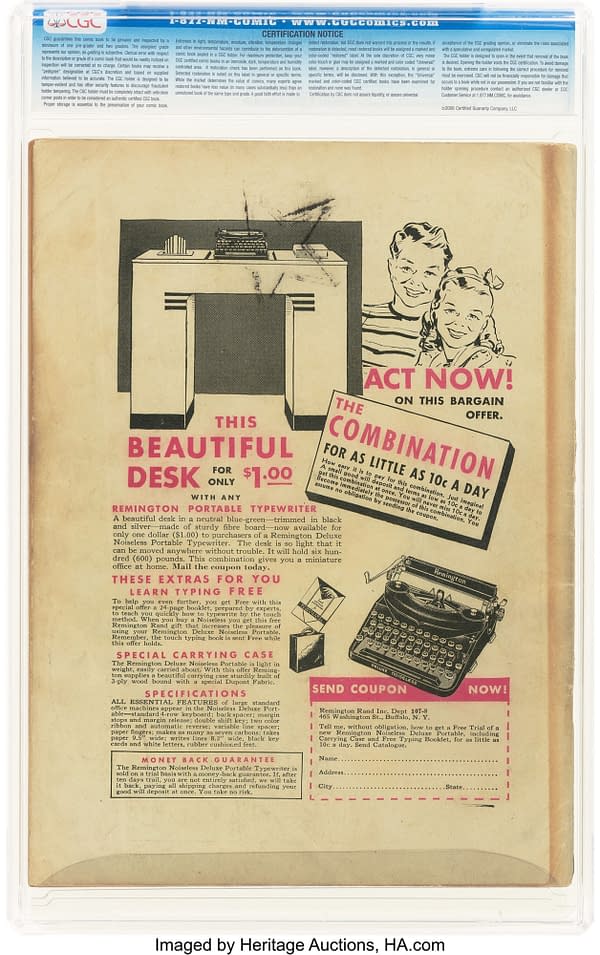
Furthermore, the physical artifact itself offers a snapshot of 1930s media consumption. In addition to the interior stories, the back cover of the issue features historical ephemera of the era, such as an advertisement for a Remington portable typewriter complete with an illustrated desk, children, and a mail-in coupon—providing modern historians with valuable context regarding the target demographic and commercial ecosystem surrounding early comic books.
Industry Analysis and Expert Perspectives
Vintage comic book historians and market analysts point to early Fox publications as critical stepping stones in the evolution of visual storytelling. While publishers like National Allied Publications (later DC Comics) and Timely Comics (later Marvel) often dominated historical retrospectives, Fox Feature Syndicate cultivated a distinct aesthetic characterized by visceral action, moody atmospheric covers, and boundary-pushing science fiction concepts.
The pairing of Lou Fine and Dick Briefer in Mystery Men Comics #2 represents a confluence of elite talent during a formative epoch. Fine’s ability to imbue mechanical constructs and human adventurers with a palpable sense of menace and motion set a benchmark that influenced subsequent generations of comic book artists. Meanwhile, Briefer’s willingness to embrace cosmic absurdity—solving a medical crisis by relocating a celestial body—demonstrates the boundless narrative freedom enjoyed by creators before industry self-regulation and genre standardization took firm root in the subsequent decades.
Market observers note that pre-1940 comic books in certified mid-grades, particularly those featuring definitive artwork by acknowledged masters like Fine, continue to attract institutional and high-end private collector interest. As the supply of investment-grade Golden Age books remains strictly finite, competition for scarce registry-level copies remains robust.
Broader Impact and Implications
The upcoming auction of Mystery Men Comics #2 serves as more than a simple financial transaction; it highlights the ongoing institutional and cultural preservation of America’s pop-culture heritage. Original comic books from 1939 are increasingly viewed not merely as nostalgic ephemera, but as vital cultural artifacts that documented the hopes, anxieties, and technological fascinations of the pre-World War II era.
As collectors vie for ownership of this rare piece of comic book history, the legacy of creators like Lou Fine and Dick Briefer is reaffirmed. Their ability to synthesize real-world medical challenges—such as the 1930s radium shortage—with space-opera escapism laid the groundwork for modern speculative fiction. The preservation of issues like Mystery Men Comics #2 ensures that future generations can examine the raw, uninhibited creativity that birthed an entire artistic medium.