Christopher Nolan Directs The Odyssey as a Masterclass in Epic Filmmaking and Ancient Adaptation

Christopher Nolan’s latest cinematic venture firmly cements his status as a defining auteur of modern cinema, translating Homer’s foundational 2,700-year-old epic into a gritty, psychologically complex feature film. Released to widespread critical acclaim, the three-hour adaptation bridges the gap between primeval storytelling and contemporary filmmaking techniques. Rather than relying on superficial spectacle, the production delves deeply into the heavy human toll of conflict, exploring themes of post-traumatic stress, the abandonment of ethical principles, and the bitter realities of homecoming.
Faithful Adaptation Meets Gritty Realism
While cinematic adaptations of ancient texts often take sweeping liberties with narrative structure and historical aesthetics, Nolan’s script maintains a remarkable fidelity to the Homeric tradition while introducing distinct structural innovations. Departing from the strictly linear presentation of standard Hollywood epics, the film frames Odysseus’s sprawling journey through memories recounted to the nymph Calypso, played by Charlize Theron, on whose isolated island the hero has been stranded for years.
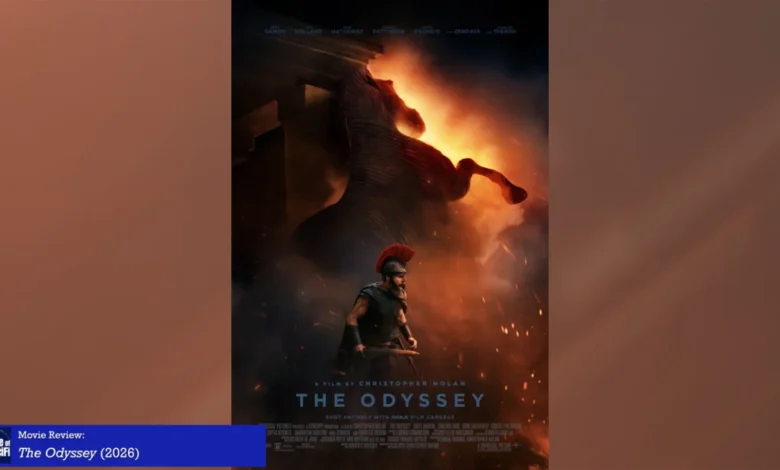
The production design breaks away from the glossy, theatrical conventions of 20th-century sword-and-sandal historical dramas, such as the 1963 film Cleopatra. Instead, the visual palette is earthy and gritty. Sets, costumes, and weaponry have been meticulously researched and rendered to feel authentic to the Late Bronze Age. A prime example of this meticulous attention to detail is Nolan’s depiction of the Trojan Horse. Rather than focusing solely on the iconic silhouette, the camera emphasizes the claustrophobic terror experienced by the Greek soldiers trapped within the belly of the inanimate structure. Similar historical grounding is extended to the construction of ancient sea vessels, including the fragile raft upon which Odysseus navigates perilous waters.
Mythological Terrors and Psychological Depth
The film opens with the stark tagline, "A time of apparent magic," setting the stage for an uncompromised encounter with the supernatural elements of Greek mythology. Without offering extraneous or modern explanations for their origins, Nolan brings legendary figures and creatures to life with state-of-the-art visual effects. Audiences witness the terrifying Cyclops, the seductive yet dangerous witch Circe portrayed by Samantha Morton, the alluring Sirens, and the perilous marine hazards of Scylla and Charybdis.
Particularly striking is the introduction of the Laestrygonians, a man-eating giant race whose menacing presence underscores the constant peril faced by the crew. Later in the narrative, a chilling sequence depicts Odysseus and his surviving men summoning the dead by sacrificing goats, letting the fresh blood draw forth prophetic and unsettling spirits, including the blind seer Tiresias, played by James Remar. The ensuing panic as the sailors flee back to their ships provides one of the film’s most visceral and eerie sequences.
The sack of Troy is strategically placed in the latter half of the film, capturing what Odysseus describes as a decade of accumulated rage unleashed by the Greek forces. In their commission of wanton bloodshed and violation of the established laws of war, the soldiers profoundly offend the gods, setting off a chain of divine retribution. Nolan utilizes this pivotal event to frame Odysseus’s prolonged detainment on Calypso’s island not merely as a magical imprisonment, but as a manifestation of severe post-traumatic stress disorder. Odysseus is acutely aware that the moral ethos of his civilization has been fractured and that his home in Ithaca has been fundamentally altered by the prolonged absence and the loss of his entire crew.
Stellar Ensemble Cast and Character Dynamics
Matt Damon leads the star-studded ensemble as Odysseus, delivering a performance that balances pragmatic ingenuity with immense physical strength and emotional vulnerability. Damon’s portrayal captures both the calculated commander and the weary survivor, particularly during the brutal, Viking-berserker-style climax involving the slaughter of the intrusive suitors. His nuanced interactions with Charlize Theron’s Calypso anchor the film’s quieter, more introspective moments. Theron effortlessly portrays a conflicted immortal who yearns for the hero to stay, yet ultimately recognizes his psychological imperative to return home and face his past.
Anne Hathaway delivers a captivating performance as Queen Penelope, perfectly embodying the agonizing limbo of a woman whose husband has been absent for two decades—ten spent at war and another ten lost to wandering seas. Hathaway captures Penelope’s unwavering strength of will as she resists mounting political pressure to remarry, symbolized by the infamous daily weaving and nightly unravelling of her tapestry. Her brief, tender flashback scenes with Damon establish the profound emotional stakes underlying the entire voyage.
Tom Holland surprises audiences with a grounded and determined portrayal of Telemachus. Though physically smaller than the arrogant suitors and his legendary father, Holland’s Telemachus exhibits fierce loyalty and budding warrior capabilities. The narrative thoughtfully incorporates key diplomatic detours, including a visit to Menelaus, played by Jon Bernthal, and brief, impactful appearances by Lupita Nyong’o as Helen of Troy.
Further enriching the cast is John Leguizamo, who delivers a nearly unrecognizable and brilliant performance as Eumaeus, the loyal and blind swineherd. Samantha Morton brings both coyness and ruthless wisdom to her role as Circe, delivering hard-earned truths about human nature that resonate throughout the narrative.
Critical Reception and Cultural Implications
With a runtime of three hours, the film maintains a swift and gripping pace, combining high-stakes action with deep philosophical inquiry. Early industry analysis and critic consensus suggest that Nolan’s adaptation will redefine how ancient classical literature is approached within mainstream cinema. By treating the source material with absolute sincerity while infusing it with modern psychological realism, the production avoids the pitfalls of campy fantasy and elevates the myth to a profound meditation on war, trauma, and identity.
As studios look toward high-concept literary adaptations for future box-office viability, The Odyssey sets a rigorous new benchmark for artistic integrity, scale, and performance depth. The film’s commercial and critical success underscores a growing audience appetite for intelligent, big-budget epics that refuse to compromise narrative complexity for the sake of mass market accessibility.
Related posts: