Skate Ali #2 Delivers High-Octane Action with Arrests, Rooftop Dares, and Supernatural Encounters

Dark Horse Comics is set to release Skate Ali #2 this Wednesday, July 22nd, 2026, plunging its protagonist, Ali, deeper into a perilous world of high-stakes skateboarding, authoritarian pursuit, and unsettling mysteries. The sophomore issue of this five-part sci-fi skatepunk saga promises an escalation of tension, featuring arrests, daring rooftop stunts, and the ominous possibility of spectral encounters as Ali navigates the chaotic realm of the Skull Clan. This installment continues the narrative established by Eisner-winning writer Kelly Sue DeConnick and hitmaker Sam Humphries, with vibrant artwork by Natacha Bustos, positioning the series as a compelling exploration of youth rebellion against a backdrop of futuristic dystopia.
Synopsis of Issue #2: A Descent into Chaos

Skate Ali #2 picks up with Ali already embroiled in the Skull Clan’s activities, a situation that rapidly spirals into legal trouble and extreme challenges. The issue opens with Ali recounting her recent tribulations in a letter to her father, revealing she has been arrested—a "LOL" indicating a mix of youthful bravado and underlying anxiety. Her involvement with the Skull Clan, initially perceived as "cool," is now fraught with ambivalence, as she notes some members are "really unpleasant" and expresses a desire to leave. This internal conflict underscores the complex moral landscape Ali is forced to traverse, where camaraderie is intertwined with potential danger and ethical compromises.
A central catalyst for Ali’s continued involvement is Skull Queen 9, the enigmatic leader who has promised to resolve Ali’s problems if she participates in a "big stupid race." This proposition introduces a clear narrative objective while simultaneously deepening Ali’s entanglement with the group. The stakes are immediately raised when Maria, identified as the Skull Clan’s best skater, challenges Ali to an audacious and potentially fatal stunt: skating off the edge of a rooftop. This dare not only tests Ali’s physical limits and courage but also highlights the extreme culture of the Skull Clan, where personal risk is a common currency. Ali’s internal monologue, "I think I might die?" encapsulates the immediate peril and her growing realization of the life-threatening situations she now faces. Adding another layer of mystery and unease, Ali reports, "I think I saw a ghost," hinting at supernatural elements or psychological stress that further complicate her already volatile circumstances.
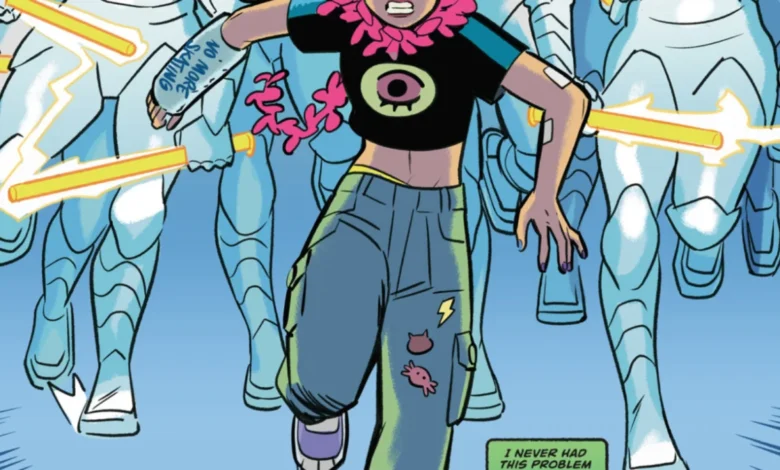
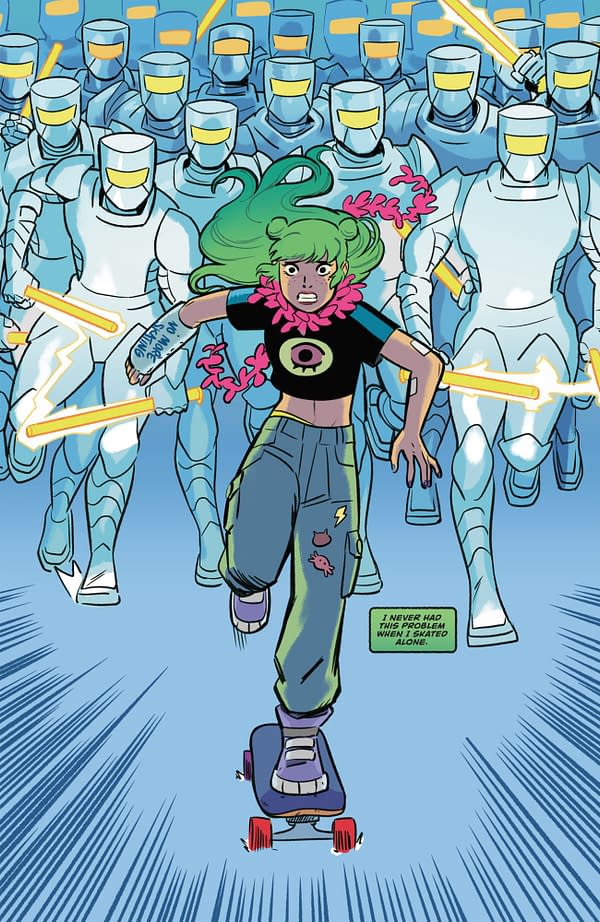
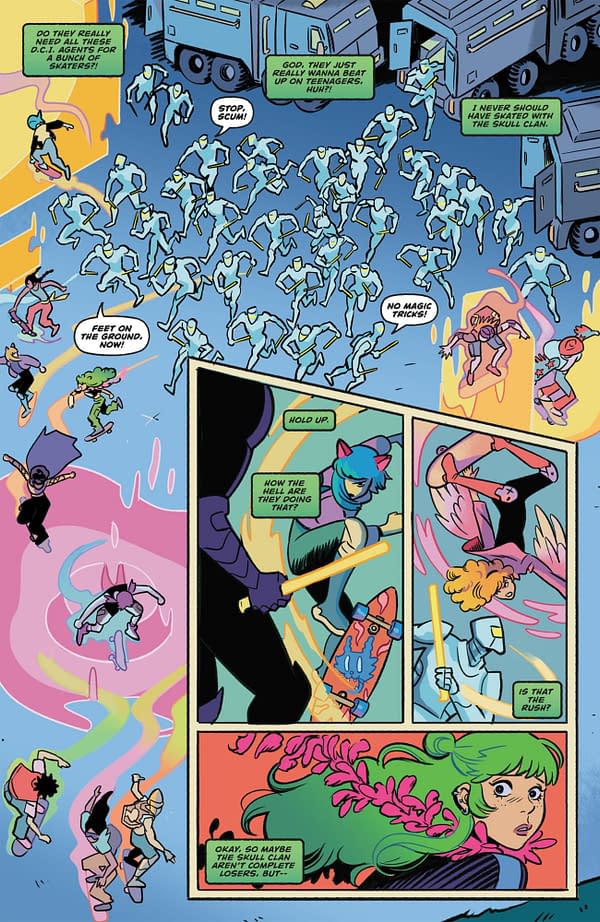
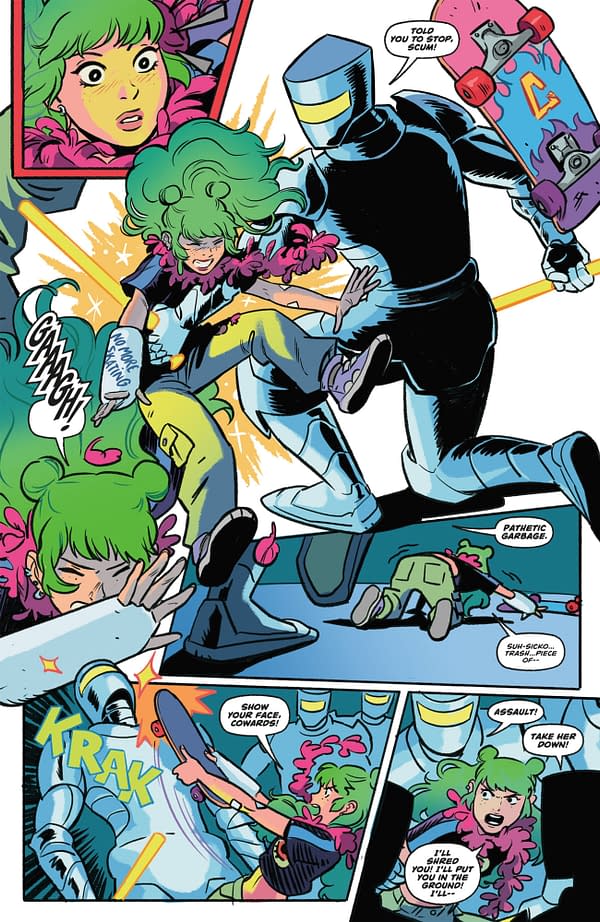
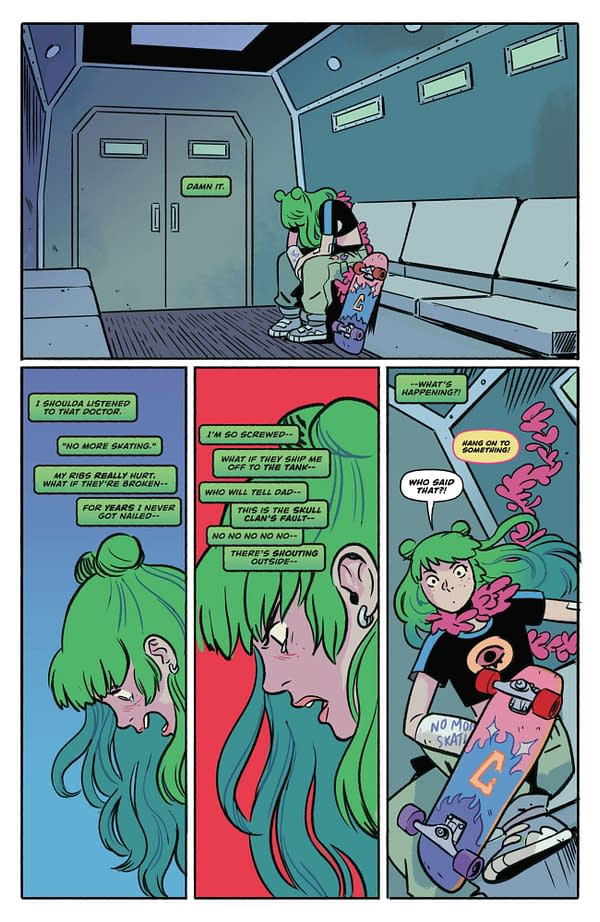
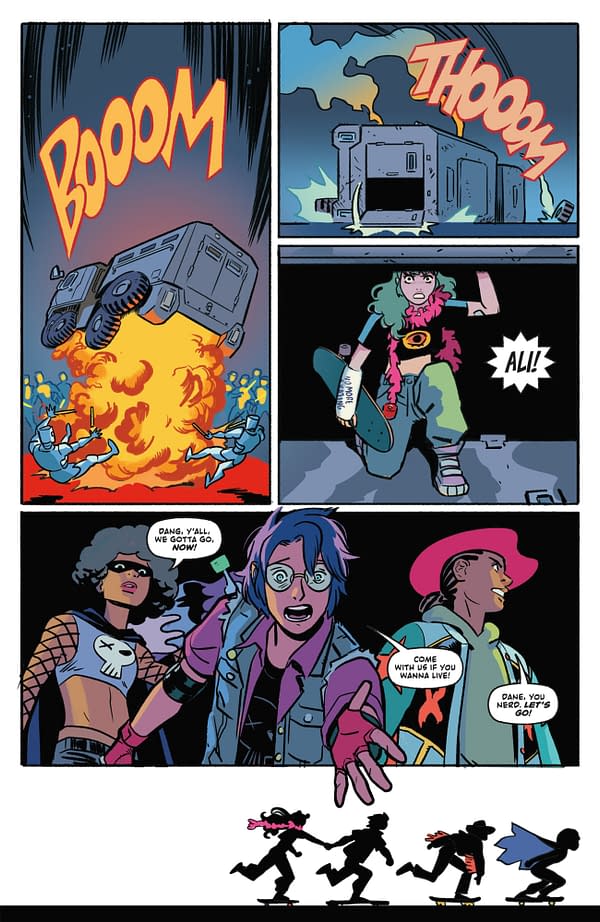
Preview pages accompanying the release further illustrate the intense action within the issue. Ali is depicted being pursued by an army of identical, robotic-looking agents, presumably representing the D.C.I. (Department of Criminal Investigations) or a similar authoritarian force. This pursuit suggests that Ali’s arrest is not an isolated incident but part of a broader crackdown on rebellious youth, particularly those associated with the Skull Clan. The visual narrative portrays Ali surrounded by her colorful skater companions, implying a sense of community and defiance against the uniformity of the D.C.I. enforcers. The threat of "shipping to a tank for her crimes" underscores the severe and disproportionate response of the authorities, painting them as an oppressive regime determined to quash any form of dissent or unconventional behavior, particularly from teenage skaters. This dynamic sets up a classic rebellion narrative, pitting individual freedom and subculture against institutional control.
The Visionary Creative Team Behind Skate Ali
The Skate Ali series benefits from a formidable creative team, uniting acclaimed talents known for their innovative storytelling and distinctive artistic styles. Kelly Sue DeConnick, an Eisner-winning writer, brings her signature depth and character-driven narratives to the project. Renowned for her work on critically acclaimed titles such as Bitch Planet and FML, DeConnick has consistently explored themes of social commentary, feminism, and resistance. Her ability to craft complex protagonists and build immersive worlds is a significant asset to Skate Ali, promising a narrative that extends beyond mere action to delve into the psychological and emotional journey of its young hero.
Collaborating with DeConnick is Sam Humphries, a prolific writer celebrated for his dynamic and often irreverent contributions to series like Harley Quinn and Guardians of the Galaxy. Humphries’s knack for fast-paced plotting, witty dialogue, and high-energy storytelling is evident in the premise of Skate Ali, ensuring a vibrant and engaging reading experience. His experience with character-focused action and genre-bending narratives makes him an ideal partner in developing this unique sci-fi skatepunk universe.
The visual dynamism of Skate Ali is brought to life by artist Natacha Bustos. Known for her work on Moon Girl and Miles Morales, Bustos possesses a distinctive art style characterized by expressive characters, fluid action sequences, and a vibrant color palette. Her ability to convey both kinetic energy and emotional nuance is crucial for a series centered around skateboarding and teenage angst. Bustos’s artistic contribution ensures that the world of Skate Ali feels alive and visually distinct, enhancing the sci-fi and punk aesthetics. Rosemary Valero-O’Connell provides the captivating cover art for Skate Ali #2, her acclaimed style often blending ethereal beauty with a grounded sense of emotion, which likely contributes to the issue’s intriguing visual identity. The combined talents of DeConnick, Humphries, and Bustos signal a deliberate effort to create a comic that is both narratively rich and visually striking, pushing the boundaries of the genre.
Exploring the Sci-Fi Skatepunk Genre and Core Themes
Skate Ali is explicitly defined as a "high-octane, genre-smashing sci-fi skatepunk saga." This fusion of genres is central to its appeal and thematic depth. The "sci-fi" element likely manifests through the futuristic setting, advanced technology (such as the robotic D.C.I. agents), and possibly unique environmental or societal structures that influence the narrative. The "skatepunk" aspect is not merely aesthetic; it embodies a philosophy of rebellion, anti-establishment sentiment, DIY ethos, and a celebration of counter-culture. Skateboarding itself is a symbol of freedom, individuality, and defiance, especially when performed in forbidden spaces or under oppressive surveillance. The series uses this subculture as a vehicle to explore larger themes.
At its heart, Skate Ali is a story about "friendship, rebellion, and finding your line when the world wants to knock you down." Ali’s journey into the Skull Clan, despite her reservations, highlights the human need for belonging and connection, even in unconventional groups. The dynamic between Ali and Skull Queen 9, and the challenge from Maria, underscore the complexities of these relationships. The theme of rebellion is woven into the very fabric of the series, as Ali and her companions actively defy authority, represented by the D.C.I. The concept of "finding your line" serves as a powerful metaphor for self-discovery and resilience. In skateboarding, "finding your line" refers to successfully navigating a complex route or trick sequence. In Ali’s life, it translates to discovering her own moral compass, her boundaries, and her identity amidst external pressures and internal conflicts. This theme resonates particularly with the target audience of age 9 and up, as it addresses universal coming-of-age challenges in an accessible yet thrilling manner. The five-issue format allows for a focused and intense exploration of these themes, building momentum and escalating stakes with each installment.
Publication Details and Availability
Skate Ali #2 is published by Dark Horse Comics, a prominent independent publisher known for its diverse range of titles that often push creative boundaries. Dark Horse has a long history of supporting creator-owned comics and genre fiction, making it an ideal home for a unique series like Skate Ali. The issue is scheduled to hit stores on Wednesday, July 22nd, 2026. This release date positions it as a significant new entry in the comic book release schedule, building anticipation from the first issue.
The physical specifications of the comic include dimensions of 6.64"W x 10.18"H x 0.05"D, a weight of 2 oz, and a page count of 32. These standard comic book dimensions ensure a familiar reading experience, while the 32 pages provide ample space for the story’s progression and detailed artwork. The issue is priced at $4.99, aligning with current market standards for single-issue comics. The ISBN/UPC for the issue is 76156801589800211. Dark Horse Comics has rated the series for "Age 9 and up," indicating its suitability for a broad readership, including younger audiences who can appreciate the themes of adventure, friendship, and challenging authority without encountering overly mature content. The availability of variants, as hinted in the solicitation, suggests collectible options for dedicated readers and fans.
Broader Impact and Implications
The release of Skate Ali #2 carries broader implications for the comic book industry and its readership. In an era where mainstream superhero narratives often dominate, independent series like Skate Ali offer fresh perspectives and genre experimentation. Dark Horse Comics’ commitment to such unique stories contributes to the diversity of the comic landscape, providing alternatives for readers seeking narratives outside conventional superhero tropes. The combination of established, award-winning creators also lends significant credibility and attracts attention, potentially drawing new readers to the independent comic scene.
The series’ focus on youth rebellion and counter-culture themes taps into a timeless appeal, particularly for younger readers who are navigating their own identities and relationships with authority. The blend of sci-fi elements with the visceral energy of skatepunk creates a visually and narratively rich world that can engage readers on multiple levels. The escalating stakes in issue #2, with Ali facing arrest, extreme dares, and unexplained phenomena, ensure that the narrative maintains a high level of suspense and excitement, encouraging readers to follow Ali’s perilous journey to its conclusion. The exploration of "ghosts" introduces a layer of supernatural or psychological horror, further diversifying the narrative’s emotional and thematic range.
Furthermore, Skate Ali contributes to the ongoing conversation about youth empowerment and the challenges faced by adolescents in restrictive environments. Ali’s internal struggle with the Skull Clan—recognizing their "coolness" while also acknowledging their "unpleasant" aspects—mirrors real-world dilemmas faced by young people when choosing allegiances and defining their values. The D.C.I.’s heavy-handed response to teenage skaters can be interpreted as a commentary on societal control and the suppression of individual expression. As the series progresses through its five-issue run, it is poised to offer a compelling narrative on resistance, self-discovery, and the power of finding one’s authentic path.
Readers interested in Skate Ali #2 can find it at their local comic book specialty stores or through digital platforms when it becomes available on July 22nd, 2026. The series promises to be a vibrant and thought-provoking addition to the Dark Horse Comics lineup, offering a thrilling ride through a world where skateboards are tools of rebellion and every rooftop presents a new frontier.