St. John Publishing Company’s Authentic Police Cases #6 (1948) occupies a singular, highly contentious space in the history of American comic books. As collectors and vintage paper historians prepare for the upcoming Heritage Auctions event on December 10, 2026—which features a CGC VG 4.0 copy with off-white pages—the issue continues to be analyzed for its artistic significance, its connection to a turbulent era of censorship, and its role as a primary exhibit in the moral panic that nearly destroyed the comic book industry.

Featuring early contributions from legendary artist Matt Baker and carrying the infamous distinction of being cited in Dr. Fredric Wertham’s anti-comics crusade, this specific issue encapsulates the friction between creative expression and societal backlash during the Golden Age of comics.
Main Facts and the Heritage Auctions Listing
The copy heading to auction is certified by the Certified Guaranty Company (CGC) at a Very Good (VG) 4.0 grade, featuring off-white pages. The CGC census currently records 39 Universal entries for Authentic Police Cases #6, with five copies graded at 4.0 and 21 sitting at higher numerical grades. Given the book’s dual scarcity and historical notoriety, high-grade and mid-grade copies routinely command significant interest from vintage collectors specializing in Pre-Code crime fiction.

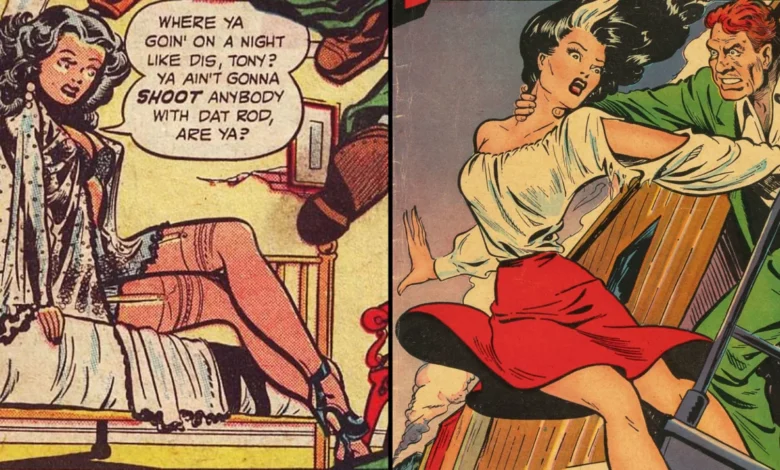
The issue’s cover is a collaborative triumph credited to Matt Baker and Ray Osrin, depicting a dramatic, high-stakes scene of a woman clinging to a train railing as a man reaches for her while an adjacent train rushes past. However, the interior pages hold an even greater weight in comic book lore. The title page of the Walter Johnson-illustrated story “Human Cat Trapped by Death Gun Slugs” features a striking image of a gun moll named Rose dressed in lingerie. This exact panel was later immortalized—and condemned—in Fredric Wertham’s landmark 1954 exposé on the medium, Seduction of the Innocent, under the chilling caption, “An invitation to learning.”
Chronology and the St. John Publishing Pivot
To understand the trajectory of Authentic Police Cases #6, one must examine the timeline of publisher Archer St. John’s corporate strategy during the late 1940s. St. John was navigating an increasingly hostile public relations environment characterized by intense scrutiny over depictions of crime, violence, and sexuality in comic books.

Around the time Authentic Police Cases #6 arrived on newsstands in 1948, local authorities and media watchdogs across the United States were stepping up campaigns against objectionable reading material marketed to minors. In Washington state, a prominent reporter publicly singled out the preceding issue, Authentic Police Cases #5, highlighting a cover featuring a "bare-kneed girl helping a convict shoot it out with an officer" as an egregious example of corruptive youth media.
The immediate fallout was swift. Both Authentic Police Cases and its sister publication Crime Reporter—which had marked Matt Baker’s earliest cover assignments for St. John—were abruptly canceled in the exact same month. Recognizing the writing on the wall, Archer St. John pivoted rapidly to safer commercial waters. The very next month, the publishing house launched its first-ever romance comic book, Teen-Age Romances, featuring a cover by Matt Baker. This strategic shift not only altered the professional trajectory of Baker—who would become one of the premier romance artists of the era—but also stabilized St. John Publishing during a volatile transitional window.

While the short-lived Crime Reporter was permanently retired, the anti-comics fervor of 1948 eventually subsided just enough for St. John to reintroduce Authentic Police Cases to newsstands approximately 17 months later, in early 1950. The title went on to enjoy a healthy 38-issue run lasting from 1948 to 1955, ultimately featuring 28 distinct covers illustrated by Matt Baker.
Fact-Checking the "Authentic" Crime Stories
Despite its title promising true-to-life accounts of law enforcement triumphs, Authentic Police Cases blended genuine historical events with sensationalized, fictionalized melodrama typical of the Pre-Code era.

The story "Human Cat Trapped by Death Gun Slugs" focused on a cat burglar named Antonio Boccadora. While newspapers of the period frequently used the moniker "the human cat" to describe daring urban burglars, historical records show no evidence of a real-life criminal named Boccadora matching the comic’s narrative. Furthermore, Rose, the gun moll featured prominently in the infamous opening montage cited by Wertham, is allotted barely a single panel of dialogue or presence in the remainder of the story. Wertham utilized this visual isolation to frame the medium as exploitative, offering abstract moral hazards to impressionable youths without providing substantial context for the narrative surrounding the art.
Conversely, the same issue included "Bullets Blaze the Mounties’ Trail," a story originally published in Chesler’s Dynamic Comics #14 in 1946. This segment offered a thoroughly documentable true-crime saga. Grounded in official records—specifically the Royal Canadian Mounted Police report concerning a 1932 homicide—the comic detailed the manhunt and subsequent trial of William Kurulak, who was sentenced to be hanged, and his brother Mike Kurulak, who received a 15-year prison sentence for the murder of RCMP Corporal Ralls.

Broader Impact and Industry Implications
The inclusion of Walter Johnson’s artwork in Fredric Wertham’s Seduction of the Innocent cemented Authentic Police Cases #6 as a cornerstone text in the history of comic book censorship. Wertham’s crusade ultimately led to the 1954 Senate Subcommittee Hearings on Juvenile Delinquency, which in turn forced the comic book industry to establish the Comics Code Authority (CCA) later that same year. The CCA effectively dismantled the Pre-Code crime and horror genres, leading to the cancellation of hundreds of titles and shifting the market almost exclusively toward sanitized superhero and romance comics.
For contemporary collectors, books like Authentic Police Cases #6 serve as physical artifacts of a cultural war zone. They represent a brief, unrestrained period of artistic experimentation where master illustrators like Matt Baker pushed visual boundaries just before the iron curtain of industry self-regulation fell. As the CGC 4.0 copy heads to the auction block at Heritage Auctions, its value extends far beyond its grade; it remains a tangible piece of the fierce debate that shaped modern pop culture history.