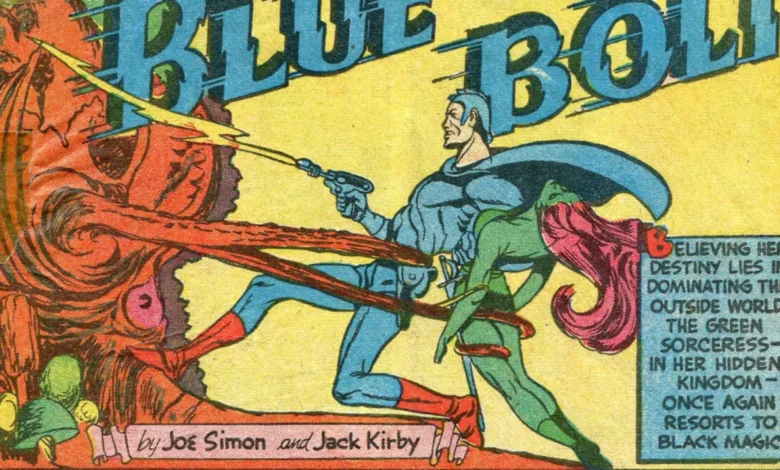
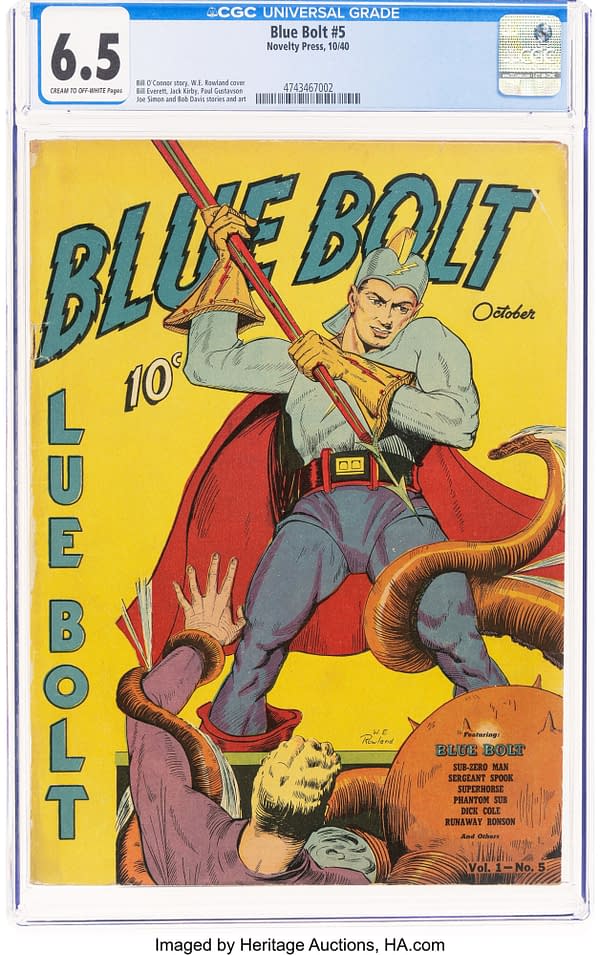
The Golden Age of comic books continues to captivate collectors, historians, and pop-culture enthusiasts as rare artifacts from the industry’s foundational years emerge for public acquisition. Among the most anticipated pieces heading to the auction block is a well-preserved copy of Blue Bolt #5, published by Novelty Press with a cover date of October 1940. This specific issue marks a critical turning point in the storied careers of legendary creators Joe Simon and Jack Kirby, serving as the first installment in the series to feature their formal, joint byline. Graded at CGC FN+ 6.5 with cream to off-white pages, the artifact is a headline offering in the upcoming Golden Age Century Comics Showcase Auction VI, scheduled for November 5, 2026.

A Crucial Milestone in Comic Book History
To understand the significance of Blue Bolt #5, one must examine the rapid evolution of the American comic book industry at the dawn of the 1940s. Joe Simon originally conceived the character Blue Bolt prior to his historic professional partnership with Jack Kirby. In earlier issues, Simon’s signature stood alone as the creative force behind the feature. However, as noted by comic book historian Harry Mendryk in his extensive studies of the duo’s early bibliography, issue #5 formally acknowledges the collaborative synergy that was rapidly transforming the medium.
Although Simon and Kirby had already begun pooling their talents behind the scenes, this issue represents the debut of their official joint credit. The partnership would eventually yield some of the most iconic characters and genres in comic book history, most notably the creation of Captain America for Timely Comics later that same era. The transition visible in Blue Bolt #5 demonstrates two masters of the craft locking into a rhythm that blended high-octane superhero action with increasingly sophisticated narrative experiments.
Cosmic Horror Meets Pulp Science Fiction
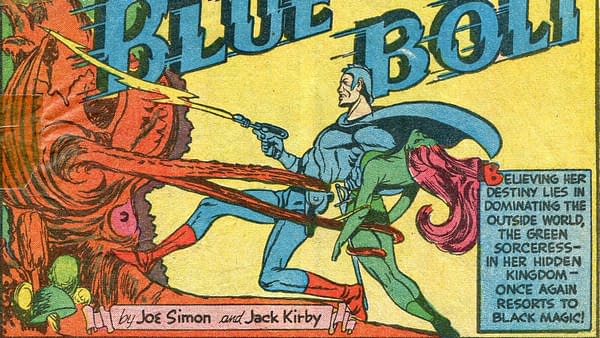
The narrative of Blue Bolt #5 pushes the boundaries of traditional Golden Age storytelling by injecting robust elements of cosmic horror and fourth-dimensional science fiction. The plot is set into motion by the Green Sorceress, who utilizes an ancient, obscure book delivered by a supernatural messenger to orchestrate a terrifying multidimensional incursion. The initial objective of these otherworldly forces is deceptively simple: to plunder Earth’s precious radium supplies.
However, the scale of the threat quickly spirals beyond terrestrial comprehension. Faced with a scheme that threatens to shatter the barrier between dimensions, a brilliant scientist equips Blue Bolt for an intercept mission. The resulting journey into the fourth dimension alters the hero’s physical state, rendering him transparent and inducing a surreal sensory overload. By perceiving every side of objects simultaneously, Blue Bolt becomes temporarily unmoored from conventional human comprehension, unable to make practical sense of his environment until specialized corrective goggles restore his three-dimensional perspective.
This imaginative depiction of higher spatial dimensions reflects a broader cultural fascination with theoretical physics and metaphysical concepts during the early 20th century. The narrative concepts deployed by Simon and Kirby trace their intellectual lineage back to foundational texts such as Charles Howard Hinton’s 1884 essay What Is the Fourth Dimension?, which explored how an extra spatial dimension could allow passage beyond physical enclosures and reveal hidden aspects of solid objects. By the late 1930s, these abstract mathematical and philosophical ideas had filtered into popular media, often intersecting with spiritualism and early pulp science fiction to capture the public imagination.
Publication Details, Cover Art, and Market Rarity
While the interior storytelling and artwork showcase the burgeoning genius of Simon and Kirby, the external presentation of Blue Bolt #5 features contributions from other hands. The front cover bears the signature of W.E. Rowland, a credit whose exact identity has long been a subject of debate among comic book scholarship. Consensus remains divided on whether Rowland was a genuine illustrator, a corporate house name, or a pseudonym for artist Larry Antonette. Despite these historical ambiguities, the cover art successfully establishes a mood of peril, depicting Blue Bolt brandishing a lance against an aggressive, orange tentacled entity—a visual motif that harmonizes neatly with the Lovecraftian undertones of the interior story.
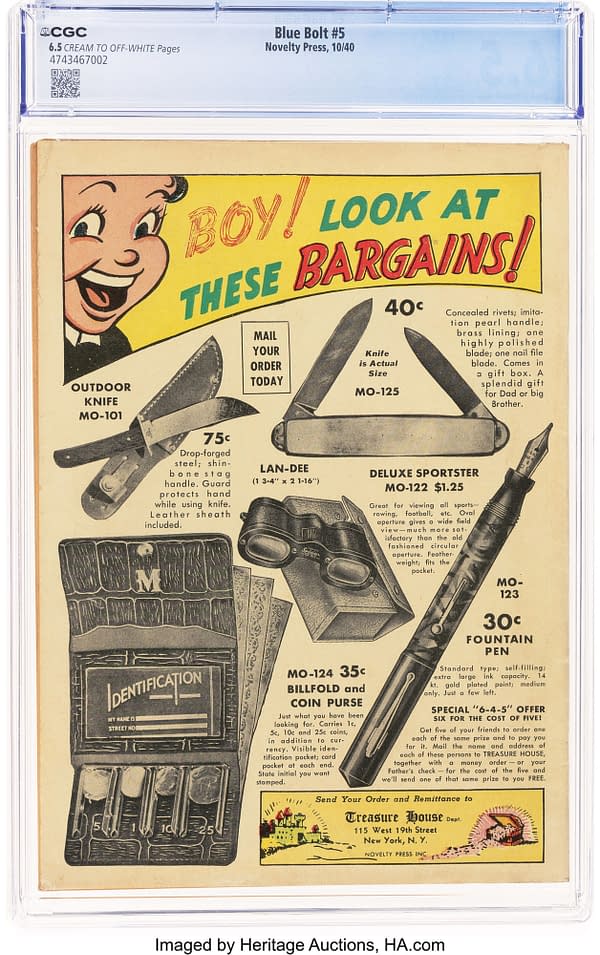
The back cover features a classic "Treasure House" merchandise advertisement characteristic of the era, promoting various boys’ novelties including pocketknives, sports viewers, fountain pens, and billfolds beneath the enthusiastic heading, "Boy! Look at These Bargains!" These vintage advertisements provide modern collectors with an evocative glimpse into the commercial ecosystem that sustained early comic book publishing.
Rarity and condition dictate value in the vintage comic book market, and Blue Bolt #5 is a surprisingly scarce commodity. Census data from the Certified Guaranty Company (CGC) indicates a total known population of only 11 Universal copies. Among these, the census lists just two copies graded at 6.5, two higher-grade examples, and a single restored copy. Because mid-to-high grade survivals of 1940s anthology-style books are exceptionally uncommon, the availability of a CGC FN+ 6.5 copy represents a notable acquisition opportunity for dedicated archives and high-end private collectors.

Broader Implications for Vintage Collecting
The upcoming sale of this specific issue highlights the enduring appeal of the Golden Age market, particularly for works associated with industry architects like Simon and Kirby. While superhero books from 1938 to 1955 have always commanded respect, items that capture the precise historical moment when key creators discovered their signature style carry an elevated level of academic and financial interest.
As historical artifacts, comic books from this era document the intersection of pulp fiction traditions, wartime anxieties, and emerging sci-fi tropes. The blending of cosmic horror and superhero action in Blue Bolt #5 anticipated the genre-bending storytelling that would dominate later decades of the medium. For institutional collectors, preservationists, and market investors alike, the appearance of this rare Novelty Press publication at the Golden Age Century Comics Showcase Auction offers a tangible connection to the formative days when the comic book industry first began to flex its boundless creative potential.
Related posts: