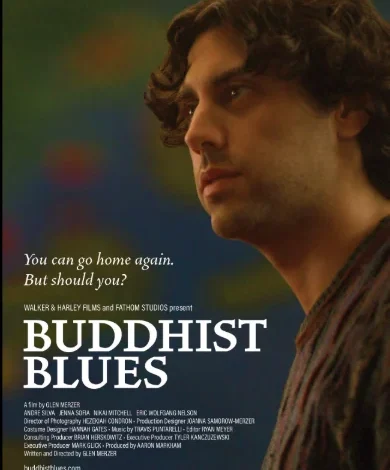
Walker & Harley Films and Fathom Studios have officially announced the upcoming release of Buddhist Blues, a bold feature film written and directed by Glen Merzer that promises to redefine the boundaries of narrative tension. By utilizing the notoriously difficult "real-time" filming technique, the production aims to replicate the visceral, uninterrupted experience of a live stage play within a cinematic framework. The film is designed to capture exactly ninety minutes of high-stakes interpersonal drama, forcing both the characters and the audience to endure a continuous, linear progression of conflict without the reprieve of editing jumps or temporal ellipses.
The Real-Time Narrative Tradition
The choice to film in real time is a significant creative risk that places Buddhist Blues in a small, prestigious lineage of experimental cinema. The device—often referred to as a "pressure cooker" narrative—strips away the ability to compress time, requiring the actors to maintain emotional continuity over the entire duration of the feature.
Historically, this technique has been used to create a sense of heightened urgency. Alfred Hitchcock’s 1948 classic Rope remains the most famous early experiment in this field, using long, hidden cuts to simulate a single, continuous take. In the modern era, the television series 24 successfully popularized the concept for a serialized format, while films like Before Sunset and the seminal courtroom drama 12 Angry Men have used the constraints of time and space to sharpen character development.
Buddhist Blues seeks to merge the claustrophobic intimacy of 12 Angry Men with the modern, raw character study, focusing on the psychological erosion that occurs when individuals are unable to step away from a confrontation. By forcing the audience to witness every hesitation, breath, and micro-expression, the film demands a level of performance precision rarely required in conventional filmmaking, where editors can typically "save" a performance through strategic cuts.
Plot and Setting: St. Louis, 1993
Set against the backdrop of 1993 St. Louis, the narrative is anchored in a domestic setting that serves as the crucible for the story’s central conflicts. The plot revolves around Lou, played by Eric Wolfgang Nelson, a man living on the fringes of society and deeply alienated from his Jewish heritage and family. The inciting incident is a high-stakes visit to his cousin, Susan, portrayed by Jenna Sofia.
The complexity of the situation is heightened by the presence of Susan’s ex-husband, Nick (Andre Silva), who is still reeling from the dissolution of their marriage. The equilibrium of the household is shattered by the arrival of Lou’s girlfriend, Lili (Nikai Mitchell). The arrival of Lili serves as the structural "ticking clock" that ignites the friction between the four characters. As the ninety-minute real-time window progresses, the film explores themes of cultural displacement, the lingering trauma of divorce, and the persistent weight of family secrets.
By setting the film in 1993, Merzer utilizes a pre-digital era of communication, where the characters are physically present with one another, unable to retreat into the distraction of mobile technology. This period piece element serves to heighten the isolation of the setting, ensuring that the characters must resolve their grievances face-to-face.
Production and Creative Vision
The production team behind Buddhist Blues emphasizes that the film’s success relies on a seamless integration of technical execution and performance. According to writer-director Glen Merzer, the real-time format is intended to strip away the artifice of cinema.
"Real-time storytelling leaves nowhere for the characters—or the audience—to hide," Merzer stated in a press release. "Like great theater, the stakes organically escalate because you cannot cut away from the discomfort or the truth. It demands absolute precision from the actors and the filmmaking team."
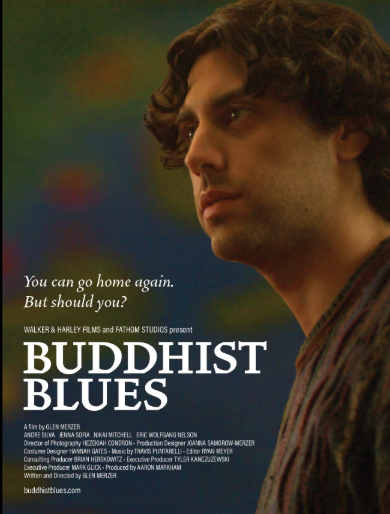
To achieve this level of immersion, the film utilized a specialized production crew. Joanna Samorow-Merzer served as the production designer, tasked with creating a space that felt authentic to a 1993 domestic environment while providing the necessary mobility for a long-take shooting schedule. Cinematographer Hezekiah Condron was responsible for capturing the claustrophobia of the interior, ensuring that the camera movements felt natural rather than performative.
The film’s technical team also includes costume designer Hannah Gates and editor Ryan Meyer, who faced the unique challenge of maintaining the "real-time" illusion while ensuring the film remained visually engaging. The emotional tenor of the piece is underscored by an original score composed by Travis Puntarelli, which serves to bridge the gaps in dialogue without breaking the immersion of the real-time experience. The production is steered by producer Aaron Markham, with Brian Herskowitz as a consulting producer and executive producers Tyler Kanczuzewski and Mark Glick.
Implications for Independent Cinema
The emergence of Buddhist Blues comes at a time when the independent film industry is increasingly looking for ways to distinguish itself from the high-budget, CGI-heavy spectacles of the major studios. By returning to the basics of character-driven storytelling, the production represents a shift toward "theatrical cinema"—films that prioritize the written word and acting performances over visual effects.
From a production standpoint, the real-time approach is highly efficient in terms of set logistics, as it limits the number of locations, but it is incredibly demanding in terms of rehearsal time. Industry analysts note that such projects often require weeks of intensive pre-production, essentially treating the film set like a stage rehearsal. The success of this project could indicate a growing appetite for minimalist, high-tension dramas that provide an alternative to the rapid-fire editing styles common in contemporary streaming content.
The Shift Toward "Event" Storytelling
The decision to market the film as a real-time experience suggests that Walker & Harley Films and Fathom Studios are positioning Buddhist Blues as an "event" film. In an era where audiences are inundated with content, the unique selling point of a 90-minute, uninterrupted narrative experience is designed to drive engagement.
If the film manages to successfully maintain tension throughout its entirety, it could serve as a case study for future independent filmmakers interested in exploring the boundaries of time and space in film. The lack of narrative shortcuts forces the audience to engage in "active watching," where they must track the development of four separate character arcs simultaneously.
Future Outlook and Distribution
As of the current announcement, distribution details and festival premiere dates for Buddhist Blues remain forthcoming. The filmmakers have provided a portal for updates at https://buddhistblues.com/, where viewers can monitor the project’s progress.
The partnership between Walker & Harley Films and Fathom Studios signals a continued commitment to producing provocative, character-centric narratives. By challenging traditional cinematic structures, these companies are positioning themselves as vital contributors to the independent film landscape, pushing for stories that require more than just passive observation from the viewer.
As the industry moves toward the next cycle of film festivals, Buddhist Blues stands as a project to watch—not merely for its subject matter, but for its adherence to a rigid, uncompromising artistic structure that aims to bring the intensity of the Broadway stage to the global cinema screen. Whether this experiment will resonate with a broader audience remains to be seen, but the commitment to such a demanding format reflects a dedication to the craft of storytelling that is increasingly rare in the modern cinematic climate.
Related posts: