

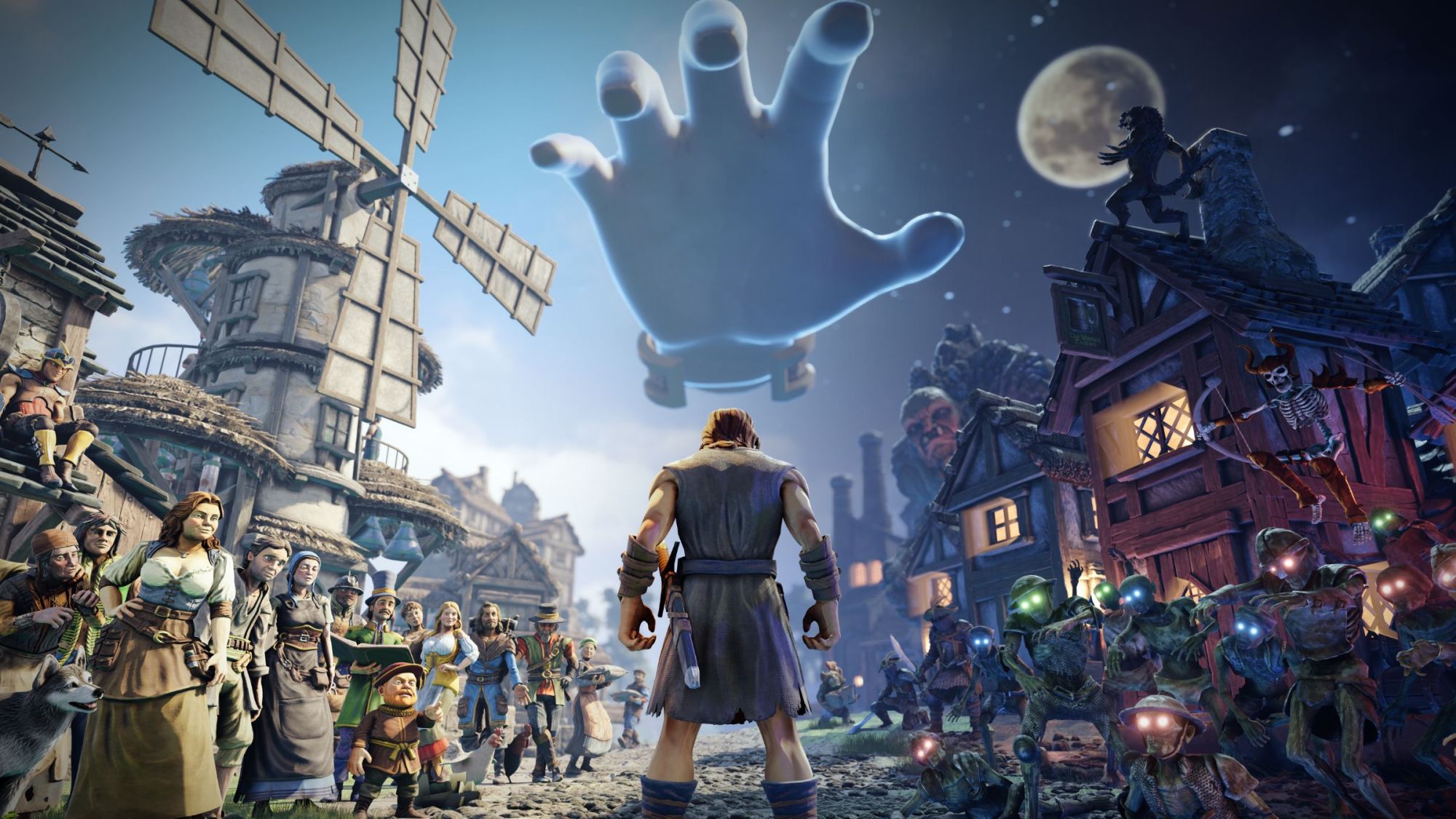
The announcement, accompanied by a compelling new launch trailer, marks a significant moment for fans of visionary game design and those who have followed Molyneux’s prolific career. Two years after its initial unveiling in 2024, Masters of Albion is positioned by publisher 22cans as a strategic and simulation title that empowers players to wield divine influence over the mythical land of Albion, while also offering the unprecedented ability to "possess" its inhabitants, stepping directly into the action. This innovative blend aims to marry the grand strategy of a God Game with the immersive, character-driven adventure typically found in third-person action role-playing games, a hybrid approach that has garnered considerable attention and speculation within the gaming community.
Peter Molyneux: A Legacy Defined by Innovation and Expectation
Peter Molyneux stands as one of the most recognizable and often discussed figures in the video game industry. His career, spanning several decades, is characterized by groundbreaking titles that have pushed the boundaries of interactive entertainment, particularly within the "God Game" genre he is widely credited with defining. Molyneux’s journey began with Bullfrog Productions, where he created seminal works such as Populous (1989), a title that not only pioneered the God Game concept but also demonstrated the immense potential for players to directly influence virtual worlds and their inhabitants. Populous allowed players to act as a deity, shaping terrain, guiding followers, and engaging in divine conflict, setting a template for an entire subgenre.
Following Populous, Molyneux continued to innovate with titles like Dungeon Keeper (1997), which ingeniously inverted traditional fantasy tropes by casting the player as an evil overlord managing a subterranean dungeon, and Theme Park (1994), a management simulation that showcased his ability to craft engaging and intricate systems. His subsequent studio, Lionhead Studios, founded in 1997, further cemented his reputation with games like Black & White (2001), a direct evolution of the God Game genre that introduced a dynamic creature companion whose personality was shaped by the player’s divine actions, and the hugely successful Fable series (2004), an action RPG renowned for its moral choice systems, emergent storytelling, and charming, whimsical take on fantasy.
The Fable series, in particular, resonated deeply with players, offering a world where every decision, from major heroic deeds to petty mischief, visibly altered the player character and their reputation. The allure of Albion, with its distinct British folklore inspirations, memorable characters, and sense of consequence, became a hallmark of Molyneux’s design philosophy. His games consistently aimed to create living, breathing worlds where player agency was paramount, and narrative unfolded organically based on choices.
However, Molyneux’s visionary pronouncements have also been accompanied by a unique phenomenon often dubbed the "Molyneux factor" – a tendency for his ambitious ideas to sometimes exceed the technical capabilities or development timelines, leading to expectations that occasionally outpaced the final product. This aspect of his legacy contributes to the intense scrutiny and excitement surrounding each new release, as players and critics eagerly anticipate whether a project will fully realize its grand ambitions. Masters of Albion arrives against this rich backdrop, carrying the weight of Molyneux’s pioneering past and the high expectations that come with his name.
A Return to Albion: Weaving Familiarity with Novelty
The decision to set Masters of Albion within the world of Albion is a deliberate and significant one. While not explicitly a Fable sequel, the name itself instantly conjures images of the enchanting, morally ambiguous world that captivated millions. For many, Albion is synonymous with choice, consequence, and a particular brand of British fantasy charm. This return provides a nostalgic anchor for long-time fans while also offering a fresh perspective on the lore and geography through the lens of a God Game.
The original Fable series, which debuted on the Xbox in 2004, was lauded for its innovative approach to player morality and character development. Players could visibly transform into heroes or villains, with physical attributes changing to reflect their alignment. The world itself, brimming with quirky characters and emergent quests, felt alive and responsive. Masters of Albion seeks to tap into this established affection for the setting, but rather than reliving the adventures of a single hero, players now assume the ultimate authority – a literal "God Hand" overlooking the entire realm. This shift in perspective is a bold move, attempting to leverage the emotional connection to Albion while fundamentally altering the player’s role within it.
The implications of this setting choice are multifaceted. It allows for the reuse of beloved themes, architectural styles, and perhaps even some of the whimsical tone that defined Fable. However, it also demands a unique interpretation of Albion’s history and mythology to accommodate the player’s new divine role. The game’s narrative will likely explore the origins or ongoing struggles of this world from a macro perspective, offering insights into its societies, conflicts, and belief systems that were previously only hinted at from a ground-level view. This blend of nostalgic familiarity with a fundamentally new gameplay paradigm is central to Masters of Albion‘s appeal.
Masters of Albion: A Hybrid Genre Experience Unveiled
The core innovation of Masters of Albion lies in its ambitious genre fusion. Billed as "a bold reimagining of the God Game genre," it introduces a dual gameplay loop that allows players to seamlessly transition between macroscopic divine management and microscopic character-level engagement. As the "God Hand," players will construct, cultivate, and guide the developing societies of Albion, shaping landscapes, influencing events, and wielding powerful supernatural abilities. This involves strategic resource management, urban planning, and potentially responding to the needs and prayers of their followers, a classic hallmark of the God Game genre.
The twist, however, comes with the "possession" mechanic. Players can literally step into the shoes of any inhabitant of Albion, experiencing the world from a third-person perspective. This allows for direct exploration, engagement in quests, and participation in combat, effectively turning the game into a traditional action-adventure or RPG at will. This hybrid approach seeks to address a common criticism of pure God Games: the lack of personal connection to the world and its inhabitants. By allowing players to immerse themselves directly within the lives of their followers, Masters of Albion aims to create a deeper emotional investment and provide immediate feedback on the impact of their divine interventions.
The launch trailer provided a glimpse into these mechanics in action, showcasing the majestic sweep of the God Hand manipulating the environment alongside close-up combat sequences involving possessed characters. The visual fidelity and art direction appear consistent with the charming, slightly exaggerated aesthetic often associated with Molyneux’s games. The challenge for 22cans and Molyneux will be to ensure that both halves of this hybrid equation are robust and compelling, and that the transitions between them are fluid and intuitive rather than jarring. A successful implementation could offer an unparalleled sense of scale and agency, allowing players to feel both omnipotent and intimately connected to their creation. Conversely, a poor integration risks neither genre feeling fully fleshed out, leading to a diluted experience. This balancing act is critical for the game’s long-term success.
The Chronology of Development and Early Access Approach
Masters of Albion‘s journey to release has been a measured one, reflecting the modern trends in game development and community engagement. First announced in 2024, the game has been in development under 22cans, Molyneux’s current studio, for at least two years leading up to its Early Access launch. The initial announcement generated significant buzz, primarily due to Molyneux’s involvement and the promise of a return to the Albion setting, details that immediately captured the imagination of his dedicated fanbase.
The decision to launch into Early Access on April 22, 2026, is a strategic one, aligning with an industry trend that allows developers to involve their player base during crucial development phases. Early Access provides a platform for iterative design, where player feedback can directly influence the game’s evolution, helping to refine mechanics, balance gameplay, and prioritize features. For Masters of Albion, this approach is particularly pertinent given its ambitious genre-blending nature. Community input on the balance between God Game management and third-person action, the responsiveness of the world, and the overall player experience will be invaluable.
Publisher 22cans has outlined a clear plan for the Early Access period, which is anticipated to last approximately one year. At launch, the game will offer the "complete Chapter One experience from start to finish." This structured approach is designed to provide players with a cohesive, albeit initial, segment of the game, rather than an unfinished sandbox. Throughout the Early Access phase, the developers intend to introduce new areas of the world, expand content, and continuously refine existing gameplay based on community feedback. This transparent roadmap aims to build trust with early adopters and manage expectations for the evolving nature of the game. The release of the "launch trailer" just days before the Early Access debut serves as a final, comprehensive showcase of the current state of the game, providing a crucial visual representation of what players can expect from this initial offering.
The Role of Early Access in Modern Game Development
Early Access has become a cornerstone of modern game development, offering both significant opportunities and inherent risks for developers and players alike. For studios like 22cans, it provides a vital source of early funding and, more importantly, a direct channel for community-driven development. Player feedback, bug reports, and suggestions gathered during Early Access can be instrumental in shaping the final product, ensuring it aligns more closely with player desires and addressing potential issues before a full release. This collaborative model has given rise to numerous success stories, where games have evolved dramatically and positively through public iteration.
However, the Early Access model also carries inherent caveats. Players purchasing an Early Access title are effectively investing in a work-in-progress, and there is always a risk that the game may not be completed as promised, or that its development trajectory might shift. Managing player expectations is therefore paramount. The price point of $24.99 USD for Masters of Albion, with a 10% launch discount, positions it as a mid-tier Early Access offering, signaling a commitment to a substantial experience even in its initial state. The promise of a "complete Chapter One" suggests a more structured and less amorphous Early Access than some other titles, which can reassure potential buyers.
For Peter Molyneux, who has a history of engaging with communities and, at times, managing lofty expectations, the Early Access model could be particularly beneficial. It allows for a gradual rollout of his vision, fostering a dialogue with players that can help refine his ambitious ideas in real-time. This iterative process could mitigate some of the "Molyneux factor" by allowing the community to be part of the developmental journey, providing a reality check and helping to shape the game into its most robust form. The success of Masters of Albion in Early Access will not only depend on the quality of its current build but also on the developer’s responsiveness and transparency throughout the planned one-year period.
Broader Implications and Future Outlook
The launch of Masters of Albion carries significant implications across several fronts, from Peter Molyneux’s personal legacy to the evolution of the God Game genre and the broader independent development scene.
For Peter Molyneux, this title represents another critical juncture in his illustrious career. Following his departure from Microsoft and Lionhead Studios, 22cans has been his independent vehicle for new creative endeavors. While titles like Curiosity – What’s Inside the Cube? and Godus showcased experimental ideas and community engagement, Masters of Albion appears to be a more direct return to the large-scale, intricate game design that initially established his reputation. A successful run for Masters of Albion could solidify his position as a perennial innovator, demonstrating his continued ability to deliver compelling and genre-defining experiences. Conversely, if the game struggles to meet its ambitious goals, it could further entrench the perception of the "Molyneux factor" as a persistent challenge.
For the God Game genre, Masters of Albion has the potential to inject new life and innovative mechanics. The genre, while beloved, has seen fewer high-profile releases in recent years compared to its heyday. By blending traditional divine oversight with direct character control, Molyneux is attempting to evolve the core concept, potentially inspiring other developers to explore new hybrid forms. If this fusion proves successful, it could redefine player expectations for what a "God Game" can be, broadening its appeal beyond its niche audience.
For 22cans, Masters of Albion is likely their most significant release to date. The studio’s trajectory will be heavily influenced by the game’s performance in Early Access and its eventual full launch. A strong showing could establish 22cans as a notable independent developer capable of delivering complex, innovative titles, attracting talent and investment for future projects.
For players, the anticipation is palpable. The blend of a familiar, cherished setting with novel mechanics from a legendary designer creates a unique proposition. The Early Access period offers an opportunity for dedicated fans to actively participate in the game’s creation, shaping its destiny. However, potential players will also weigh the inherent risks of Early Access against the promise of Molyneux’s vision. The initial reception, community engagement, and the developers’ responsiveness to feedback will be crucial in determining whether Masters of Albion lives up to its immense potential.
Ultimately, Masters of Albion is more than just a new game; it is a testament to Peter Molyneux’s enduring creative spirit and his continuous quest to push the boundaries of interactive storytelling. As it embarks on its Early Access journey, the gaming world will be watching closely to see if this ambitious hybrid can truly forge a new path for the God Game genre and deliver a memorable return to the enchanting world of Albion. Players eager to embark on this divine adventure can wishlist Masters of Albion on Steam and prepare for its Early Access launch on April 22nd.


